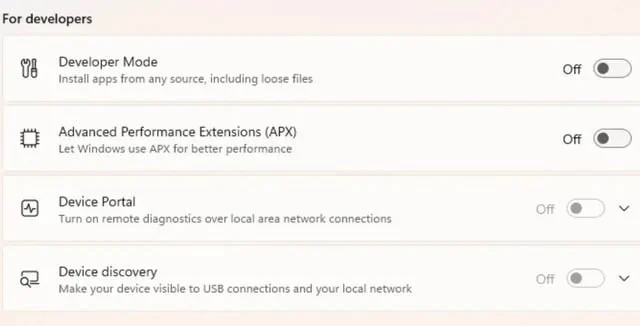
Microsoft has officially initiated preliminary testing for a transformative architectural advancement known as Advanced Performance Extensions (APX) within the latest Windows 11 build, signaling a significant shift in how the operating system interacts with future generations of silicon. Discovered within the Windows 11 build 29695, this feature represents a collaboration between Microsoft’s software ecosystem and Intel’s upcoming hardware roadmap. While the current integration remains in an experimental state, the inclusion of APX hooks indicates that the next evolution of personal computing performance will rely on a symbiotic relationship between compiler-level optimization and advanced x86 instruction sets.
The Emergence of APX in Windows 11 Build 29695
The discovery was first brought to public attention by a prominent Windows enthusiast and analyst, known on social media platform X as XenoPanther. By digging into the hidden configuration files and registry keys of the latest Windows 11 preview build, the user identified specific flags related to "APX." This revelation suggests that Microsoft is laying the groundwork for hardware-software integration well ahead of the commercial release of the silicon required to power it.
For the average user, the interface of Windows 11 may appear unchanged. However, beneath the surface, the operating system is being modified to recognize and utilize the architectural enhancements offered by Intel’s future processors. The APX framework is not a consumer-facing setting that can be toggled to improve immediate performance; rather, it is a low-level architectural protocol that requires both operating system support and specialized software compilation to function effectively.
Understanding Intel’s APX: A Technical Deep Dive
To understand why this development is significant, one must look at the technical limitations of the existing x86 instruction set architecture (ISA). For decades, x86 has been the backbone of the PC industry, but it has faced criticism for its aging structure, particularly when compared to the lean efficiency of ARM-based architectures.
Intel’s Advanced Performance Extensions are designed to modernize x86 by introducing several key improvements:
- Expanded Register Access: The most significant feature of APX is the increase in the number of general-purpose registers. By doubling the number of available registers from 16 to 32, the processor can keep more data "close" to the execution core. This reduces the need for the CPU to constantly fetch data from the slower system memory (RAM), thereby drastically cutting latency.
- Enhanced Instruction Set: APX adds new variations of existing instructions, allowing for more efficient code execution. By providing more ways for the compiler to optimize the translation of high-level code into machine code, the processor can perform complex tasks with fewer total instructions.
- Conditional Execution: APX introduces new ways to handle conditional branches in code. By reducing "branch mispredictions"—where a processor guesses which path a program will take and guesses wrong—APX helps maintain high throughput during complex data processing tasks.
The Timeline: Bridging the Gap to 2027
The integration of APX into Windows 11 at this early stage follows a standard industry practice known as "hardware-software co-design." By incorporating these features into beta builds years before the hardware hits the shelf, Microsoft ensures that the Windows kernel is robust and compatible by the time the silicon arrives.
According to the current industry roadmap, the first generation of processors to fully utilize these extensions will be the Intel Nova Lake series. While early speculation suggested earlier iterations, current forecasts point to a commercial launch window in early 2027. This timeline presents a clear, multi-year strategy:
- 2024-2025: Initial exploration and architectural definitions added to Windows Insider builds.
- 2025-2026: Compiler support expansion (via tools like LLVM and GCC) to allow developers to recompile applications for APX.
- Late 2026: OEM testing of systems featuring Nova Lake architecture.
- Early 2027: Public launch of hardware-supported APX on Windows 11/12 platforms.
The Role of Developers and Recompilation
A critical caveat to the performance gains promised by APX is that the software must be "APX-aware." Unlike some performance features that provide a blanket speed boost to all applications, APX requires software developers to recompile their applications using updated toolchains.
The process, however, is designed to be relatively painless. Developers do not need to rewrite their source code from scratch. Instead, by updating their compilers to support the new APX instruction set, the compiler will automatically map code to the new registers and instructions during the build process. Once recompiled, an application can run significantly faster on an APX-capable processor, while still maintaining compatibility with older processors through a "fallback" mechanism that uses standard x86 instructions.
Impact Analysis: Where Will Users Feel the Difference?
Industry analysts have noted that the impact of APX will not be uniform across all computing tasks. Because APX focuses on general-purpose register efficiency and instruction throughput, the benefits will be most pronounced in:
- Productivity Suites: Applications like Microsoft Excel, data analysis tools, and heavy spreadsheet environments will likely see the largest gains. These programs involve massive amounts of data manipulation where register access is a common bottleneck.
- Content Creation: Video rendering, image processing, and complex code compilation benefit significantly from the reduction in memory-to-processor traffic.
- Background Services: Operating system tasks and background processes that run concurrently will benefit from the improved efficiency, potentially leading to better overall system responsiveness and power efficiency.
Conversely, gaming performance—which is traditionally more dependent on GPU (Graphics Processing Unit) performance and specific cache-heavy architectures (like Intel’s L3 cache or AMD’s 3D V-Cache)—may see only marginal improvements. While APX will speed up the game’s "logic" and "physics" calculations, the frame rate bottlenecks in modern gaming remain tied primarily to the GPU.
Industry Implications and Competition
The move to push APX into the mainstream is also a defensive and offensive strategic play for Intel. With the rise of the Apple Silicon M-series chips and the increasing adoption of Windows on ARM, the x86 architecture has been under intense pressure to prove its relevance. By extending the x86 ISA, Intel is signaling to the market that the platform is not stagnant.
Furthermore, this development solidifies the "Wintel" alliance, which has historically defined the PC era. By working closely with Microsoft to ensure that Windows 11 is the first OS to support these extensions, Intel ensures that its hardware remains the primary choice for enterprise and high-performance computing.
Looking Ahead: The Future of Windows Architecture
The testing of APX in Windows 11 build 29695 is a testament to the long-term vision of the Windows engineering team. In an era where silicon manufacturing is reaching the limits of physical miniaturization (approaching 2nm and beyond), performance gains are increasingly coming from architectural cleverness rather than just clock speed increases.
As we move toward 2027, the role of the operating system will become increasingly complex. It will not just be a platform for running apps, but a sophisticated layer that intelligently manages instruction sets to squeeze every drop of performance out of the silicon. Users should not expect immediate results from the current test build, but they should view this as a necessary infrastructure upgrade—a "future-proofing" measure that will likely define the speed and efficiency of the next generation of Windows PCs.
In summary, while the APX feature remains dormant for now, its existence in the Windows code base is a clear roadmap indicator. The partnership between Microsoft and Intel to evolve the x86 architecture ensures that the Windows platform remains competitive, scalable, and capable of handling the increasingly demanding computational needs of the late 2020s. For developers, the next two years will be a period of preparation, and for the industry, it marks a pivotal transition toward a more efficient, instruction-rich computing future.