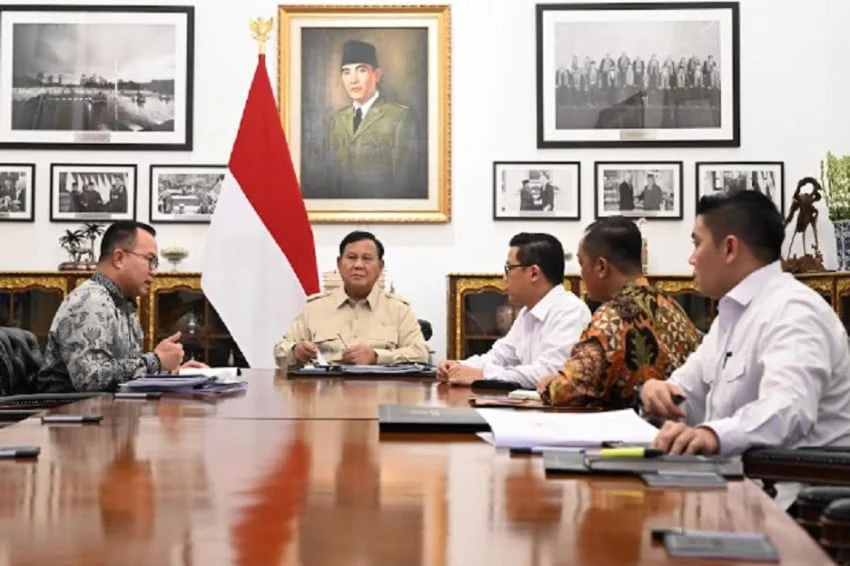
President Prabowo Subianto hosted the Head of the National Research and Innovation Agency (BRIN), Arif Satria, at the Merdeka Palace in Jakarta. The high-level consultation centered on accelerating and aligning the nation’s scientific capabilities with critical developmental goals, sustainable environmental management, and technological self-reliance. As Indonesia navigates complex socioeconomic and ecological challenges, the meeting underscored the administration’s growing reliance on data-driven policymaking and scientific innovation to address systemic vulnerabilities.
During the extensive briefing, the BRIN leadership presented progress updates on several core national initiatives. The discussions spanned a wide spectrum of urgent domestic issues, including the mitigation of recurrent forest and land fires, the commercialization of alternative energy derived from palm oil waste, the acceleration of domestic vaccine manufacturing alongside herbal medicine research, and the deployment of advanced technology to overhaul municipal waste management systems. The encounter highlights a broader strategic pivot within the current administration toward integrating empirical research directly into executive decision-making frameworks.
Strategic Focus on Forest and Land Fire Mitigation
A primary focus of the discussion between President Prabowo and the BRIN leadership was the persistent national threat of forest and land fires, commonly known in Indonesia as karhutla. These environmental disasters have historically inflicted severe ecological damage, disrupted regional economic activity, and generated transboundary haze that strains international relations. The President demonstrated active engagement on the issue, demanding that the scientific community deliver comprehensive solutions that operate across immediate, medium-term, and long-term horizons.
According to the BRIN Head, the administration is closely monitoring vulnerable regions to prevent catastrophic blazes before they escalate. "President Prabowo continues to monitor forest and land fires and consistently emphasizes that research results to solve this issue—spanning short, medium, and long-term strategies—must be rigorously implemented," the BRIN leadership noted following the conclusion of the meeting at the Merdeka Palace.
To tackle immediate flare-ups, BRIN has operationalized an integrated response mechanism in close coordination with several key state institutions. This multi-agency task force includes the Badan Meteorologi, Klimatologi, and Geofisika (BMKG) for meteorological forecasting, the Badan Nasional Penanggulangan Bencana (BNPB) for disaster logistics and deployment, the Ministry of Forestry for territorial management, and the Indonesian Air Force (TNI AU) for aerial interventions. A central component of this short-term tactical approach has been the execution of Weather Modification Operations (OMC), which utilize advanced atmospheric seeding techniques, including dry ice applications, to induce rainfall over drought-stricken, fire-prone peatlands.
Beyond Immediate Emergency Response: Modeling Fire Propagation
While emergency cloud-seeding and water-bombing operations remain vital for extinguishing active flames, the federal government has recognized that reactive firefighting is insufficient for a sustainable national strategy. Consequently, President Prabowo has explicitly instructed BRIN to scale up its medium and long-term research portfolio, focusing heavily on predictive analytics and preventative modeling.
The research agency is currently developing sophisticated models to understand fire propagation dynamics under varying climatic conditions. By mapping how fires spread through different soil types—particularly carbon-rich peatlands—scientists aim to provide regional authorities with predictive tools that can anticipate fire trajectories days or even weeks in advance. "The President also emphasized the importance of medium-term research, and subsequently long-term research, on how to anticipate future challenges, which includes identifying the actual mechanics of fire propagation models so that we can mitigate them in the future," the BRIN Head explained.
This proactive stance represents a significant paradigm shift. Rather than deploying emergency resources only after fires have ravaged thousands of hectares of land, the state is moving toward a prevention-first model governed by computational physics, geographical information systems (GIS), and real-time satellite telemetry. This approach aims to protect Indonesia’s biodiversity, reduce greenhouse gas emissions associated with deforestation, and safeguard public health across Southeast Asia.
Expanding the National Research Agenda: Bioenergy, Health Security, and Waste Management
Beyond environmental security, the strategic dialogue at the Merdeka Palace covered a diverse array of scientific domains critical to Indonesia’s future economic resilience and public welfare. Among these was the optimization of renewable energy sources, specifically the conversion of palm oil waste into viable alternative fuels. As the world’s leading producer of palm oil, Indonesia generates massive quantities of solid and liquid agricultural byproducts, such as Empty Fruit Bunches (EFB) and Palm Oil Mill Effluent (POME). Harnessing these materials through advanced biorefining technologies offers a dual benefit: it minimizes the environmental footprint of the agricultural sector and diversifies the national energy matrix away from imported fossil fuels.
In the public health sector, the administration reviewed ongoing efforts to accelerate domestic vaccine development and enhance the scientific validation of traditional herbal medicines, known locally as jamu or fitofarmaka. The COVID-19 pandemic exposed vulnerabilities in global supply chains, prompting Jakarta to prioritize national pharmaceutical independence. By streamlining the clinical research pipeline and strengthening collaboration between state laboratories and private biotechnology firms, BRIN aims to position Indonesia as a regional hub for vaccine production and tropical disease research.
Furthermore, the agenda addressed the escalating crisis of urban waste management. Rapid urbanization and shifting consumption patterns have overwhelmed municipal landfills across major Indonesian metropolitan areas. BRIN presented technological frameworks utilizing waste-to-energy incineration, advanced recycling systems, and biological decomposition methods designed to transform municipal refuse into usable energy and organic fertilizers. These innovations are expected to support local governments in meeting stringent national targets for waste reduction and circular economy transition.
Institutional Background and the Evolution of BRIN
The intensification of these research initiatives occurs against the backdrop of significant institutional restructuring within Indonesia’s scientific ecosystem. The National Research and Innovation Agency was established to consolidate the country’s fragmented research landscape, merging previously independent bodies such as the Indonesian Institute of Sciences (LIPI), the Agency for the Assessment and Application of Technology (BPPT), the National Nuclear Energy Agency (BATAN), and the National Institute of Aeronautics and Space (LAPAN) under a single administrative umbrella.
The consolidation was designed to eliminate bureaucratic silos, optimize state budget allocation for research, and create a critical mass of scientific talent capable of tackling complex national problems. However, the centralization process has faced transitional hurdles, including cultural adjustments among researchers, administrative integration challenges, and the need to establish clear pathways for research commercialization.
Under the leadership of President Prabowo, there is a renewed push to ensure that the massive consolidation yields tangible, real-world outcomes. The administration has repeatedly signaled that scientific funding will no longer be treated as an academic luxury, but rather as an essential national investment tied directly to key performance indicators in economic growth, food security, energy transition, and ecological preservation.
Broader Economic and Geopolitical Implications
The alignment between the executive branch and the nation’s premier research agency carries profound implications for Indonesia’s standing in the global community. As emerging economies face mounting pressures from climate change, resource nationalism, and technological disruption, the capacity to generate homegrown intellectual property and scientific solutions is a core determinant of sovereignty.
In the context of environmental diplomacy, Indonesia’s ability to scientifically manage and drastically reduce forest fires directly influences its international climate commitments, including its Nationally Determined Contributions (NDCs) under the Paris Agreement. Enhanced fire monitoring and predictive modeling provide empirical transparency, bolstering the nation’s credibility in international carbon markets and climate finance negotiations.
Economically, the commercialization of palm oil waste-to-energy technologies and the advancement of domestic health products reduce import dependencies while creating high-value employment opportunities within the knowledge economy. By fostering an ecosystem where academic research translates seamlessly into industrial application, Indonesia seeks to avoid the middle-income trap and transition toward a knowledge-driven, sustainable economic model.
Conclusion and Future Outlook
The working meeting between President Prabowo Subianto and BRIN Head Arif Satria at the Merdeka Palace marks a decisive step in institutionalizing science-backed governance in Indonesia. By demanding actionable, multi-tiered research solutions for complex crises such as forest fires, alongside forward-looking investments in bioenergy, health security, and waste management, the administration has signaled a commitment to long-term national resilience.
As BRIN rolls out its enhanced predictive modeling for fire mitigation and accelerates its biotechnology and renewable energy programs, the success of these initiatives will depend heavily on sustained cross-ministerial cooperation and robust regional implementation. For an archipelago nation vulnerable to environmental shocks yet rich in biological and intellectual capital, the integration of rigorous scientific research into statecraft offers an indispensable pathway toward sustainable prosperity and national self-reliance.