The transformation of traditional farming into a technology-driven enterprise has become a focal point for agricultural development in West Java. The Ministry of Agriculture, in close collaboration with the Sukabumi Regency Government, is aggressively pushing for higher agricultural productivity via the implementation of modern farming methodologies known as the Pertanian Modern–Advanced Agriculture System (PM-AAS). This strategic initiative represents a cornerstone in the national agenda to secure long-term food security, reduce import dependencies, and uplift the economic standing of rural farming communities.
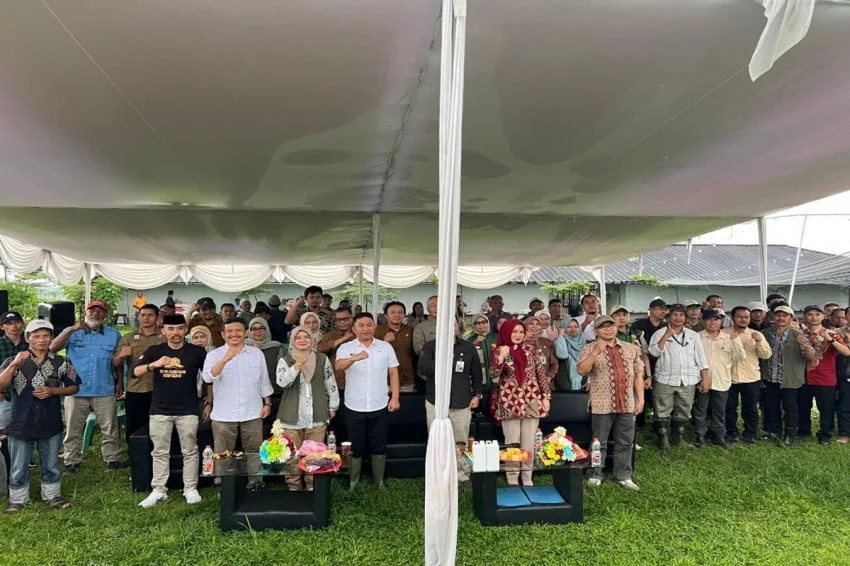
The concerted effort materialized recently with the official launch of the PM-AAS Rice Cultivation Field School. Held under the broader umbrella of the Sustainable Food Self-Sufficiency Program, the launch took place at the agricultural lands managed by the Subur Rejeki Farmers Group, located in Sukaresmi Village, Cisaat Subdistrict, Sukabumi Regency. This program is designed not merely as a temporary intervention, but as a comprehensive educational and operational framework to reshape how agrarian communities approach food crop production in the face of modern climatic and economic pressures.
Expanding the Horizon of Modern Farming
The newly inaugurated PM-AAS Field School functions as a vital educational hub dedicated to upgrading the operational capacity and technical competence of local farmers. Through a carefully structured curriculum that combines rigorous theoretical instruction with hands-on practical training, participants are guided through the entire agricultural lifecycle. The learning modules cover critical phases of modern crop management, ranging from precision seed selection and advanced land preparation to meticulous crop maintenance, harvesting techniques, and post-harvest evaluation of technology-driven yields.
This localized initiative in Cisaat Subdistrict does not stand in isolation. Rather, it serves as an expansion and continuation of an ongoing regional strategy to optimize the PM-AAS framework across Sukabumi Regency. Prior to the Cisaat launch, pilot implementations and preliminary optimization efforts were successfully rolled out in two other strategic districts: Palabuhanratu and Waluran. By scaling the program across diverse geographic and agroecological zones within the regency, agricultural authorities aim to test, adapt, and refine the technology to suit varying soil compositions, water availability, and local climatic conditions.
Promising Yields: The Empirical Evidence from Demplot Harvests
The theoretical and practical foundations of the PM-AAS initiative are heavily supported by promising empirical data gathered from local demonstration plots (demplots). On October 15, 2026, a milestone was achieved at the Cisaat demplot site, where a modest evaluation plot spanning 2,800 square meters conducted its inaugural harvest. The results of the conventional crop-cutting survey (ubinan) yielded exceptional figures, registering a peak productivity equivalent to 11.2 tons of dry harvested grain per hectare.
This impressive output significantly exceeds traditional regional averages, signaling a transformative potential for paddy cultivation in the area. However, agricultural scientists and regional officials emphasize that this high yield serves as an initial performance indicator rather than a final destination. Continuous evaluation remains a mandatory protocol. Agronomists are closely monitoring several critical variables to ensure the long-term viability of the system:
- Seed Management and Quality: Assessing the resilience and adaptability of superior seed varieties under intensive management systems.
- Precision Planting Techniques: Evaluating optimal plant spacing and root system development to maximize nutrient uptake.
- Balanced Fertilization: Fine-tuning macro and micro-nutrient applications based on real-time soil testing data to prevent soil degradation and chemical runoff.
- Integrated Pest Management (IPM): Monitoring and controlling plant-destroying organisms (Organisme Pengganggu Tumbuhan – OPT) through biological and targeted chemical interventions.
- Agroecological Alignment: Ensuring that the imported technological parameters harmonize with the local environmental carrying capacity of Sukabumi’s distinct agricultural landscapes.
Official Stance and Regional Strategic Frameworks
Addressing the rollout of the program, Sukabumi Deputy Regent H. Andreas underscored the profound alignment between the PM-AAS initiative and the broader governmental mission to achieve sustainable food self-sufficiency. He noted that technological adoption is no longer a luxury for the agricultural sector, but an absolute necessity if regencies like Sukabumi are to safeguard local food supplies against external economic shocks, supply chain disruptions, and the escalating pressures of population growth.
To operationalize this vision at the municipal level, the Sukabumi Regency Government has championed an integrated regional policy framework known as the Sangkuriang strategy—an acronym and conceptual model representing Sustainable Food Self-Sufficiency and Food Independence (Swasembada Pangan Berkelanjutan dan Kemandirian Pangan). This strategic framework seeks to synchronize central government directives with grassroots execution, ensuring that agricultural extension workers, local cooperatives, and individual farmers work in unison toward common productivity targets.
Chronology of Agricultural Modernization in Sukabumi
The integration of advanced agricultural systems in Sukabumi did not happen overnight. It represents the culmination of a multi-phase policy evolution designed to modernize Indonesia’s agricultural landscape:
- Phase I: Conceptualization and Pilot Identification (Early 2025): The Ministry of Agriculture identifies Sukabumi as a strategic secondary food buffer zone for West Java, prompting preliminary feasibility studies for modern agricultural technology deployment.
- Phase II: Initial Regional Rollout (Late 2025): Pilot projects for the Pertanian Modern–Advanced Agriculture System (PM-AAS) are formally introduced in the coastal and inland districts of Palabuhanratu and Waluran, focusing on water management and soil conditioning.
- Phase III: Demplot Establishment and Monitoring (Mid-2026): Small-scale demonstration plots are established across various subdistricts, including the 2,800-square-meter plot in Sukaresmi Village, Cisaat, to test high-density planting and modern input management.
- Phase IV: Empirical Validation (October 15, 2026): The inaugural harvest of the Cisaat demplot yields a breakthrough equivalent of 11.2 tons per hectare, providing concrete data to justify program expansion.
- Phase V: Institutionalization via Field Schools (Current Status): The official launching of the PM-AAS Field School institutionalizes knowledge transfer, moving the initiative from isolated experimental plots to community-wide educational programs.
Broader Economic and National Implications
The collaborative push between the Ministry of Agriculture and the Sukabumi Regency Government carries profound implications for the national economy. In broader legislative and executive circles, agricultural modernization is frequently discussed in tandem with other critical resource security sectors. For instance, ongoing parliamentary debates—such as those recently highlighted by members of the House of Representatives (DPR)—underscore that energy independence, such as oil and gas self-sufficiency, holds a parallel level of strategic urgency to food self-sufficiency. Both pillars are viewed by policymakers as non-negotiable prerequisites for true national sovereignty.
By raising per-hectare productivity from conventional averages to upwards of 11 tons, initiatives like the PM-AAS directly address the diminishing availability of productive agricultural land caused by urban expansion. When land area cannot be horizontally expanded, vertical intensification through technology remains the primary viable pathway to maintain national grain reserves.
Furthermore, the emphasis on farmer education through field schools addresses the persistent demographic challenge facing Indonesian agriculture: the aging farming population. By introducing mechanized tools, data-driven fertilizers, and systematic farm management, modern agriculture becomes increasingly attractive to younger generations who view traditional farming as labor-intensive and economically unviable.
As the PM-AAS program deepens its roots in Sukabumi—bridging the gap between the Ministry of Agriculture’s technological resources and the practical field execution by groups like Subur Rejeki—the region stands as a potential blueprint for other agricultural hubs across the archipelago. The ongoing monitoring of soil health, pest dynamics, and economic return on investment will ultimately determine how swiftly and extensively this model can be replicated nationwide in the continuous pursuit of resilient and sustainable food independence.