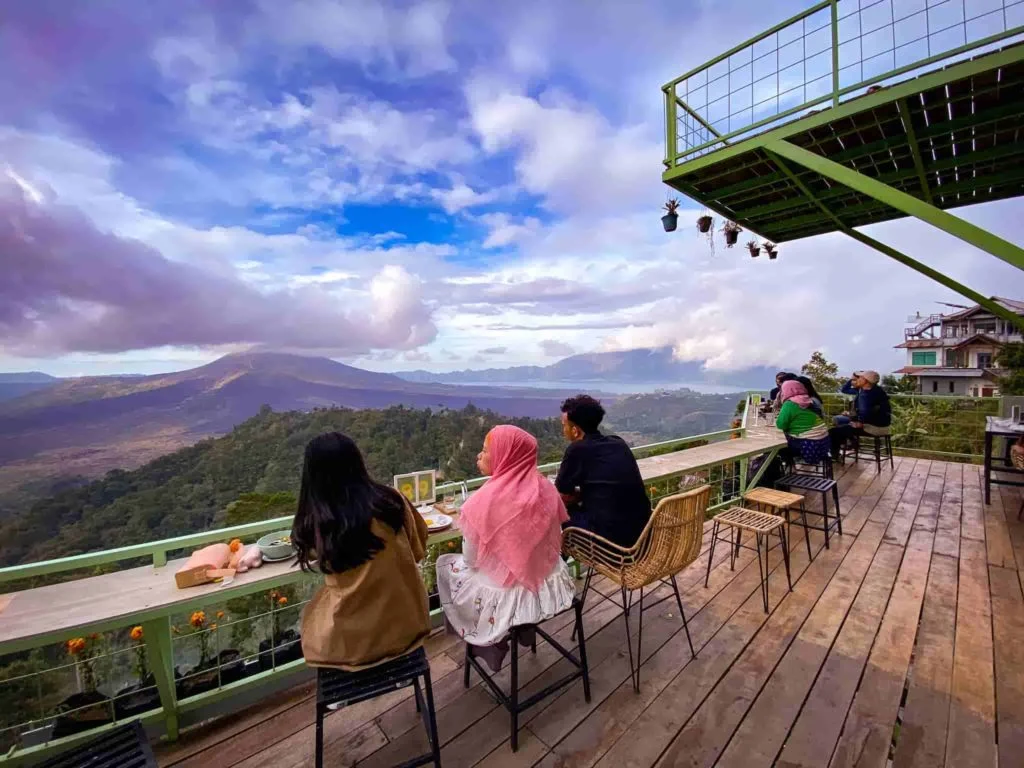
Bali has long held its position as Indonesia’s premier tourism crown jewel, renowned globally for its vibrant cultural heritage, pristine southern beaches, and spiritual sanctuaries. However, beyond the bustling coastline of Kuta, Seminyak, and Canggu lies a completely different side of the island: the dramatic and refreshing highlands of Kintamani. Situated along the outer caldera of Mount Batur in Bangli Regency, this mountainous region has undergone a significant transformation over recent years. What was once primarily an agricultural hub famous for citrus farming and localized coffee production has evolved into one of Southeast Asia’s most sought-after lifestyle and café destinations.
The shift toward modern hospitality infrastructure in Kintamani gained substantial momentum in late 2019, driven by travelers seeking alternatives to coastal saturation and the rising global appetite for photogenic, nature-integrated architecture. Today, Kintamani’s ridge-side cafes are celebrated not only for their specialty Arabica coffee—locally known as Kintamani coffee, distinguished by its citrusy aroma—but also for their striking architectural designs that seamlessly merge indoor spaces with panoramic vistas of Mount Batur, Mount Abang, Mount Agung, and the crescent-shaped Lake Batur. Operating at altitudes where temperatures frequently drop to a chilly 17 to 18 degrees Celsius, these establishments offer a stark contrast to Bali’s tropical heat, prompting visitors to trade swimwear for jackets and warm sweaters.
An Overview of Kintamani’s Cafe Evolution
The proliferation of multi-story viewing platforms, glass-walled observation lounges, and rooftop terraces along the Penelokan ridge represents a major economic and spatial shift for the Bangli Regency. Historically, tourism revenue in Bali concentrated heavily in the southern regencies of Badung and Denpasar. The rapid development of specialty coffee shops in Kintamani has successfully redistributed tourist footfall toward the central highlands, boosting local employment, driving demand for locally sourced agricultural products, and elevating the valuation of ridge-adjacent real estate.
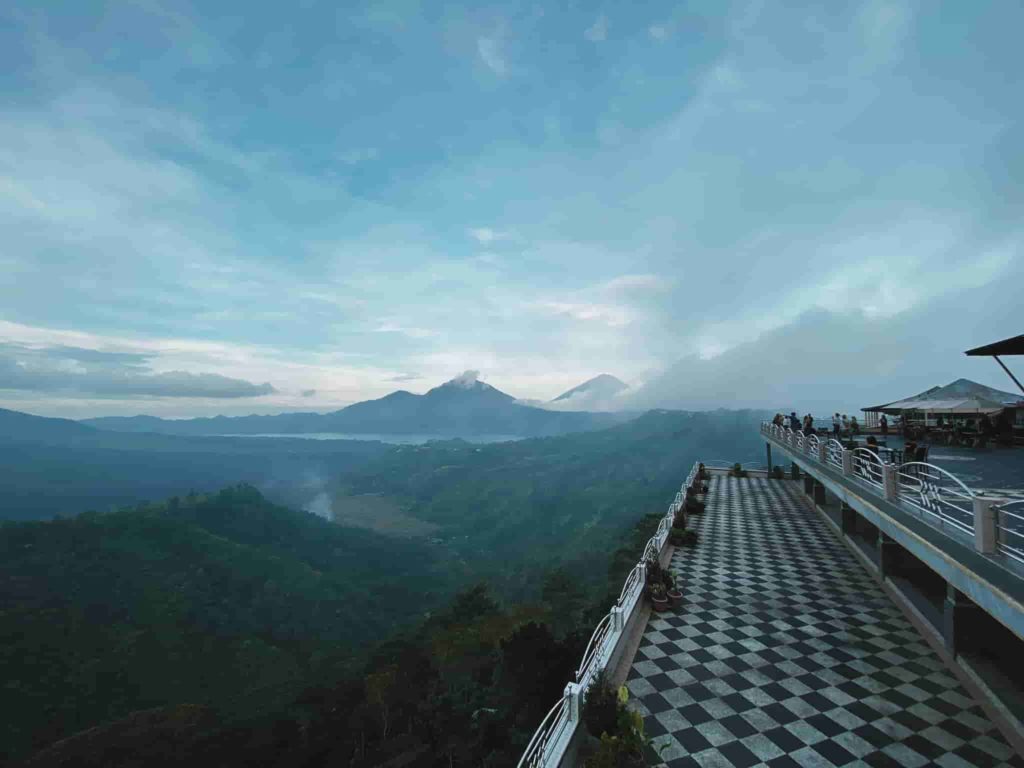
Local authorities and tourism analysts note that this architectural boom prioritizes visual engagement with the landscape. Designers have leveraged the natural topography—building cascading tiers down steep volcanic slopes—to ensure unobstructed lines of sight for every patron. This strategic layout maximizes aesthetic appeal while catering to the modern digital traveler’s demand for shareable content. However, this growth also brings logistical and environmental considerations, including waste management, sustainable water usage, and land-use planning along fragile volcanic slopes.
Curated Guide: Five Premier Destinations for Coffee and Scenery
For travelers and locals planning an excursion to Bali’s volcanic highlands, five distinct establishments stand out based on architectural innovation, vantage points, culinary offerings, and overall visitor experience.
- Tegu Kopi: Pioneering the Modern Ridge Experience
Located strategically along Jalan Raya Penelokan, Tegu Kopi opened its doors in December 2019, establishing itself as one of the early catalysts for the modern café wave in Kintamani. Positioned directly on the edge of the ancient caldera rim, the venue offers sweeping vistas encompassing the active cone of Mount Batur, the towering peak of Mount Abang, the sacred heights of Mount Agung, and the glittering expanse of Lake Batur below.
Tegu Kopi is particularly favored for afternoon visits. As the sun begins its descent behind the western mountain ranges, the sky transitions through hues of amber, violet, and deep blue, casting dramatic shadows across the caldera floor. The crisp ambient temperature, often hovering around 17 degrees Celsius, encourages patrons to linger over hot brews. The interior design emphasizes clean, minimalist aesthetics with expansive glass elements, ensuring that even indoor seating provides an unobstructed connection to the surrounding alpine environment.
- Eco Bike Coffee: Multi-Tiered Agritourism and Hospitality
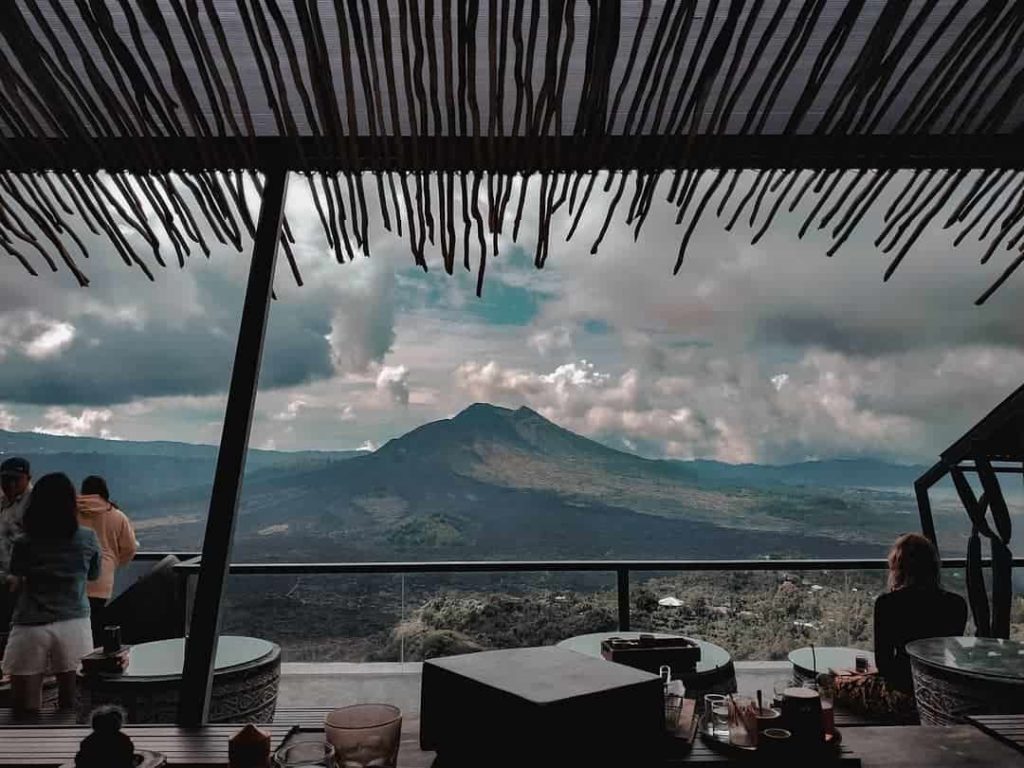
Standing out as one of the largest hospitality complexes along the Kintamani cliffside, Eco Bike Coffee adopts a comprehensive approach to agritourism across its expansive three-story structure. The establishment integrates commercial hospitality with agricultural education and lodging, featuring a working coffee plantation on its lowest tier.
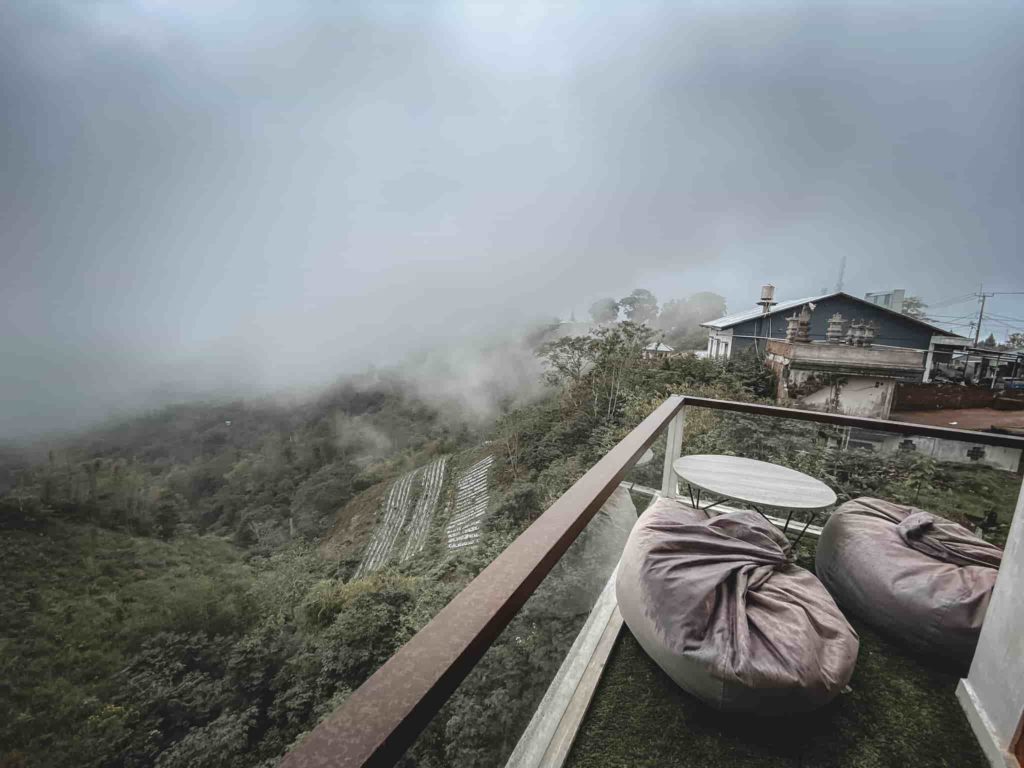
The architectural layout distributes visitor experiences across distinct levels: the ground floor connects guests directly to the agricultural roots of Kintamani coffee production alongside boutique accommodation options, while the topmost tier features an open-air rooftop deck designed for uninterrupted horizon viewing. Because of its elevation and exposure, visitors are routinely advised to monitor meteorological forecasts prior to arrival. During high-altitude cloud cover or heavy mist, the panoramic views of Mount Batur can be entirely obscured, leaving visitors surrounded by a minimalist white shroud. When skies are clear, however, the venue offers some of the most comprehensive vantage points in the region.
- Akasa Coffee: Premium Elevation and Alpine Comfort
Positioned among the highest points along the Penelokan strip, Akasa Coffee combines upscale dining with an intimate mountain atmosphere. The venue caters to visitors seeking refined comfort amid rugged natural surroundings. Its menu features a diverse selection ranging from artisan breakfast platters and specialty teas to curated coffee beverages and imported beers.
Reflecting its elevated status and premium offerings, average expenditures per visitor lean toward the higher end for the region, typically averaging around IDR 150,000 per person. The interior features warm wooden accents, plush seating arrangements, and sheltered viewing decks designed to mitigate the biting mountain winds. Due to the significant drop in temperature compared to coastal Bali, patrons—particularly those sensitive to cold weather—are strongly encouraged to bring adequate outerwear. Optimal experiences at Akasa Coffee occur during morning hours when visibility of the volcanic complex is at its peak before afternoon cloud accumulation.
- Batur 1926: The Ultimate Sunrise Observatory
For early risers, Batur 1926 offers a specialized dawn experience that distinguishes it from neighboring establishments. Opening its doors in the pre-dawn hours, the café welcomes visitors as early as 5:30 AM to witness the sunrise over the eastern caldera rim. On clear mornings, the vantage point yields a rare simultaneous view of three major peaks: Mount Batur, Mount Abang, and Mount Agung, illuminated by the golden light of early morning.
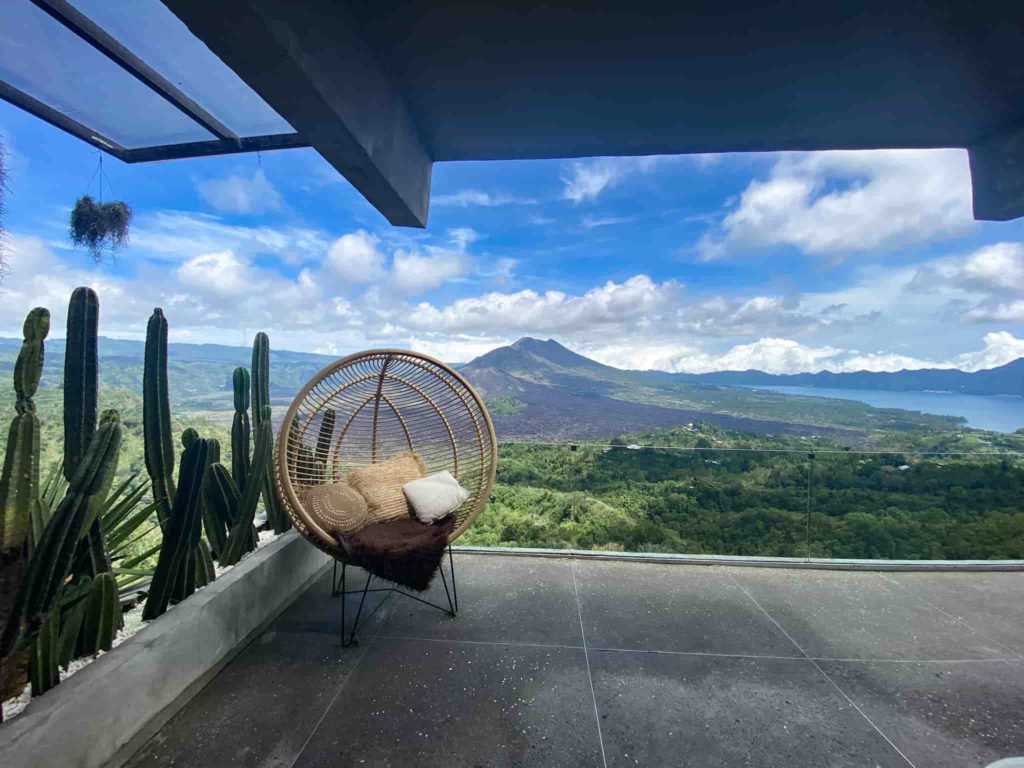
Beyond its natural positioning, Batur 1926 incorporates distinct cultural architectural elements into its design. The rooftop terrace features a traditional Balinese-style stone gateway (candi bentar) that frames the volcanic backdrop, serving as a popular focal point for photography enthusiasts looking to enrich their visual portfolios. The venue successfully merges traditional aesthetic motifs with contemporary hospitality standards, appealing to both culture-focused travelers and modern content creators.
- Kava Coffee: Immersive Interior Design and Lake-Level Proximity
Situated closer to the basin near the legendary shores of Lake Batur, Kava Coffee offers a unique perspective compared to ridge-top venues. Rather than looking down from a high cliff, visitors experience the scale of the surrounding stratovolcanoes from an intermediate elevation that emphasizes the sheer height of the caldera walls.
Upon entering, guests are greeted by an interior design scheme deliberately chosen to harmonize with the tones of the surrounding volcanic terrain. The semi-outdoor seating areas feature extended communal tables and ergonomic lounging furniture, shielded from the elements by floor-to-ceiling glass paneling. This architectural choice ensures that inclement weather or chilly winds do not compromise the visual connection to Mount Batur, Mount Abang, and Mount Agung, allowing patrons to enjoy the dynamic weather shifts of the highlands in comfort.
Economic Implications and Sustainable Tourism Outlook
The rapid expansion of the Kintamani café sector carries significant socio-economic implications for Bangli Regency. Historically one of Bali’s less economically dense regions compared to the urbanized south, Bangli has experienced a notable increase in local employment opportunities, ranging from hospitality management and culinary arts to agricultural supply chain integration. Cafes increasingly source their coffee beans, dairy, and fresh produce directly from regional farmers, establishing a localized circular economy that supports traditional farming communities.
However, regional planners and environmental advocates emphasize the need for rigorous regulatory frameworks to manage the long-term impact of this hospitality boom. Key areas of concern include sustainable waste management, protection of water catchments around Lake Batur, and adherence to spatial planning laws to prevent environmental degradation along the delicate volcanic slopes. Balancing rapid commercial growth with environmental conservation remains a critical priority for local governance as Kintamani cements its status as a permanent fixture on Bali’s international tourism itinerary.