The transition from sports stardom to the highest echelons of political leadership is a rare feat, but few stories rival that of George Tawlon Manneh Oppong Ousman Weah. Long before he assumed the presidency of Liberia in December 2017, Weah captured the global imagination as a generational football talent. Renowned for his explosive pace, sublime technical ability, and clinical finishing, he dominated European football during the 1990s, representing powerhouse clubs such as AC Milan, Paris Saint-Germain, Monaco, Chelsea, and Manchester City. As the only African player in history to win both the FIFA World Player of the Year and the Ballon d’Or, his athletic legacy was already secured. However, rather than fading into a quiet retirement, Weah chose a more arduous path: dedicating his post-football life to the reconstruction, democratization, and political transformation of his war-torn homeland, culminating in his historic democratic election to the Liberian presidency.
Humble Beginnings in Monrovia: The Early Years and Domestic Rise
Born on October 1, 1966, in Monrovia, the capital of Liberia, George Weah grew up in a society grappling with immense economic challenges. Raised largely by his grandmother in the Gibraltar neighborhood of Monrovia, a poor and congested district, young Weah found solace and a potential pathway out of poverty in association football. Lacking formal facilities, he honed his skills playing barefoot on makeshift pitches and sandy lots across the city, developing the close ball control and agility that would later baffle elite defenders in Europe.
Weah’s raw natural talent quickly caught the attention of local talent scouts and domestic clubs. His early career featured stints with several Liberian sides, including Invincible Eleven, Mighty Barolle, Bongrange Bonguine, and Young Survivors from Claretown. It was during his time with the latter that his leadership qualities began to emerge. As a teenager, Weah played a pivotal role in guiding Young Survivors—a team operating remarkably without a formal coach—to promotion into the nation’s top-tier division. This early success served as the launching pad for his professional trajectory, showcasing not only his athletic prowess but also an innate ability to inspire and elevate those around him.
The African Stepping Stone: Transition to Professional Football in Cameroon
In 1987, Weah’s career crossed international borders when he was scouted by Tonnerre Yaoundé, one of the most prominent clubs in Cameroon. Relocating to Central Africa marked his first exposure to professional-level training, tactical discipline, and competitive pressure. The transition proved seamless for the young forward.
During his single season with Tonnerre Yaoundé, Weah made an immediate impact, helping the club secure the Cameroonian league title. More importantly, his performances in domestic competitions and continental tournaments brought him to the attention of European scouts. Among them was Claude Le Roy, a legendary French manager then in charge of Cameroon’s national team, who recognized Weah’s extraordinary potential and urgently recommended him to AS Monaco manager Arsène Wenger. This pivotal connection altered the course of football history and brought Weah to the doorstep of European club football.
Conquering French Football: AS Monaco and Paris Saint-Germain
Arriving in France in 1987 at the age of 21, George Weah faced the cultural and climatic adjustments typical of African players migrating to Europe, yet his adaptation on the pitch was instantaneous. Under the astute guidance of Arsène Wenger at AS Monaco, Weah refined his raw attributes, transforming from a purely instinctive striker into a devastatingly complete forward.
During his five seasons with Monaco (1988–1992), Weah netted 57 goals across all competitions, terrorizing defenders in the French Division 1 with his trademark lung-busting runs from deep inside his own half. His crowning team achievement during this period came in 1991, when he helped Monaco capture the Coupe de France, cementing his status as one of Europe’s most promising young talents.
Seeking a new challenge and an opportunity to compete consistently at the highest level, Weah transferred to Paris Saint-Germain (PSG) in 1992. His tenure in the French capital elevated his career to global prominence. With PSG, Weah became the focal point of an ambitious project, leading the club to domestic glory, including another Coupe de France title and the French Division 1 championship in the 1993–1994 season.
His performances in the UEFA Champions League further burnished his reputation. In the 1994–1995 campaign, Weah finished as the top scorer in the Champions League with seven goals, famously scoring a mesmerizing individual goal against FC Barcelona at the Camp Nou. He guided PSG to the semi-finals of the tournament, leaving an indelible mark on European football and securing 37 goals in 123 total appearances for the Parisian club.
The Pinnacle of Excellence: AC Milan and Historic Individual Honors
In the summer of 1995, Weah made a high-profile move to Italian giants AC Milan, stepping into the ultra-competitive environment of Serie A, widely considered the premier league in the world at the time. Surrounded by world-class teammates, Weah adapted instantly to Italian tactics and physical defending, establishing himself as the talisman of the Rossoneri.
During his five seasons at the San Siro (1995–2000), Weah scored 51 goals in 114 league appearances, leading Milan to Serie A titles in the 1995–1996 and 1998–1999 seasons. It was during his inaugural year in Milan, however, that he achieved immortality in the history of the sport. In late 1995, Weah was awarded the prestigious FIFA World Player of the Year, alongside the Ballon d’Or, becoming the first and, to date, only African player to sweep both individual accolades in the same year.
In his acceptance speech, rather than basking solely in personal glory, Weah famously dedicated the awards to his mentor Arsène Wenger and to the people of Africa, bringing international attention to the potential and struggles of his home continent. After leaving Milan, Weah enjoyed brief spells in the English Premier League with Chelsea—winning the FA Cup in 2000—and Manchester City, before concluding his illustrious playing career with stints at Olympique de Marseille and Al-Jazira.
From Sports Icon to Political Activist: The Post-Football Transition
While George Weah’s football career brought him fame, fortune, and global adulation, his homeland of Liberia was enduring a catastrophic period of devastation. Between 1989 and 2003, Liberia was gripped by two brutal civil wars that resulted in the deaths of an estimated 250,000 people, the displacement of millions, and the total collapse of the nation’s infrastructure, economy, and educational systems.
Throughout the conflict, Weah used his personal wealth, global platform, and influence to advocate for peace. He funded the Liberian national football team out of his own pocket when the federation lacked resources, served as a UNICEF Goodwill Ambassador, and traveled extensively to raise awareness about the plight of child soldiers and war victims. Recognizing that charity and goodwill missions were insufficient to enact systemic change, Weah made the momentous decision to transition from humanitarian advocacy to active politics.
His entry into the political arena was met with skepticism by the traditional political elite, who viewed him as an outsider lacking formal administrative experience and higher education. Undeterred, Weah founded the Congress for Democratic Change (CDC) party and ran for president in the 2005 general elections. Though he won the first round of voting, he was ultimately defeated in the run-off by Ellen Johnson Sirleaf, a Harvard-trained economist and Nobel Peace Prize laureate.
Rather than abandoning politics after his initial defeat, Weah demonstrated political resilience. Recognizing criticisms regarding his educational background, he enrolled at DeVry University in the United States, eventually earning a bachelor’s degree in business administration in 2011, followed by a master’s degree from Keller Graduate School of Management. He continued to build grassroots support, serving as a Senator for Montserrado County from 2015 to 2018, thereby gaining crucial legislative experience.
The 2017 Presidential Election: A Historic Victory
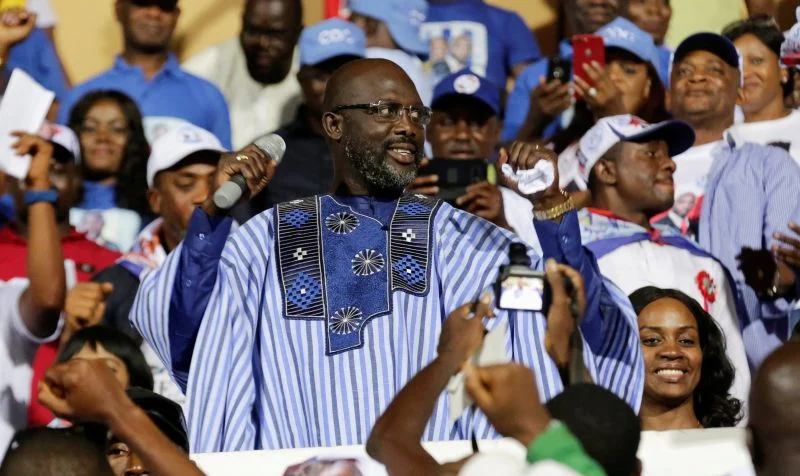
The culmination of Weah’s decades-long political journey arrived in October and December 2017. As incumbent President Ellen Johnson Sirleaf prepared to step down following two constitutionally mandated terms, Liberia faced its first democratic transfer of power in over seven decades. Weah positioned himself as the standard-bearer of the Coalition for Democratic Change (CDC), running on a populist platform focused on youth empowerment, educational reform, infrastructure development, and anti-corruption measures.
In the initial October 2017 election, Weah led the field of candidates with roughly 38% of the vote, though he fell short of the absolute majority required to avoid a run-off. This set up a high-stakes electoral showdown against Vice President Joseph Boakai. Despite challenges and legal delays regarding alleged irregularities in the first round, the National Elections Commission proceeded with the run-off on December 26, 2017.
On December 29, 2017, official results confirmed a landslide victory for George Weah. He secured over 61% of the vote, defeating Boakai across 14 of Liberia’s 15 counties. The victory was hailed domestically and internationally not only as a triumph for Weah personally, but as a historic milestone for Liberia—marking the first peaceful, democratic transition of power from one elected leader to another in the country since 1944.
Implications, Challenges, and Legacy
George Weah’s inauguration as the 25th President of Liberia on January 25, 2018, brought immense optimism to a population eager for economic recovery and social progress. Supporters flooded the Samuel Kanyon Doe Sports Complex in Monrovia—the very stadium where Weah had once inspired fans as a national team player—to witness his swearing-in ceremony.
However, the transition from sports hero to head of state brought formidable economic and structural challenges. Inheriting a nation burdened by heavy foreign debt, high inflation, widespread poverty, and the lingering scars of the Ebola epidemic and civil wars, Weah’s administration faced intense scrutiny. Critics pointed to difficulties in curbing institutional corruption, addressing infrastructural deficits, and improving public sector salaries during his tenure.
Despite these governance challenges, Weah’s legacy remains a unique sociological and political phenomenon. He proved that an individual from the most impoverished backgrounds could rise through sheer talent and perseverance to conquer the summit of world sport, and subsequently channel that immense capital into achieving democratic political power. Whether viewed through the lens of athletic greatness or the complexities of statecraft, George Weah’s journey from the sandy pitches of Monrovia to the Executive Mansion stands as one of the most remarkable life trajectories of the modern era.