The transition of an individual from the pinnacle of global sports stardom to the highest political office of a sovereign nation remains one of the most remarkable narratives of the modern era. In December 2017, George Tawlon Manneh Oppong Ousman Weah achieved this unprecedented feat, officially securing his election as the President of Liberia. This monumental political victory arrived more than two decades after he was crowned the FIFA World Player of the Year in 1995—a distinction that remains deeply historic as he is, to this day, the only African-born player to have ever received the prestigious award and the contemporaneous Ballon d’Or. Before navigating the complex corridors of statecraft and national leadership, Weah was globally celebrated as a trailblazing striker who terrorized defensive lines across Europe, representing powerhouse clubs such as AC Milan, Paris Saint-Germain, AS Monaco, Chelsea, and Manchester City. His pivot from professional athletics to public service following his retirement from the pitch underscored a profound commitment to his homeland, a nation recovering from decades of civil conflict, institutional instability, and socio-economic devastation.
Humble Beginnings and the Genesis of a Football Prodigy
The foundational chapters of George Weah’s life were forged in the densely populated neighborhoods of Monrovia, the capital city of Liberia, where he was born on October 1, 1966. Growing up in a resource-limited environment, Weah’s prodigious football talent was cultivated on the unforgiving, dusty sandlots of his hometown. Long before the global scouting networks recognized his athletic capabilities, he honed his distinctive ball-control, agility, and spatial awareness in informal street matches.
His raw talent soon caught the attention of local clubs, propelling him through the ranks of Liberian football. Weah initially showcased his abilities with domestic sides including Invincible Eleven, Mighty Barolle, Bongrange Bonguine, and Young Survivors from Claretown. It was during his formative teenage years that his natural leadership qualities began to emerge. Notably, he spearheaded Young Survivors—a team operating entirely without the guidance of a formal coach—to a historic promotion into the nation’s premier division. This early success served as an unmistakable harbinger of a career defined by defying odds and elevating under-resourced groups to unprecedented heights.
The turning point in his international career materialized in 1987 when he captured the attention of scouts and secured a transfer to Tonnerre Yaoundé, a prominent club in Cameroon. Despite the significant leap in competition, Weah adapted instantly to the professional demands of Central African football. In his debut season with the club, he played an instrumental role in guiding Tonnerre Yaoundé to the domestic league championship. This rapid ascent not only validated his immense potential but also served as a vital stepping stone toward European football, where his legendary status would eventually be cemented.
The European Conquest: Ascending to the Global Stage
The transition from African domestic leagues to European football marked the rapid acceleration of George Weah’s professional career. Impressed by his physical prowess, explosive acceleration, and clinical finishing, French club AS Monaco lured the young striker to Europe in 1987. Under the meticulous tactical guidance of manager Arsène Wenger—who would later cultivate a lifelong mentorship relationship with the player—Weah flourished in the French Division 1.
During a prolific five-season tenure with AS Monaco spanning from 1987 to 1992, Weah established himself as one of the most lethal forwards in European football. By the time he departed the club, he had amassed an impressive tally of 57 goals across all competitions. His impact extended beyond individual scoring records; in 1991, he spearheaded Monaco’s campaign to victory in the prestigious Coupe de France (French Cup), securing his first major silverware on European soil.
Recognizing his relentless work ethic, technical versatility, and unmatched athletic dynamism, Paris Saint-Germain (PSG) secured Weah’s transfer ahead of the 1992–1993 season. His spell in the French capital elevated his status from a promising talent to a bona fide global superstar. In the colors of PSG, Weah delivered some of the most memorable performances of his career. He led the club to domestic glory, capturing another French Cup title and the French Division 1 championship. Furthermore, his exploits on the continental stage were instrumental in guiding PSG to the semi-finals of the UEFA Champions League in the 1994–1995 campaign, during which he finished as the tournament’s top goalscorer. Across 123 total appearances for the Parisian powerhouse, Weah netted 37 goals and provided crucial assists, cementing his legacy as a cornerstone of the club’s modern history.
Peak Athletic Brilliance and Historic Accolades
The zenith of George Weah’s footballing career arrived following his high-profile transfer to Italian giants AC Milan in the summer of 1995. Entering the demanding and tactically rigorous environment of the Serie A, Weah wasted no time asserting his dominance. His combination of blistering pace, exceptional ball-striking ability, and intelligent off-the-ball movement made him a nightmare for elite Italian defenders.
During his initial stint with AC Milan from 1995 to 2000, Weah was the offensive focal point of a squad competing at the absolute pinnacle of world football. He immediately rewarded the club’s investment by helping the Rossoneri capture the Serie A league titles in the 1995–1996 and 1998–1999 seasons. It was also during this period that he produced the single most iconic moment of his athletic career: a sensational, coast-to-coast individual goal against Hellas Verona at the San Siro in 1996, where he picked up the ball deep inside his own penalty box and dribble past nearly the entire opposing team before slotting it home.
Statistically and individually, the year 1995 represented the crowning achievement of his athletic journey. In addition to his domestic successes, Weah was officially named the FIFA World Player of the Year, the Ballon d’Or winner, and the African Footballer of the Year—all within the same calendar year. This unprecedented triple crown remains an extraordinary milestone in football history. Across 114 official league appearances for AC Milan, he found the back of the net 51 times. Following his successful tenure in Italy, Weah experienced brief spells in the English Premier League with Chelsea and Manchester City, as well as a concluding chapter with Marseille in France and Al-Jazira in the United Arab Emirates, before officially hanging up his boots in 2003.
From the Soccer Pitch to the Political Arena
Long before his retirement from professional athletics, George Weah demonstrated a profound commitment to the socio-economic welfare of Liberia. Throughout the devastating civil wars that plagued his homeland during the 1990s and early 2000s, Weah utilized his personal wealth, global platform, and influence to advocate for peace. He served as a UNICEF Goodwill Ambassador, funding education and health initiatives for displaced children, and frequently used his own resources to finance the Liberian national football team when the federation lacked adequate funding.
As his playing career drew to a close, Weah recognized that his popularity and moral authority could be leveraged to effect structural change within the Liberian government. The transition from sports to politics was neither immediate nor without friction; early critics questioned his formal educational background and political experience. Undeterred, Weah pursued higher education, eventually earning a degree in business administration from DeVry University in the United States, while systematically building a grassroots political base.
In 2005, Weah made his first major foray into national politics, running for the presidency of Liberia under the banner of the Congress for Democratic Change (CDC). Although he secured a significant share of the vote in the initial round, he was ultimately defeated in the run-off election by Ellen Johnson Sirleaf, a seasoned economist and Harvard-educated stateswoman who would become Africa’s first elected female head of state. Rather than retreating from public life, Weah accepted the electoral outcome with democratic maturity, returned to his studies, and spent the subsequent decade serving in various capacities, including as a Liberian Senator representing Montserrado County starting in 2014. This legislative tenure provided him with essential governance experience and solidified his standing as a serious, dedicated political operator.
The Historic 2017 Presidential Election and National Implications
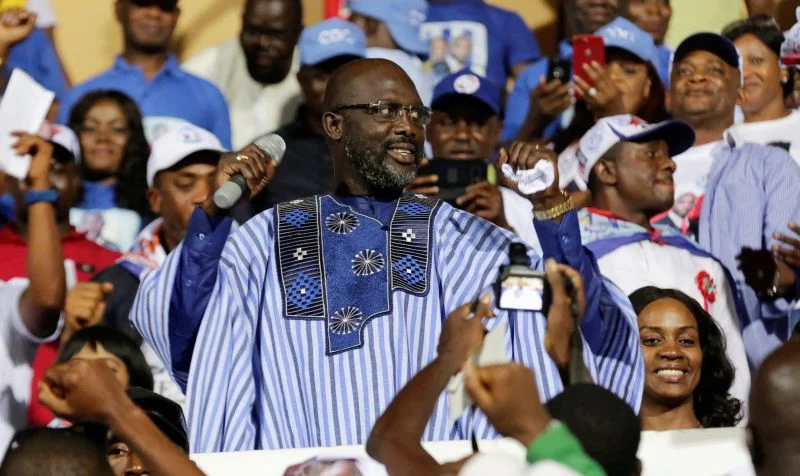
The culmination of George Weah’s political evolution arrived in the general elections of late 2017. Running once again for the presidency, Weah capitalized on widespread public fatigue with entrenched political elites, economic stagnation, and infrastructural deficits. Operating under the Coalition for Democratic Change, his platform focused heavily on youth empowerment, educational reform, infrastructural development, and the eradication of systemic corruption—issues that resonated deeply with Liberia’s young demographic, who viewed him not merely as a former sports star, but as a national hero who had risen from the slums of Monrovia to conquer the world.
In the historic runoff election held in December 2017, Weah decisively defeated his opponent, the incumbent Vice President Joseph Boakai, securing a sweeping democratic mandate. International observers lauded the electoral process as a peaceful and significant milestone for a nation that had struggled for decades to establish stable democratic transitions. Heads of state, global organizations, and international sporting bodies flooded the newly elected leader with congratulatory messages, acknowledging the symbolic power of a former Ballon d’Or winner assuming the highest office of state.
The implications of George Weah’s presidency extended far beyond the borders of Liberia. Domestically, his administration inherited an economy heavily reliant on foreign aid, commodity exports, and recovering from the devastating impacts of the recent Ebola epidemic. Economists and political analysts noted that while Weah’s immense popularity provided him with a unique political capital capable of uniting a fractured populace, the immense expectations of the Liberian electorate posed a formidable governance challenge. Fulfilling campaign promises related to job creation, healthcare modernization, and transparency required rigorous policy implementation that transcended charismatic leadership.
Globally, Weah’s ascent served as a powerful testament to the potential of athletes transitioning into transformative civic leadership. By successfully navigating the treacherous waters of post-conflict reconstruction and democratic transition, George Weah permanently etched his name into history—not solely as one of the greatest football players the world has ever witnessed, but as a dedicated statesman who answered the call of his nation during its most critical hour of need.