LUCKNOW — The Indonesian national badminton team has delivered an exceptional performance on the international stage, securing an impressive four representations in the final round of the prestigious Syed Modi India International 2026. The milestone was officially achieved following a series of high-stakes, dominant matches during the semifinal fixtures held at the state-of-the-art Babu Banarasi Das Indoor Stadium in Lucknow, India, on Saturday, November 28, 2026.
The tournament, classified as a BWF World Tour Super 300 event, has consistently served as a crucial battleground for international shuttlers seeking to accumulate valuable ranking points toward the season finals and improve their standing in the global badminton hierarchy. For the Indonesian contingent, the tournament in Lucknow has transformed into a showcase of depth, resilience, and tactical execution, particularly across multiple divisions where both seasoned veterans and rising stars have managed to leave an indelible mark.
The journey to the finals was characterized by intense internal battles, commonly referred to as "civil wars" within the national training camp, alongside decisive triumphs over formidable international opponents. With four tickets successfully punched to the championship matches, the Indonesian squad stands on the verge of sweeping multiple titles on Indian soil, reflecting the relentless efforts of the coaching staff under the Badminton Association of Indonesia (PBSI).
Strategic Overview of the Syed Modi India International 2026
The Syed Modi India International holds a storied history on the Badminton World Federation (BWF) calendar, named after the legendary Indian badminton player Syed Modi. Over the years, the tournament has evolved from a regional championship into a major stop on the World Tour circuit, attracting top-tier talent from across the globe. For the 2026 edition, the stakes were particularly high as players entered the latter stages of the competitive calendar, looking to secure psychological advantages and financial rewards before the conclusion of the competitive year.
The conditions at the Babu Banarasi Das Indoor Stadium have traditionally tested players’ adaptability, with complex drift and shuttle speeds demanding high technical proficiency. The Indonesian coaching staff deployed a meticulous strategy, focusing on physical endurance and tactical discipline. This preparation bore fruit on Saturday, as the red-and-white contingent navigated the pressure of the semifinals with remarkable composure.
Internal Battles Dominate Mixed Doubles and Men’s Singles
One of the most compelling narratives of the semifinal Saturday was the occurrence of intra-national showdowns, where compatriots had to face off against one another for a coveted spot in the final. These matches underscored the immense depth of talent within the Indonesian national training center in Cipayung, while simultaneously presenting a bittersweet scenario for the coaching staff who witnessed players from the same training ecosystem lock horns.
In the mixed doubles division, a blockbuster clash pitted the seasoned pair of Rehan Naufal Kusharjanto and Melati Daeva Oktavianti against the rapidly rising combination of Jafar Hidayatullah and Rinjani Kwinnara Nastine. Rehan and Melati, known for their tactical maturity and wealth of experience on the BWF World Tour, entered the match as the perceived favorites. However, Jafar and Rinjani displayed extraordinary tenacity and tactical fluidity throughout the encounter.
In a tightly contested battle that kept spectators on the edge of their seats, Jafar and Rinjani ultimately overcame their senior compatriots with a narrow scoreline of 21-19, 22-20. This victory marks a monumental milestone for the young partnership. Having been paired together by the PBSI coaching board only recently in September 2026, reaching their maiden BWF World Tour Super 300 final together highlights their rapid developmental curve and seamless on-court chemistry. The upset victory not only guarantees them a career-best finish at this level but also signals a promising shift in the dynamics of Indonesia’s mixed doubles depth.
A similar narrative unfolded in the men’s singles category, where Prahdiska Bagas Shujiwo squared off against Richie Duta Richardo. Both players have been locked in a competitive race to establish themselves as the next generation of Indonesian singles stalwarts. The match showcased the technical prowess and agility of both athletes, but Richie Duta Richardo managed to seize control of the tempo from the early exchanges of the opening game.
Richie’s disciplined defensive clearances and sharp attacking variants neutralized Prahdiska’s aggressive strategy. Maintaining his composure through the rallies, Richie closed out the match in straight games with a score of 21-17, 21-15. The victory propels Richie into the final, where he carries the heavy burden and honor of representing the nation in the quest for the men’s singles crown.
Decisive Victories Over International Rivals in Men’s and Women’s Doubles
While the mixed doubles and men’s singles divisions featured dramatic internal rivalries, the men’s and women’s doubles categories required the Indonesian representatives to deliver clinical performances against tough foreign opposition. Both matches served as testaments to the adaptability and physical conditioning of the Indonesian pairs.

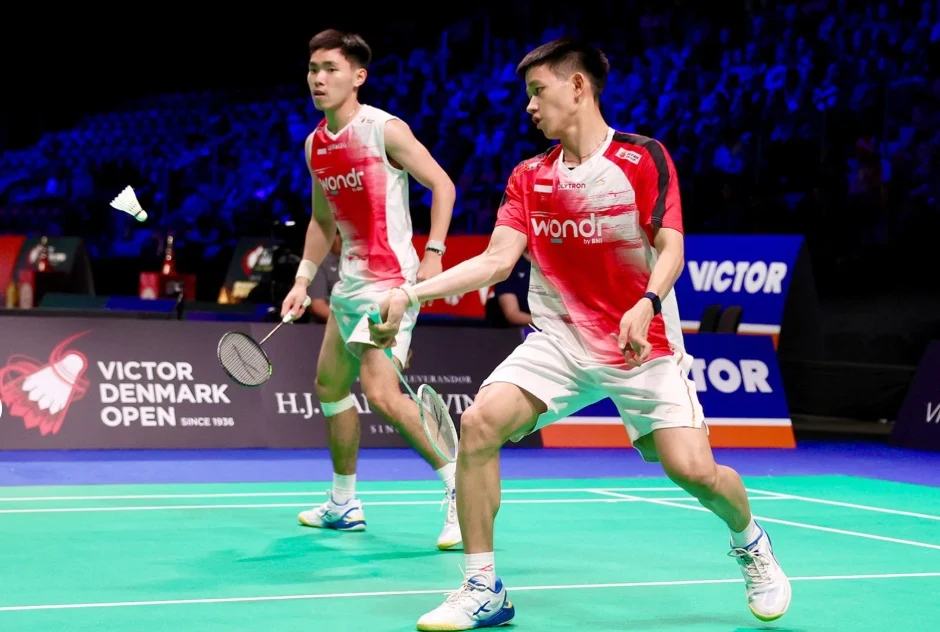
In the men’s doubles bracket, the promising duo of Raymond Indra and Nikolaus Joaquin stepped onto the court with a clear mission: to dismantle the Thai partnership of Chaloempon Charoenkitamorn and Worrapol Thongsa-nga. The Thai pair entered the semifinal with a reputation for high-speed, flat-exchange rallies designed to suffocate their opponents. However, Raymond and Nikolaus exhibited exceptional tactical awareness, opting to vary the pace of the game and exploit the spaces at the back of the court.
From the outset of the first game, Raymond and Nikolaus dictated the momentum. Their synchronized rotations and lethal smash placements kept the Thai pair on the defensive. Capitalizing on unforced errors from their opponents, the Indonesian pair comfortably took the first game 21-14. The second game followed a similar script, with Raymond and Nikolaus maintaining their intensity and refusing to allow any window for a comeback. They secured the match with a decisive 21-13 scoreline in the second game, sealing their spot in the final in dominant fashion and cementing their status as one of the most exciting young men’s doubles pairs to watch.
Meanwhile, in the women’s doubles division, the formidable pairing of Isyana Syahira Meida and Rinjani Kwinnara Nastine delivered another masterclass performance. Facing the European challenge posed by England’s Abbygael Harris and Estelle Van Leeuwen, Isyana and Rinjani displayed superior court coverage and defensive resilience. The English pair attempted to disrupt the Indonesian rhythm with deep lifts and aggressive net play, but Isyana and Rinjani absorbed the pressure effectively before turning defense into offense with rapid counter-attacks.
The Indonesian duo claimed the first game 21-13 with relative ease. Although Harris and Van Leeuwen mounted a stronger resistance in the second game, tightening the scoreline through sustained pressure, Isyana and Rinjani held their nerve in the crucial closing points to wrap up the match 21-18. This victory not only adds another feather to their cap in the 2026 season but also ensures that Indonesia maintains a multi-frontal assault in Sunday’s championship matches.
Chronological Recap of Semifinal Fixtures
To fully appreciate the scope of Indonesia’s success at the Babu Banarasi Das Indoor Stadium on Saturday, November 28, 2026, a chronological review of the matches highlights the physical and mental demands placed on the players:
- Morning Session – Mixed Doubles Civil War: The day commenced with high drama as Rehan Naufal Kusharjanto/Melati Daeva Oktavianti faced Jafar Hidayatullah/Rinjani Kwinnara Nastine. The grueling 45-minute battle concluded with Jafar/Rinjani prevailing 21-19, 22-20, securing their first-ever Super 300 final together.
- Mid-Day Session – Men’s Singles All-Indonesian Clash: Prahdiska Bagas Shujiwo and Richie Duta Richardo took to the court in a battle of attrition. Richie’s tactical discipline carried him past Prahdiska in straight games, 21-17, 21-15, in under 40 minutes.
- Afternoon Session – Men’s Doubles Foreign Challenge: Raymond Indra and Nikolaus Joaquin faced Thailand’s Chaloempon Charoenkitamorn and Worrapol Thongsa-nga. Displaying tactical superiority, the Indonesian young guns cruised to a 21-14, 21-13 victory.
- Late Afternoon Session – Women’s Doubles Closing Triumph: Isyana Syahira Meida and Rinjani Kwinnara Nastine wrapped up the semifinal campaign for the contingent by dispatching England’s Abbygael Harris and Estelle Van Leeuwen 21-13, 21-18, securing the fourth and final ticket for the red-and-white camp.
Official Responses and Analytical Perspectives from the Coaching Staff
While post-match official press conferences are still developing, early assessments from analysts and insights into PBSI’s strategic blueprint point toward a highly successful transitional phase for the national team. The inclusion of newly formed pairs—such as Jafar/Rinjani and the continued development of younger talents like Raymond Indra and Nikolaus Joaquin—demonstrates the efficacy of the federation’s developmental pipeline.
Badminton analysts observing the tournament noted that the ability of Indonesian players to excel in both internal pressure situations and international matchups reflects a broader improvement in mental fortitude. Historically, mental resilience in tight closing stages has been identified as an area for growth among emerging Indonesian shuttlers. However, the outcomes in Lucknow—particularly the tightly contested 22-20 second game in the mixed doubles and the composed finish by Isyana and Rinjani—suggest that sports psychology and match management protocols within the national training center are yielding tangible results.
Furthermore, the presence of multi-generational representation in the finals, blending the experience of players like Melati Daeva Oktavianti with the raw energy of younger counterparts, ensures a balanced squad capable of sustaining competitive excellence across the international circuit.
Broader Implications and Outlook for the Finals
The qualification of four representatives for the finals of the Syed Modi India International 2026 carries significant implications for Indonesian badminton. Beyond the immediate prestige and potential collection of titles and prize money, these ranking points are vital as players position themselves for higher-tier tournaments in the upcoming 2027 BWF World Tour season.
For the young pairs, a victory in a Super 300 final acts as a massive psychological catalyst. Winning a title at this level validates months of rigorous training, validates the federation’s pairing decisions, and instills the self-belief required to challenge the world’s elite in Super 500, Super 750, and Super 1000 events.
As the spotlight turns to the finals at the Babu Banarasi Das Indoor Stadium, the Indonesian contingent prepares for the ultimate test of endurance and skill. With internal bragging rights settled and foreign hurdles cleared, the focus shifts entirely to converting these four semifinal triumphs into championship titles, ensuring that the Indonesian national anthem resonates strongly in Lucknow once more.