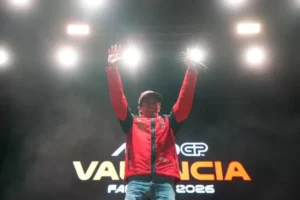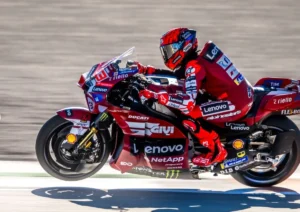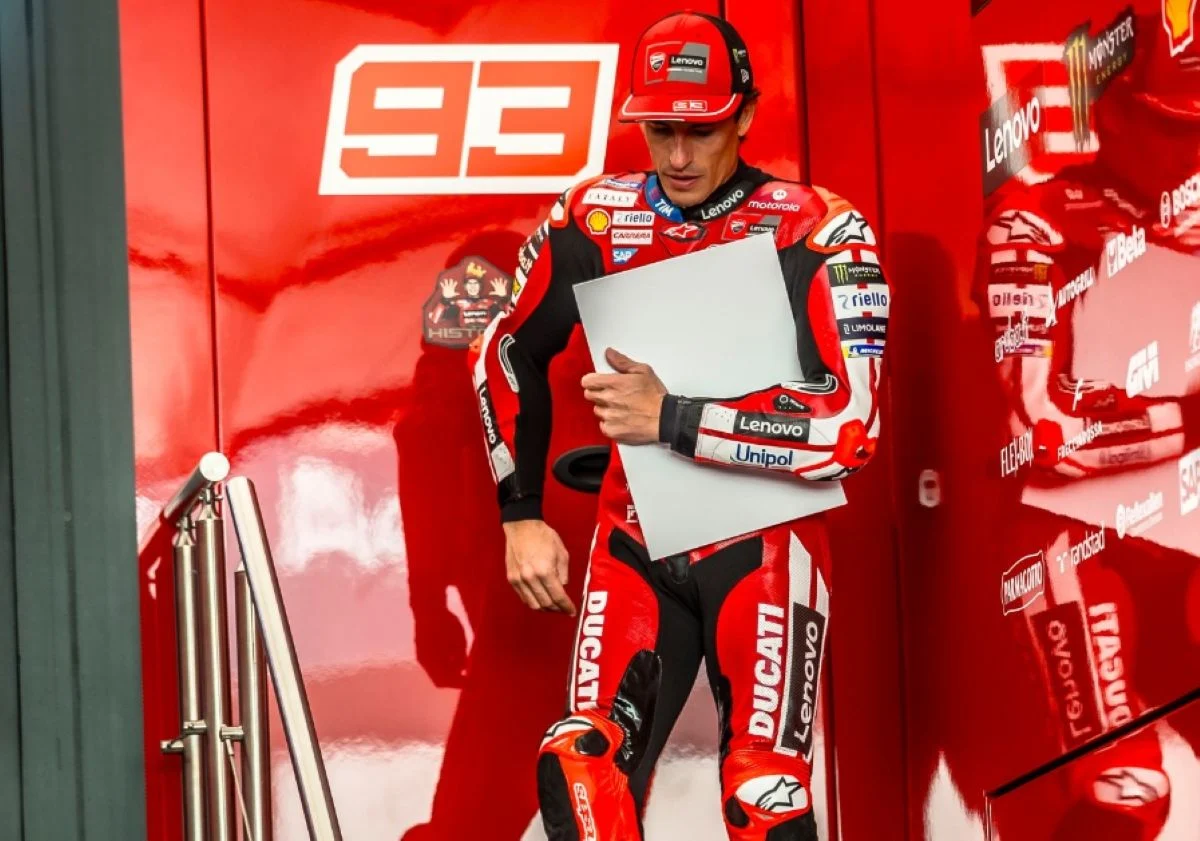
VALENCIA — In a revelation that has sent shockwaves through the global motorsports community, Ducati Lenovo factory rider Marc Marquez has disclosed the definitive medical factors underlying his emotional decision to hang up his helmet at the conclusion of the 2026 MotoGP World Championship season. Speaking during a densely attended special press conference convened ahead of the opening free practice session at the Circuit Ricardo Tormo for the Grand Prix of Valencia, the Spanish megastar confirmed that alongside his long-standing battles with chronic right arm and shoulder injuries, he was once again severely troubled by recurring bouts of diplopia, commonly known as double vision.
The announcement, delivered on Friday, November 27, 2026, officially marks the impending closure of one of the most decorated, dominant, and tumultuous careers in the modern history of Grand Prix motorcycle racing. While rumors regarding Marquez’s physical toll had circulated in the paddock for months, the confirmation that his historical neurological struggles had returned added a harrowing new dimension to his retirement. For a rider whose aggressive style and superhuman reflexes defined an era of premier-class racing, the realization that his vision was once again compromised served as the ultimate catalyst for stepping away from the grid at 33 years of age.
The Triggering Incidents: Mandalika and Le Mans
According to Marquez, the recurrence of diplopia was directly linked to high-impact highside crashes suffered at two distinct points on the modern racing calendar. The first of these alarming episodes occurred in the wake of a vicious accident during the Grand Prix of Indonesia at the Mandalika International Street Circuit, an event that has previously tested the physical limits of several premier-class riders. The second incident transpired following a terrifying highside crash during the Sprint race at the historic French Grand Prix at Le Mans in May 2026.
These high-speed ejections subjected Marquez’s helmeted head and neural pathways to violent rotational forces, ultimately triggering the exact ocular vulnerabilities that had previously threatened to derail his career during his tenure with Repsol Honda. The recurrence of double vision—a condition where a single image is perceived as two overlapping images—is profoundly debilitating for any professional athlete, but it represents an absolute career-ending hazard for a motorcycle racer navigating machines capable of exceeding 350 kilometers per hour with millimeter precision.
Elaborating on the duration and severity of these recent episodes during his emotional Valencia media briefing, Marquez provided specific timelines for the first time. "After the GP of Indonesia, alongside the arm injury, I once again suffered from double vision, although thankfully it persisted for only 48 hours," Marquez told reporters and international media outlets. "Then, following the incident at Le Mans earlier this year, the double vision returned once more, lasting for 12 hours."
While the durations were significantly shorter than the harrowing months-long recovery periods he endured following similar crashes in 2011, 2021, and 2022, the psychological impact of seeing double once again was unmistakable. For Marquez, the return of diplopia served as an unmistakable warning sign from his body, signaling that the structural integrity of his vision system could no longer reliably absorb the inevitable impacts of elite-level motorcycle racing.

A Historical Battle with Diplopia
Diplopia is a condition with which Marc Marquez has tragically intimate familiarity. The neurological affliction first severely impacted his career in late 2011, when a heavy crash during the Moto2 Free Practice session at the Malaysian Grand Prix at Sepang resulted in a fracture of the superior oblique cranial nerve. That initial injury forced him to miss the final round of the intermediate-class season and cast a dark shadow over his winter preparations, requiring specialized surgical intervention and prolonged rest before he could successfully debut in the premier class in 2013.
A decade later, the nightmare returned with terrifying familiarity. In October 2021, a training accident while preparing for the Algarve Grand Prix resulted in a concussion and a subsequent recurrence of diplopia, forcing him to miss the final two rounds of the 2021 MotoGP season as well as the crucial post-season tests at Jerez. True to form, the Spaniard fought back tenaciously, but the vulnerability struck yet again early in the 2022 season following a violent, airborne highside during the warm-up session for the Indonesian Grand Prix at Mandalika—the very circuit that would haunt him once more in the twilight of his career.
That 2022 Mandalika incident forced Marquez to miss two Grands Prix and ultimately precipitated a fourth major surgery on his chronically misaligned right humerus in June 2022. By detailing how the condition resurfaced in both Indonesia and France during the 2026 campaign, Marquez illustrated how closely his physical preservation was tied to sheer luck during the final chapter of his career.
Heightened Caution and the Psychological Toll
The recurrence of these neurological symptoms fundamentally altered how Marquez approached the latter half of the 2026 season. Known historically for a relentless, risk-everything riding philosophy that earned him the moniker "The Baby Alien," the veteran rider admitted that the lingering memory of blurred vision forced him to recalibrate his risk-reward calculations on the asphalt.
"When you experience double vision, even for a few hours, your perspective on life and racing changes dramatically," Marquez reflected during the press conference. "It makes you much more cautious. You start questioning where the limit truly lies, not just in terms of lap time, but in terms of your long-term health and your ability to live a normal life after racing."
Marquez acknowledged that he felt profoundly fortunate that his vision cleared relatively quickly following the Mandalika and Le Mans crashes. However, the transient nature of the symptoms did little to soothe the underlying anxiety. In elite motorcycle racing, fractions of a second and absolute visual acuity are non-negotiable. Knowing that a single fall could trigger a relapse that might permanently impair his vision created a psychological barrier that even a six-time premier-class world champion could not entirely ignore.
The decision to retire, therefore, was not merely a reaction to a declining lap time or a reluctant acceptance of physical frailty in his right arm. It was a calculated, proactive choice to preserve his quality of life before a catastrophic neurological accident could permanently rob him of his sight.

Official Responses and Paddock Reactions
The announcement of Marquez’s retirement sent ripples of shock and profound respect through the MotoGP paddock. Competitors, team executives, and governing body officials rushed to pay tribute to a rider who transformed the sport over more than a decade of competition.
Ducati Corse General Manager Luigi "Gigi" Dall’Igna expressed deep admiration for the Spaniard’s transparency and his immense contributions to the factory team during their partnership. "Marc brought an extraordinary level of data, dedication, and raw speed to Ducati," Dall’Igna stated following the press conference. "While we are saddened to lose such an iconic talent from the grid, health and human well-being must always take precedence over sport. His honesty regarding these physical struggles only elevates our respect for him as a man and a champion."
Rival riders, including long-standing competitors and the younger generation of talent inspired by Marquez’s exploits, took to social media and media scrums to voice their astonishment and admiration. Many noted that few outside the inner circle fully understood the physical sacrifices Marquez had endured simply to maintain a competitive baseline following his catastrophic 2020 Jerez arm break and subsequent complications.
Broader Impact and Implications for MotoGP
Marquez’s departure marks the definitive end of an era for the FIM MotoGP World Championship. As one of the last remaining active legends who bridged the gap between the Rossi-Lorenzo-Pedrosa golden era and the modern aerodynamic, sprint-heavy era of grand prix racing, his absence will leave a massive vacuum both on and off the track.
From a sporting perspective, Ducati Lenovo will now face the complex task of reshaping its factory roster for the upcoming championship cycles, while the broader championship promoter, Dorna Sports, must navigate a television and marketing landscape missing one of its most bankable global superstars. Furthermore, Marquez’s candid revelations about diplopia and recurrent head trauma are expected to reignite crucial conversations regarding safety protocols, helmet technology, and the neurological assessment thresholds enforced by circuit medical directors following highside crashes.
As the 2026 season reaches its crescendo at Valencia, the racing community’s collective focus has shifted swiftly from championship points to a retrospective celebration of a phenomenal career. Marc Marquez leaves the sport not as a fallen hero defeated by time, but as a warrior who listened to his body, recognized the ultimate boundaries of human endurance, and chose to walk away on his own terms—ensuring that his legacy remains untarnished by the permanent consequences of the sport he helped define.