
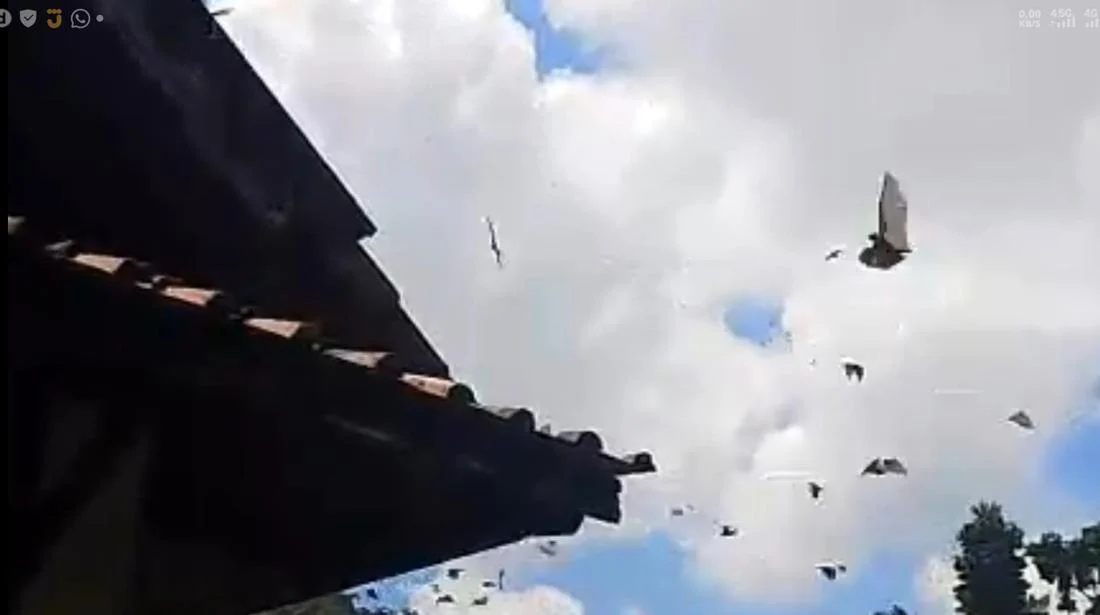
The quiet neighborhood of Kampung Gentong in Desa Buniasih, Kadipaten, Tasikmalaya Regency, was recently the site of an extraordinary wildlife encounter that necessitated a specialized response from local emergency services. More than 15,000 bats were discovered nesting within the roof and ceiling structure of a local residence, creating a significant public health concern and a logistical challenge for the Tasikmalaya Regency Fire Department (Damkar). The homeowner, identified as Enung, reported the incident after discovering that her property, which had remained vacant for a considerable period, had been effectively reclaimed by the massive colony of winged mammals.
The scale of the infestation was so vast that it transformed a standard residential structure into a makeshift cave, with thousands of bats clinging to wooden rafters, tiles, and the interior of the ceiling. The situation highlights the growing challenges of urban-wildlife conflict in West Java, particularly in areas where human dwellings border natural habitats or where abandoned properties provide ideal conditions for opportunistic species to thrive.
Discovery and Initial Assessment
The discovery occurred when Enung visited the property, which had been left uninhabited for several years. Upon entering, she was met with a pervasive, pungent odor and the sound of thousands of wings fluttering within the upper reaches of the house. "It was overwhelming; there were so many bats. I immediately realized I couldn’t handle this alone and sought help from the Fire Department," Enung stated.
The initial report received by the Tasikmalaya Regency Fire Department (UPTD Damkar) did not fully convey the magnitude of the situation. When the call came in on Tuesday, April 14, 2026, the dispatchers understood there was a bat problem, but the sheer volume of the colony was only realized once the specialized unit arrived on the scene. A team was immediately mobilized from the central station, enduring a journey of over two hours to reach the remote location in the Kadipaten district.
Aam, the Fire Department Team Leader (Komandan Regu), noted that the initial equipment brought by the team—primarily nets—was woefully inadequate for the task at hand. "We received the report and moved quickly, bringing our standard animal rescue nets. However, the owner hadn’t specified just how many bats there were. Looking at the density of the colony, we estimated there were well over 15,000 individuals. It was an incredible sight, but also a serious hazard," Aam explained.
Chronology of the Four-Hour Evacuation Operation
The evacuation of the bats was a complex procedure that required a shift in tactics once the scale of the colony was assessed. The following timeline outlines the dramatic four-hour operation:
- Initial Deployment (10:00 AM – 11:00 AM): The Damkar team arrived at the residence in Kampung Gentong and conducted a preliminary sweep. They found that the bats had occupied almost every square inch of the attic space. Initial attempts to capture the bats using hand nets were quickly abandoned as the sheer volume of the animals made manual capture impossible and potentially dangerous for the officers.
- Strategy Adjustment (11:00 AM – 11:30 AM): Recognizing that physical capture was futile, Aam and his team decided to utilize a "smoking out" technique. This involves creating a controlled, non-toxic smoke environment to encourage the bats to vacate the premises voluntarily.
- Structural Preparation (11:30 AM – 12:30 PM): To ensure the bats had a clear exit path and to prevent them from becoming trapped or dying within the walls, the officers carefully removed several roof tiles and sections of the wooden ceiling (eternit). This provided multiple ventilation points through which the colony could escape into the open air.
- The Fumigation Process (12:30 PM – 2:00 PM): Small, controlled fires were set using damp organic material to produce thick smoke. As the smoke rose into the rafters, the bats began to dislodge from their perches.
- Mass Exodus (2:00 PM – 3:00 PM): Thousands of bats began streaming out of the newly created openings in the roof. The sky above the residence was briefly darkened by the sheer number of departing animals. Officers remained on-site to monitor the exit and ensure that the bats moved away from the residential area toward the nearby forested zones.
By the late afternoon, the majority of the colony had cleared the building. The team then performed a final sweep to remove any remaining stragglers and to assess the state of the property.
Ecological and Environmental Factors
The infestation in Kadipaten is not an isolated phenomenon but rather a symptom of specific environmental conditions. According to wildlife experts, bats are drawn to dark, humid, and undisturbed environments. Abandoned houses with structural gaps—such as missing tiles or holes in the eaves—provide the perfect microclimate for bat colonies to establish themselves.
Tasikmalaya, characterized by its mix of agricultural land and proximity to mountainous forests, is home to several species of bats, ranging from small insectivores to larger fruit bats. While the specific species in Enung’s house was not officially logged in the heat of the operation, the behavior and numbers suggest a highly social species that utilizes communal roosting for protection and temperature regulation.
The humidity mentioned by Aam as a contributing factor is critical. In West Java’s tropical climate, an unventilated attic in a vacant house can become a high-humidity chamber, mimicking the conditions of a natural cave. Once a small group of "scout" bats finds such a location, they release pheromones that attract others, leading to an exponential increase in the population over several months or years.
Public Health Implications and Hazards
The presence of 15,000 bats in a residential structure poses significant health risks to the human inhabitants and the surrounding community. The primary concern is the accumulation of guano (bat droppings) and urine.
1. Histoplasmosis: Guano provides a fertile breeding ground for Histoplasma capsulatum, a fungus that can cause respiratory infections in humans if the spores are inhaled. In a confined space like an attic, the concentration of these spores can reach dangerous levels.
2. Viral Reservoirs: Bats are known natural reservoirs for a variety of zoonotic diseases. While rabies is the most commonly cited risk, bats can also carry other viral pathogens. The proximity of such a large colony to a human living space increases the risk of interspecies transmission.
3. Structural Damage: The weight of 15,000 bats, combined with the corrosive nature of their waste, can severely compromise the structural integrity of a building. Wooden beams can rot, and ceiling boards can collapse under the weight of accumulated guano.
4. Ammonia Exposure: The buildup of bat urine produces high levels of ammonia, which can cause irritation to the eyes, nose, and throat of anyone entering the building, as was the case during the initial assessment by the Damkar team.
Official Responses and Safety Recommendations
Following the successful operation, Engking, the Head of the Administrative Sub-Division of the Tasikmalaya Regency Fire Department, praised the team’s efficiency and emphasized the department’s commitment to community safety.
"We are pleased that we could assist the resident and complete this task without causing unnecessary damage to the property or harm to the officers," Engking said. "This operation demonstrates the diverse range of challenges our personnel face. While we are primarily a fire-fighting force, animal rescue and public hazard mitigation are becoming a larger part of our daily duties."
Engking also issued a formal advisory to the residents of Tasikmalaya. He urged homeowners to conduct regular inspections of vacant properties and to seal any potential entry points for wildlife. "If residents find wildlife—whether it be bats, snakes, or wasps—nesting in large numbers within residential areas, they should report it immediately. Do not attempt to handle large colonies yourself, as the risks of disease and injury are high," he added.
Analysis: The Changing Role of Urban Emergency Services
The incident in Tasikmalaya highlights a growing trend in Indonesia where local Fire Departments (Damkar) are evolving into all-hazard response agencies. In many regions, Damkar units are now the primary responders for "Non-Fire Rescues" (Rescue Non-Kebakaran). This includes everything from removing invasive snakes and hornet nests to the massive bat evacuation seen in Kadipaten.
This shift places a significant strain on resources. As Aam noted, the team initially arrived with only nets, unaware of the scale of the problem. This suggests a need for better reporting protocols and perhaps specialized "Wildlife Response Units" within the Fire Department to handle the unique biological and environmental challenges posed by mass infestations.
Furthermore, the case of Enung’s house serves as a cautionary tale regarding property management. In many parts of Indonesia, it is common for families to own properties that remain empty for years, often due to owners working in larger cities or abroad. Without regular maintenance, these structures become "urban voids" that are quickly filled by nature. The cost of remediating a house after a 15,000-bat infestation—including cleaning, disinfecting, and structural repairs—far exceeds the cost of routine maintenance and securing the building’s exterior.
Conclusion
The successful evacuation of over 15,000 bats from a residential home in Tasikmalaya is a testament to the ingenuity and dedication of the local Fire Department. Through a combination of tactical flexibility and community cooperation, a major public health hazard was neutralized. As the residents of Kampung Gentong return to their normal routines, the event remains a stark reminder of the delicate balance between human civilization and the natural world, and the vital role that emergency services play in maintaining that boundary.
By Tuesday evening, the Damkar team had completed their final sweep, ensuring that the attic was clear and the openings were temporarily secured. The house, once a buzzing hive of nocturnal activity, finally fell silent, marking the end of one of the largest wildlife interventions in the district’s recent history.
