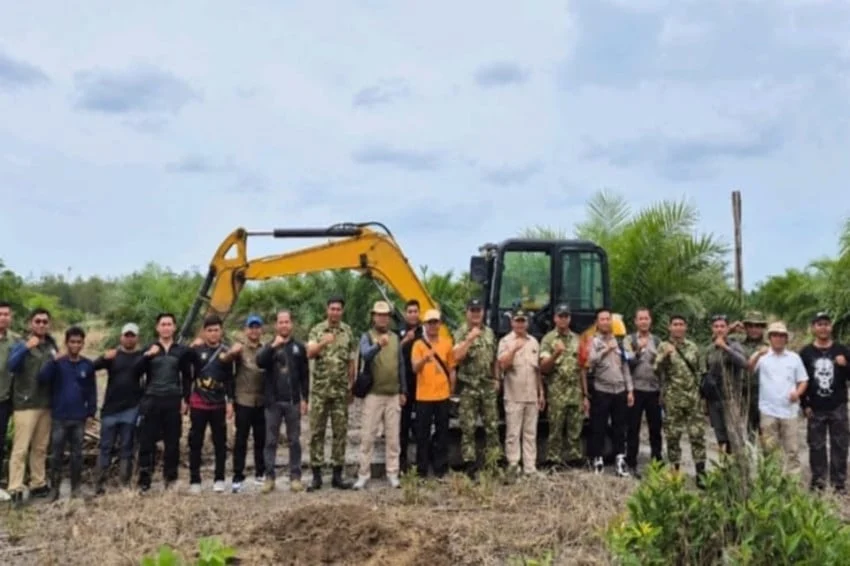
The Ministry of Forestry, acting in close coordination with the Indonesian National Armed Forces (TNI), the Indonesian National Police (Polri), the Attorney General’s Office, local government entities, and surrounding communities, has successfully executed a major enforcement operation to dismantle 88 hectares of illegal palm oil plantations operating within the ecologically sensitive Lamandau Wildlife Reserve in Central Kalimantan. This decisive enforcement action marks a significant milestone in Indonesia’s ongoing, nationwide campaign to reclaim conservation areas, protect endangered wildlife habitats, and enforce strict compliance with forestry and environmental laws.
The high-stakes operation was spearheaded by the Directorate General of Forestry Law Enforcement—specifically through the Directorate of Forest Crime Investigation and the Kalimantan Regional Office of Forestry Law Enforcement—alongside the Directorate General of Natural Resources and Ecosystem Conservation (KSDAE) via the Central Kalimantan Natural Resources Conservation Center (BKSDA). The multi-agency coalition also integrated operational support from the Sukamara Regency Government, the 1014/Pangkalan Bun Military District Command (Kodim), the Sukamara Resort Police (Polres), the Sukamara State Attorney’s Office, the Sukamara-Lamandau Forest Management Unit (KPHP), as well as active participation from the residents of Kartamulia Village and local indigenous traditional leaders.
Comprehensive Operational Scope and Direct Actions Taken
During the coordinated sweep across the targeted sector of the Lamandau Wildlife Reserve, joint task force personnel systematically eradicated illegal agricultural cultivation by felling a staggering 11,180 mature oil palm trees. The physical removal of these crops directly targeted the commercial viability of the illegal enterprise, sending an unequivocal signal that agricultural encroachment into protected sanctuaries will not be tolerated.
Significantly, the operation achieved substantial compliance without widespread conflict, largely due to a strategic blend of firm law enforcement and structured dialogue. A total of 43 individuals and parties who had previously illegally occupied and exploited the conservation zone agreed to halt their commercial and agricultural activities entirely of their own volition. Furthermore, recognizing the inevitability of administrative enforcement and the legal liabilities associated with ongoing occupation, the encroachers voluntarily dismantled 28 temporary working huts and operational shelters erected within the sanctuary boundaries.
The peaceful transition and voluntary compliance observed during the operation underscored the efficacy of integrating local community leaders into the enforcement strategy. Authorities engaged closely with the Demung, the traditional Dayak customary authorities, to foster mutual understanding regarding the ecological destruction caused by illegal logging and monoculture conversion. This culturally sensitive yet legally unyielding approach ensured that local grievances were addressed while asserting the primacy of state conservation law.
Chronology of the Lamandau Encroachment Crisis
The eradication operation in the Lamandau Wildlife Reserve did not occur in a vacuum; rather, it represents the culmination of a rigorous investigative process launched in response to environmental degradation and security violations within the sanctuary.
The timeline of the intervention traces back to a series of localized ecological crises within the reserve, most notably unauthorized land-clearing activities that culminated in severe forest and land fires. The Directorate of Forest Crime Investigation initiated a formal criminal investigation into these fires, treating them not merely as natural disasters or isolated accidents, but as deliberate acts associated with land preparation for illegal agricultural expansion.
As the investigative net widened, Forest Civil Servant Investigators (PPNS Kehutanan) summoned and interrogated 43 illegal encroachers and cultivators. Through intensive evidence gathering, field mapping, and witness testimonies, investigators established a clear paper trail and operational network linking the individuals to systemic violations of Forestry Law Number 41 of 1999 and related environmental statutes.
With the legal groundwork firmly established, operational planning commenced weeks prior to the raid. Inter-agency coordination meetings aligned the tactical objectives of the military, police, prosecutors, and forestry officials. By combining investigative findings with community outreach involving indigenous representatives, the authorities orchestrated a synchronized intervention that culminated in the successful neutralization of the 88-hectare illicit plantation network.
Broader Policy Context: The National Crackdown on Illegal Land Use
The enforcement action in Central Kalimantan is deeply intertwined with a broader, highly accelerated national agenda to restore ecological integrity and reclaim state forest domains from unlawful commercial exploitation. Under the current national administration—marked by ambitious environmental reform metrics, including prominent initiatives spearheaded under President Prabowo Subianto’s governance framework—state agencies have ramped up scrutiny against unlicensed extractive and agricultural ventures.
Recent national data highlights the sheer scale of this regulatory overhaul. Over the preceding operational year, federal enforcement bodies have systematically targeted thousands of square kilometers of unauthorized land use. Government audits and enforcement tallies indicate that within a single twelve-month window, authorities have tackled over one thousand illegal mining operations and reclaimed approximately five million hectares of illicitly established palm oil plantations nationwide.
The Lamandau Wildlife Reserve operation serves as a micro-cosmic reflection of this macro-level policy. Wildlife sanctuaries, by legal definition, are Core Zones and Sanctuary Zones where zero human extractive activity is permitted. The encroachment of monoculture palm oil plantations into such habitats severely fragments ecosystems, disrupts migration corridors for critically endangered species such as the Bornean orangutan (Pongo pygmaeus), and vastly increases the vulnerability of peatlands and lowland forests to devastating anthropogenic fires.
Perspectives and Official Reactions from Multi-Agency Stakeholders
While direct quotes from individual commanders on-site reflected a unified stance on rule of law enforcement, institutional statements issued by the participating bodies emphasize a balanced philosophy of deterrence and restoration.
Representatives from the Ministry of Forestry reiterated that conservation areas are national assets held in trust for future generations, making commercial exploitation within their borders a severe criminal offense. Officials stressed that while persuasive methods and voluntary compliance are prioritized to maintain social harmony, the state retains the full constitutional mandate to utilize penal sanctions against repeat offenders or those who violently resist forestry regulations.
Local government representatives in Sukamara Regency highlighted the socioeconomic dimensions of the transition. Regional authorities noted that the unchecked expansion of illegal oil palm plantations not only strips the region of its natural carbon sinks and biodiversity hotspots but also distorts local economic fairness by operating outside formal tax structures and labor regulations. By reclaiming the land, local administrations hope to redirect economic development toward legal, sustainable agricultural zones outside protected perimeters.
Environmental law groups and conservation watchdogs have largely commended the Lamandau operation, pointing out that multi-agency synergy—combining police, military, prosecutorial, and civil administrative powers—is the only effective way to dismantle entrenched land-mafia syndicates that frequently operate behind layers of local proxies. However, civil society organizations also emphasize that physical clearing is merely the first step; long-term ecological success requires robust post-enforcement rehabilitation and active reforestation of the degraded tracts.
Implications for Environmental Stability and Future Compliance
The successful intervention in the Lamandau Wildlife Reserve carries profound implications for the future of environmental governance in Central Kalimantan and across Indonesia’s outer islands.
First, the voluntary dismantling of infrastructure and cessation of farming by 43 encroachers sets a powerful legal precedent. It demonstrates that swift, well-documented investigations by forestry civil servant investigators, backed by the credible threat of criminal prosecution, can compel unlawful operators to relinquish control without necessitating violent confrontations.
Second, the operation signals a hardening stance against the historical normalization of agricultural encroachment within protected forests. For decades, palm oil expansion often outpaced the enforcement capacity of regional forestry offices, leading to a de facto tolerance of illegal plots once crops matured. By actively felling mature, fruit-bearing oil palm trees across nearly 90 hectares, the Ministry of Forestry has signaled that biological maturity of an illegal crop grants no immunity from eradication.
Looking ahead, the Ministry of Forestry and its allied task force partners face the critical challenge of ensuring that the reclaimed land does not experience secondary encroachment. Plans for the revitalized sector of the Lamandau Wildlife Reserve reportedly include intensive patrols by joint forestry and community task forces, alongside ecosystem restoration initiatives aimed at reintroducing native flora to accelerate natural habitat recovery.
As Indonesia continues to navigate its international climate commitments, biodiversity preservation pledges, and sustainable commodity certification standards—such as the Indonesian Sustainable Palm Oil (ISPO) framework—operations like the one executed in Sukamara represent vital stress tests for the nation’s regulatory credibility. The unwavering execution of conservation laws in Lamandau reaffirms the government’s resolve to balance economic agrarian interests with the absolute imperative of ecological preservation.