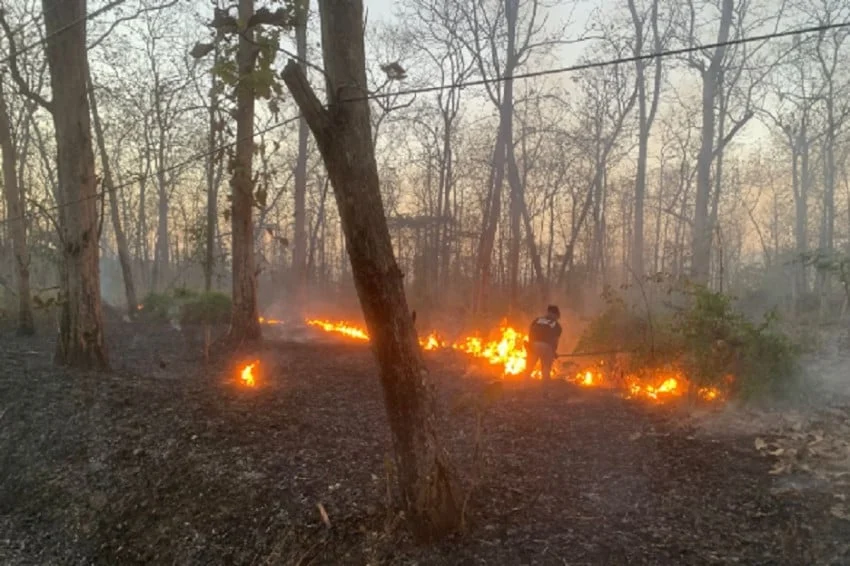
The Ministry of Forestry has officially initiated a comprehensive scientific assessment to quantify the extensive ecological and environmental impacts resulting from severe forest and land fires—locally known as Karhutla—that recently ravaged the Baluran National Park, situated in Situbondo Regency, East Java. Preliminary findings derived from rigorous academic research indicate that the financial outlay required merely for environmental rehabilitation and ecosystem restoration across the affected zones will scale up to approximately Rp5.52 billion.
The evaluation, which focuses on a massive expanse totaling 3,141 hectares of protected conservation land, was spearheaded by prominent forestry and environmental experts from the esteemed Bogor Agricultural University (IPB), namely Prof. Bambang Hero Saharjo and Prof. Basuki Wasis. Their collaborative research framework utilized advanced ecological valuation methodologies to calculate both the immediate economic loss of environmental services and the long-term investment needed to nurse the charred savannahs and monsoon forests back to ecological health.
Comprehensive Environmental Damage Assessment
The scientific appraisal went beyond mere financial estimations of scorched acreage, delving deeply into the atmospheric and chemical consequences of the disaster. According to the emissions assessment conducted by Prof. Bambang Hero Saharjo, the inferno unleashed an alarming volume of greenhouse gases and harmful airborne pollutants into the atmosphere. Specifically, the fires are estimated to have released roughly 7.63 tons of carbon dioxide equivalents alongside 0.38 tons of hazardous particulate matter.
These metrics underscore the dual threat posed by forest fires in Indonesia’s premier conservation areas: immediate habitat destruction coupled with significant contributions to regional air pollution and global climate change. However, ministry officials and the academic team have explicitly clarified that the scope of this scientific study serves a generalized analytical purpose. The figures reflect the broad, systemic ecological damage inflicted upon the inspected zones and do not represent a direct legal liability calculation attributed to specific criminal suspects, such as an individual identified in ongoing legal proceedings as MF.
The distinction between systemic ecological valuation and specific criminal restitution remains a vital component of Indonesia’s forestry law enforcement framework. While the scientific assessment provides a baseline for environmental restoration and policy formulation, individual culpability and judicial penalties will be determined through separate, rigorous criminal proceedings handled by specialized investigators.
Chronology and Operational Response in Baluran
Baluran National Park, frequently referred to as "Africa Van Java" due to its sweeping savannahs, iconic wildlife populations, and distinctive dry deciduous forest ecosystems, represents a cornerstone of Indonesia’s biodiversity conservation strategy. The vulnerability of this landscape to ignition sources, particularly during prolonged dry seasons exacerbated by regional climate phenomena, has long been a source of anxiety for environmental management authorities.
The incident under review highlights a critical period of intense firefighting efforts, inter-agency coordination, and subsequent post-fire investigation. While the immediate emergency response successfully prevented the complete devastation of the park’s core protected zones and minimized casualties among endangered native fauna—such as the Java banteng (Bos javanicus)—the lingering ecological footprint necessitated high-level academic intervention.
Following the containment of the flames, the Ministry of Forestry deployed specialized teams alongside academic researchers to map the burn scars utilizing remote sensing technology, ground-truthing, and soil laboratory analysis. This investigative phase culminated in the recent release of the IPB findings, providing authorities with a data-driven foundation to request budgetary allocations for landscape restoration.
Intensified Law Enforcement and Regional Oversight
The governance of Indonesia’s national parks and conservation forests operates under strict statutory protections. Unauthorized burning, whether intentional or the result of gross negligence, constitutes a severe violation of forestry laws. Aswin Bangun, the Head of the Forestry Law Enforcement Agency (Balai Gakkum) for the Java, Bali, and Nusa Tenggara regions, emphasized that the aggressive handling of forest and land arson remains a paramount priority for the government.
Speaking on the broader implications of the Baluran incident, Bangun underscored the unique geographical and climatic pressures facing conservation areas across the densely populated island of Java. The persistent threat of anthropogenic fires, driven by agricultural clearing practices, land encroachment, or sheer negligence, demands a paradigm shift toward proactive prevention and rapid-response architecture.
"The inherent vulnerability to forest fires across the island of Java necessitates a much higher intensity of territorial surveillance and community-based early warning systems," Aswin Bangun stated. Furthermore, he extended official commendation to the frontline personnel stationed at the Baluran National Park management unit. "We deeply appreciate the high level of preparedness demonstrated by the officers at Balai TN Baluran. Their prompt responsiveness serves as a crucial benchmark illustrating why rigorous oversight and immediate tactical reactions are indispensable for maintaining the security and integrity of protected conservation zones."
Broader Implications for Indonesian Conservation Policy
The Situbondo incident occurs against a backdrop of intensified national scrutiny regarding land and forest fires. Across the archipelago, the Indonesian government has adopted a zero-tolerance policy toward illicit burning, targeting not only individual perpetrators but also corporate entities found to have neglected their statutory environmental responsibilities. In parallel developments within the broader national landscape, federal authorities have demonstrated willingness to revoke Business Permits for Forest Utilization (HGU) held by commercial enterprises found culpable or heavily indicated to have contributed to uncontrolled regional Karhutla outbreaks.
The focus on Baluran National Park, however, brings unique challenges to the forefront. Unlike vast peatland concessions in Sumatra or Kalimantan, where fires often trigger massive subterranean carbon releases, the dryland ecosystems of Java are characterized by high biodiversity density and close proximity to agrarian human settlements. When fires sweep through regions like Baluran, the immediate threat is the fragmentation of critical habitats for protected endemic species, the degradation of watersheds, and the direct economic toll required for rehabilitation.
Restoring 3,141 hectares of fire-damaged terrain is a multifaceted undertaking that extends far beyond planting saplings. The Rp5.52 billion projected by the IPB experts encompasses soil stabilization, the eradication of invasive weed species that typically colonize burn scars—such as Acacia nilotica, which has long plagued Baluran’s natural savannahs—and the deliberate reintroduction of native flora resilient to fire cycles. Furthermore, funds must be channeled into community awareness programs, boundary demarcation, and the enhancement of firebreak infrastructures.
Policy Recommendations and Future Outlook
Environmental policy analysts observing the Baluran case suggest that the integration of academic institutions like IPB into environmental damage assessment represents a progressive step toward transparent, science-based governance. By quantifying emissions alongside fiscal restoration costs, the Ministry of Forestry builds an unassailable evidentiary base for both courtroom prosecutions and legislative budget requests.
Moving forward, the Ministry is expected to leverage these findings to upgrade fire suppression capacities across all Javanese conservation units. Recommendations arising from the study likely point toward increased deployment of geographic information systems (GIS) for real-time hotspot monitoring, the establishment of permanent community firefighting brigades (Manggala Agni) in high-risk buffer zones, and the hardening of legal penalties for individuals or syndicates utilizing fire as a cheap land-clearing mechanism.
As climate anomalies continue to alter traditional weather patterns, heightening the frequency of extreme dry spells, the lessons learned from the Baluran National Park wildfire will reverberate across Indonesia’s environmental management sector. The commitment to exact both ecological accountability and rigorous restoration funding signals a hardening resolve within the state apparatus to protect its natural heritage from the recurring scourge of preventable wildfires.