The Directorate of Traffic of the Jakarta Metropolitan Police, commonly known as Ditlantas Polda Metro Jaya, has officially prepared a series of comprehensive traffic management plans and security protocols ahead of a planned mass demonstration at the House of Representatives (DPR) building located within the Parliamentary Complex in Senayan, Central Jakarta. The security adjustments and situational traffic diversions are scheduled to be implemented on Tuesday, November 10, 2026, as authorities anticipate a significant influx of protesters and potential disruptions to major thoroughfares surrounding the legislative compound.
In an official advisory published through its verified social media channels, including the popular Instagram account @TMCPoldaMetro, law enforcement urged the general public to exercise caution, plan their commutes accordingly, and proactively seek alternative routes to avoid anticipated traffic congestion. The traffic engineering measures will be implemented on a situational basis, meaning that road closures, lane reversals, and vehicle filtering will be deployed dynamically depending on the density of the crowd, the volume of participant vehicles, and the overarching security conditions on the ground as the demonstration unfolds.
Background Context of the Demonstration
The planned assembly at the national legislative complex follows a recurring trend of public expressions of discontent, labor union mobilizations, and student-led activism targeting key policy decisions and legislative agendas deliberated within the halls of the Indonesian parliament. The DPR building, situated along the major arterial corridor of Jalan Jenderal Gatot Subroto, has historically served as the epicenter for large-scale sociopolitical movements in the capital city.
Demonstrations of this nature typically bring together diverse coalitions representing labor organizations, academic circles, civil society groups, and grassroots communities. These groups frequently utilize high-visibility national dates or symbolic anniversaries to voice their demands regarding economic reforms, labor protections, environmental policies, or legislative transparency. Law enforcement agencies in the capital are routinely tasked with balancing the constitutional rights of citizens to peacefully assemble and express their opinions with the equally critical mandate of maintaining public order, ensuring the unimpeded flow of vital urban traffic, and protecting critical national infrastructure from potential security breaches.
Chronology and Operational Preparations
Preparations for managing the November 10, 2026 demonstration began days in advance, involving high-level coordination among various divisions within the Jakarta Metropolitan Police and relevant municipal agencies. According to the Head of Public Relations for Polda Metro Jaya, Senior Commissioner Budi Hermanto, the police force has adopted a rigorous, methodical approach to crowd management and infrastructure defense.
As part of these preparatory measures, the Jakarta police conducted a comprehensive Tactical Floor Game (TFG) prior to the day of the protest. The TFG simulation brought together operational commanders, unit leaders, and tactical personnel to map out potential scenarios, review personnel deployments, and ensure seamless communication across all participating security echelons. Commissioner Budi Hermanto emphasized that the primary objective of the TFG was to synchronize operational perceptions, guaranteeing that the handling of the crowd adheres strictly to standard operating procedures (SOPs) emphasizing human rights, persuasion, and proportional response.
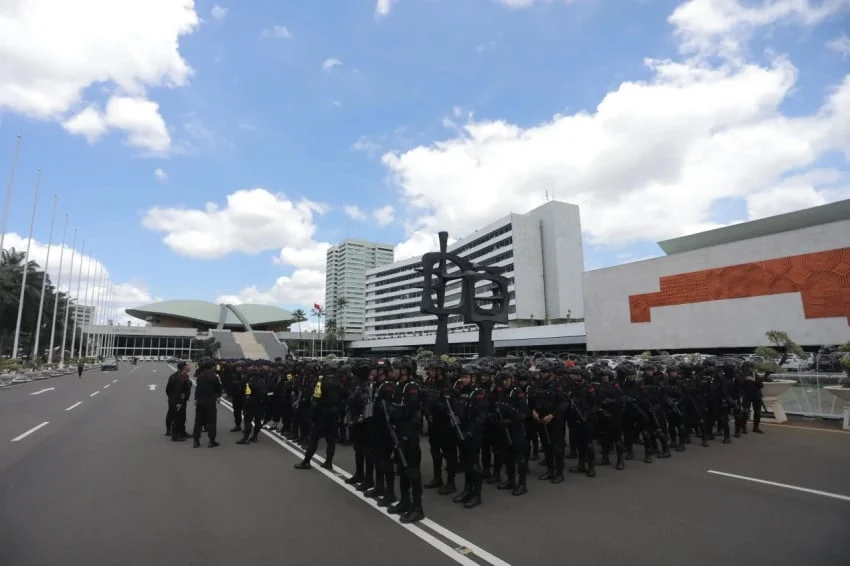
Security forces have been instructed to safeguard and escort the expression of public aspirations, ensuring that demonstrators can voice their concerns safely while preventing disruptions that could compromise public safety or damage public and private property. Thousands of joint personnel drawn from the National Police (Polri), the Indonesian National Armed Forces (TNI), and municipal public order officers (Satpol PP) have been placed on standby around strategic locations, including the DPR/MPR RI complex, the surrounding Semanggi interchange, and nearby government installations.
Traffic Engineering and Contingency Plans
The traffic engineering strategy designed by Ditlantas Polda Metro Jaya incorporates multiple layers of contingency planning to mitigate the impact of the demonstration on Jakarta’s notoriously dense vehicular circulation. While specific road closures will depend on the physical size of the crowd and the exact positioning of protesters, standard diversion protocols for the Senayan parliamentary precinct generally involve several key arterial adjustments:
- Jalan Jenderal Gatot Subroto (Eastbound/Westbound): Traffic moving from Semanggi toward Slipi may be diverted away from the parliamentary flyover or filtered through auxiliary lanes to prevent vehicles from stalling in gridlock directly in front of the DPR building gates. Conversely, traffic from Slipi heading toward Semanggi could experience intermittent slowdowns or lane restrictions.
- Access Roads Surrounding the Parliament Complex: Side streets feeding into Jalan Gerbang Pemuda and the Palmerah areas will be closely monitored. Vehicles attempting to access the back gates of the complex or nearby commercial zones may be redirected toward alternative neighborhood routes.
- Transjakarta Busway Operations: Public transportation networks, particularly Transjakarta bus corridors operating along Jalan Gatot Subroto, may experience adjusted schedules, temporary route truncations, or dedicated lane prioritization to ensure that commuters relying on public transit are not entirely stranded by the surface traffic disruptions.
Commuters and motorists traveling through Central and South Jakarta on Tuesday are strongly advised to monitor real-time traffic applications, heed instructions from traffic police officers deployed along the corridors, and allocate significantly more travel time for journeys intersecting with the affected zones.
Official Responses and Institutional Stance
The leadership of the Indonesian National Police has consistently reiterated its commitment to facilitating freedom of expression while maintaining strict adherence to the law. Under prevailing Indonesian regulations, peaceful assembly is a constitutionally protected right under Article 28E of the 1945 Constitution, as well as Law No. 9 of 1998 concerning Freedom of Expression in Public Spaces.
However, authorities have continuously reminded organizers and participants to abide by the legal boundaries governing public protests. These include obtaining the necessary prior notification letters for demonstrations, refraining from blocking toll roads or vital national infrastructure, avoiding acts of vandalism, and dispersing peacefully by the legally mandated evening deadlines.
Commissioner Budi Hermanto noted that law enforcement agencies maintain an open dialogue with student coordinators, labor leaders, and civil society representatives to encourage peaceful demonstrations and minimize the likelihood of friction between security personnel and civilian participants. Intelligence units have also been deployed to monitor potential agitators or external elements who might seek to infiltrate peaceful assemblies for the purpose of inciting violence, property destruction, or unrest.
Broader Impact and Implications for Urban Mobility
The recurrence of large-scale demonstrations in the capital underscores the complex interplay between democratic expression and metropolitan logistics in Jakarta. As a bustling megacity serving as the political and economic heart of Indonesia, urban disruptions in key districts such as Senayan inevitably generate a ripple effect across regional commerce, supply chains, and daily commuter routines.
From an economic perspective, traffic gridlocks resulting from major protests can temporarily reduce productivity, delay commercial distribution, and increase operational costs for businesses relying on timely logistics through central business districts. Consequently, municipal authorities and transportation planners are continually challenged to refine their crisis communication strategies, leveraging digital platforms and social media channels like @TMCPoldaMetro to provide real-time updates that empower citizens to make informed decisions about their daily travel.
Ultimately, the successful management of the November 10, 2026 demonstration at the DPR building will serve as another benchmark for the Jakarta Metropolitan Police in balancing constitutional obligations, public safety, and urban resilience. As the situation continues to develop, authorities remain on high alert, prepared to adapt their tactical deployments and traffic mitigation measures dynamically in response to the unfolding events on the ground.