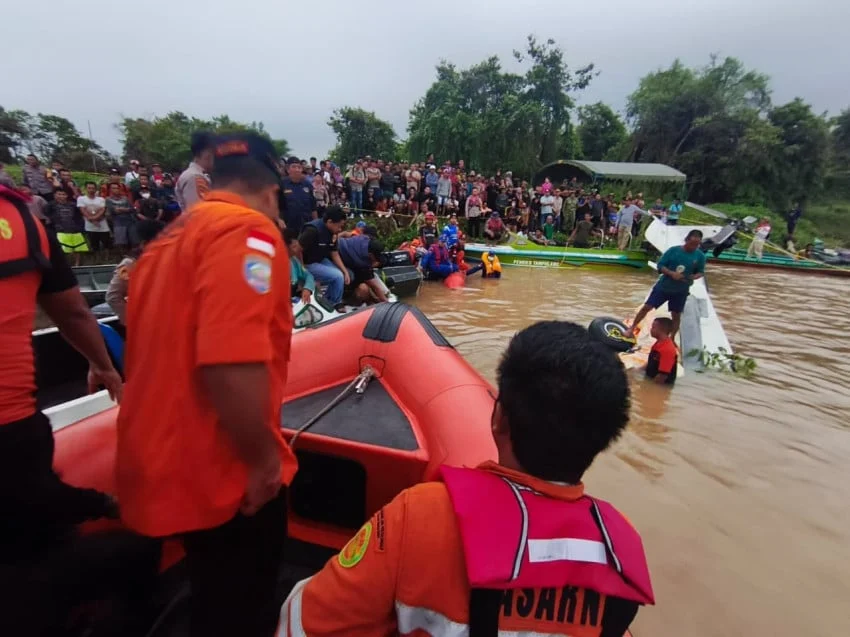
The Search and Rescue Office (Basarnas) of Banjarmasin has officially concluded search and rescue operations following the tragic crash of a Super Puma H-225 helicopter into the Barito River, located in Barito Kuala Regency, South Kalimantan. The incident, which occurred on Sunday, November 8, 2026, triggered a massive multi-agency response to locate and extract the aircraft’s occupants. By the conclusion of the coordinated rescue efforts, the joint SAR team successfully accounted for all three individuals on board. Tragically, while two crew members were recovered alive and subsequently transported for medical evaluation, one crew member was found dead at the scene.
The operation, which spanned several hours of intense underwater and surface searching in murky and swift-moving river conditions, marks a sombre moment for aviation safety and emergency response operations in the region. The aircraft involved was identified as a chartered helicopter operating under the logistical framework of the National Board for Disaster Management (BNPB). Following the recovery of the final victim, the head of the Banjarmasin SAR Office formally announced the termination of the search phase, expressing gratitude to the diverse coalition of responders who worked tirelessly against the clock.
Chronology of the Incident and Rescue Operation
The emergency began on the morning of Sunday, November 8, 2026, when air traffic monitors and local authorities received distress signals indicating that a Super Puma H-225 helicopter had gone down in the waters of the Barito River within Barito Kuala Regency. The aircraft, deployed for missions typically aligned with BNPB operations, plummeted into the waterway under circumstances that remain under active investigation.
Upon receiving the distress alert, the Banjarmasin SAR Office immediately mobilized a rapid-response unit. A joint task force comprising personnel from Basarnas, the Indonesian National Armed Forces (TNI), the Indonesian National Police (Polri), local disaster mitigation agencies (BPBD), and specialized volunteer groups rushed to the coordinates provided.
Initial reports from the field confirmed that the crash site presented immediate logistical hurdles. The Barito River, known for its deep currents, low underwater visibility, and dense river traffic, complicated the deployment of rescue divers. Nevertheless, the search teams established an incident command post near the riverbank and deployed specialized rubber boats alongside sonar equipment to pinpoint the submerged fuselage of the heavy-lift helicopter.
As the hours progressed, the joint team achieved critical breakthroughs. By Sunday afternoon, search parties located two survivors trapped near the wreckage, who were swiftly pulled from the water and administered emergency first aid before being rushed to a nearby regional hospital for comprehensive medical treatment. However, the search for the third and final crew member extended into the afternoon. Specialized divers executed multiple grid-search dives into the turbid depths of the river. Ultimately, the missing crew member was located inside the submerged cabin structure, having succumbed to fatal injuries sustained during the impact.
Official Statements and Expression of Gratitude
Following the confirmation that all three victims had been recovered and accounted for, I Putu Sudayana, Head of the Banjarmasin SAR Office, issued a formal statement detailing the conclusion of the mission. He extended profound appreciation to all participating entities, underscoring the vital role that institutional synergy played in executing a complex water-extraction operation.
"The successful evacuation of all victims is the direct result of cooperation, synergy, and exemplary coordination among all elements of the joint SAR team," Sudayana stated in a formal written release. He placed special emphasis on the grueling nature of the recovery effort, highlighting the bravery and technical expertise of the rescue divers. "We deeply appreciate the dedication and hard work of all personnel who carried out this humanitarian duty, particularly the divers who directly engaged in the underwater extraction of the victims."

While Basarnas has formally closed the active search and rescue phase, attention is now shifting toward institutional debriefings and the handover of the site to aviation investigators. The identity of the deceased crew member and the survivors have been withheld pending formal notification of next of kin and adherence to standard privacy and casualty reporting protocols.
Background Context: BNPB Operations and the Super Puma H-225
The Super Puma H-225 is a twin-engine, long-range passenger transport helicopter renowned for its heavy-lift capabilities, advanced avionics, and robust performance in demanding tropical environments. Frequently utilized for military, parapublic, and humanitarian missions globally, the aircraft is well-suited for disaster relief operations, aerial firefighting, and logistical transport in Indonesia’s expansive and challenging topography.
In Indonesia, aircraft chartered by or operating in coordination with BNPB are frequently deployed to support rapid-response logistics, aerial surveillance, and emergency personnel transport, particularly in regions prone to natural disasters such as floods, forest fires, and landslides. South Kalimantan, featuring expansive river networks and dense rainforest peripheries, regularly relies on aerial assets to bridge geographical isolation and deliver timely disaster management support.
However, operating rotary-wing aircraft in remote or aquatic environments carries inherent occupational risks. Variable weather patterns, sudden microbursts, mechanical anomalies, and navigational challenges over water bodies like the Barito River have historically contributed to aviation incidents within the archipelago.
Fact-Based Analysis of Broader Implications
The Barito River helicopter crash carries several immediate and long-term implications for aviation safety, emergency management protocols, and the deployment of chartered government aircraft in Indonesia.
First, the incident triggers a mandatory investigation by the National Transportation Safety Committee (KNKT – Komite Nasional Keselamatan Transportasi). Investigators will examine flight data recorders, maintenance logs, weather conditions at the time of departure, and pilot communications to determine the precise root cause of the crash. Whether the accident was precipitated by mechanical failure, human error, severe environmental factors, or a combination of elements will form the core of the forthcoming safety report.
Second, the crash is expected to prompt a comprehensive safety audit of all rotary-wing assets currently chartered or utilized by BNPB and other disaster mitigation agencies. Regulatory bodies and operational contractors will likely review pre-flight inspection standards, pilot training regimens for emergency water landings (ditching), and the availability of immediate safety gear for flight crews operating over aquatic terrain.
Finally, the successful multi-agency response highlights both the resilience and the ongoing modernization of Indonesia’s search and rescue infrastructure. The rapid deployment of specialized river-diving teams and the effective coordination between civilian SAR personnel, military units, and local volunteers demonstrate significant improvements in disaster response efficiency compared to historical benchmarks. Nevertheless, the loss of life serves as a stark reminder of the perpetual hazards faced by aviation professionals and rescue workers operating in the line of duty.
As the investigation moves forward, aviation authorities are expected to release preliminary findings once the wreckage of the Super Puma H-225 is fully salvaged from the Barito River bed, providing definitive answers to the aviation community and the families affected by this tragedy.