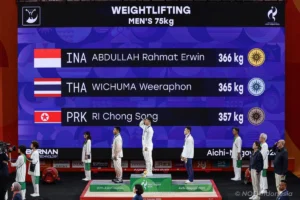
Indonesian weightlifting phenom Rahmat Erwin Abdullah delivered a performance for the ages at the 2026 Asian Games in Jakarta, clinching the gold medal in the men’s 75-kilogram category while simultaneously establishing a new world record. On Saturday, September 26, 2026, Abdullah pushed the boundaries of human strength, culminating in a combined total of 366 kilograms. This monumental achievement not only solidified his status as a premier global athlete but also provided a landmark moment for Indonesian sports history, reverberating throughout the international weightlifting community.
The Evolution of the Competition
The men’s 75-kilogram division at the 2026 Asian Games was characterized by intense parity and tactical maneuvering. From the opening moments of the snatch session, it was evident that the gold medal would be contested by a triumvirate of elite lifters: Indonesia’s Rahmat Erwin Abdullah, Thailand’s Weeraphon Wichuma, and the North Korean powerhouse Chong Song Ri.
Abdullah approached the platform with disciplined precision. He initiated his campaign with a confident lift of 155 kilograms. As the intensity mounted, he successfully transitioned to 158 kilograms in his second attempt. Showing no signs of fatigue or hesitation, he cleared 160 kilograms on his third attempt, setting a solid foundation for the clean and jerk portion of the event.
While Abdullah’s snatch performance was impeccable, he found himself in a tactical tug-of-war. Weeraphon Wichuma matched his output, creating a deadlock between the two. However, North Korean lifter Chong Song Ri established an early lead by clearing 162 kilograms, placing significant pressure on his competitors to perform under the lights of the arena.
The Clean and Jerk: A Test of Nerve
The clean and jerk session is historically where championships are won or lost, and the 2026 Asian Games proved to be no exception. As the bar weight increased, the atmosphere within the venue grew palpable. Chong Song Ri set the standard by successfully executing a 195-kilogram lift in his opening attempt, signaling his intent to defend his early lead.
Weeraphon Wichuma faced early adversity, failing his initial attempt at 200 kilograms. Displaying remarkable resilience, the Thai lifter regrouped and cleared the weight on his second attempt, maintaining his position within the medal bracket.
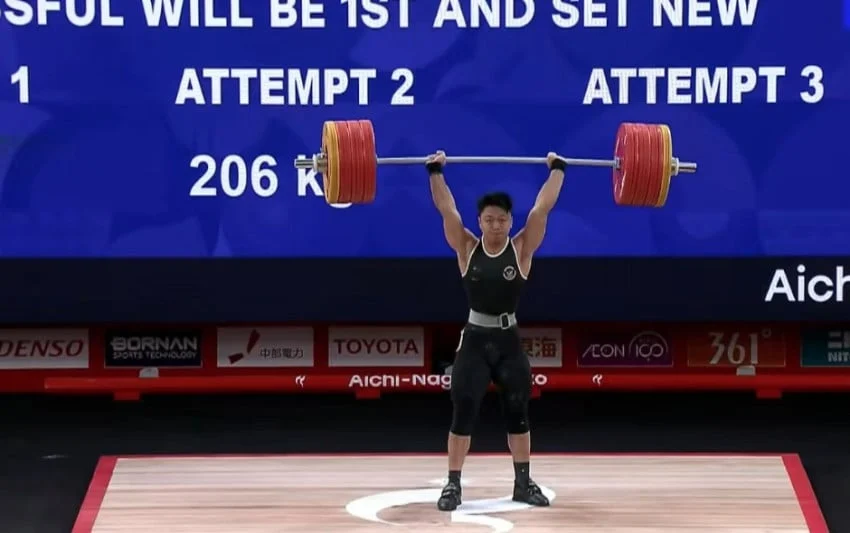
Then came the moment of truth for Rahmat Erwin Abdullah. Entering the fray at 201 kilograms, he demonstrated the technical mastery and explosive power that has defined his career. He executed the lift with textbook form, successfully locking out the bar and signaling that the gold medal was firmly within his reach. The success of this lift was the catalyst for his record-breaking trajectory, as he systematically dismantled the remaining resistance from his rivals.
A Historic Milestone in Data
The statistics surrounding Abdullah’s victory are nothing short of extraordinary. A total of 366 kilograms is a testament to years of rigorous physical conditioning and scientific training. In the context of the 75-kilogram weight class, this total represents a significant departure from previous competitive benchmarks in continental Asian weightlifting.
To understand the scale of this achievement, one must look at the progression of weightlifting records over the past decade. The 2026 Asian Games serve as a mid-point between Olympic cycles, and many athletes arrive in peak physical condition. Abdullah’s 366-kilogram total surpasses the previous world record by a margin that is statistically significant in a sport where athletes often compete for victory by mere grams.
The breakdown of his 160-kilogram snatch and 206-kilogram clean and jerk (the final lift required to reach the 366-kilogram total) highlights his versatility. Unlike many specialists who excel in only one of the two lifts, Abdullah has developed a holistic mastery of the sport, allowing him to accumulate points consistently throughout the duration of the competition.
Official Reactions and Coaching Philosophy
Following the medal ceremony, the coaching staff representing the Indonesian Weightlifting Federation expressed pride in Abdullah’s performance, noting that the victory was the result of a long-term strategic plan. "Rahmat’s success is not a coincidence," noted a team spokesperson. "It is the result of years of meticulous preparation, including specialized nutrition, psychological conditioning, and technical refinement. He approached this event with a clear understanding of the threats posed by his competitors and executed his game plan with absolute discipline."
International observers were equally effusive. Weightlifting analysts noted that Abdullah’s composure on the platform is what separates him from his peers. His ability to block out the high-stakes environment of a continental multi-sport event and focus entirely on the barbell is often cited as a benchmark for young athletes entering the sport.
Contextualizing the Asian Games Environment
The 2026 Asian Games in Jakarta have been lauded for their high level of competition and organizational success. As host nation, Indonesia has placed a significant emphasis on weightlifting, a sport in which the country has historically performed well on the international stage.
The presence of strong contingents from Thailand and North Korea underscored the regional dominance of Southeast and East Asian nations in this discipline. Weightlifting remains one of the most culturally significant sports in these regions, with government-backed training centers providing a steady pipeline of world-class talent. Abdullah’s victory in front of a home crowd serves to validate the ongoing investments in domestic sports infrastructure and youth development programs across Indonesia.
Broader Implications for International Weightlifting
The implications of Rahmat Erwin Abdullah’s world record extend far beyond the borders of Indonesia. In the international weightlifting community, the establishment of a new world record at a continental games often resets the baseline for upcoming World Championships and Olympic Games.
Competitors in the 75-kilogram division now face a new reality: the benchmark for gold has been moved significantly higher. This will undoubtedly force other nations to reevaluate their training methodologies and scouting strategies. Furthermore, the record adds to the growing debate regarding the limitations of human performance. As sports science continues to evolve, the ability to safely push for heavier lifts without incurring injury has become the primary differentiator between gold and silver medalists.
For the International Weightlifting Federation (IWF), the high performance witnessed in Jakarta is a positive indicator for the sport’s popularity and competitive integrity. Increased viewership and engagement during the 2026 Games suggest that weightlifting remains a cornerstone of the Asian Games experience, providing a spectacle of raw power that resonates with a global audience.
The Road Ahead
As the dust settles on the 2026 Asian Games, Rahmat Erwin Abdullah’s focus will inevitably shift toward the next major international cycle. Having reached the pinnacle of his division, the challenge will now be to maintain his physical peak and defend his record against an increasingly competitive field of challengers.
For Indonesia, the gold medal is more than just a victory in a weightlifting category; it is a point of national pride. Abdullah has etched his name into the annals of sporting history, becoming a figurehead for the next generation of Indonesian athletes. His journey from a promising lifter to a world-record holder is a narrative of persistence and excellence that will continue to be studied and celebrated for years to come.
In the final assessment, the 2026 Asian Games will be remembered for the day a 75-kilogram lifter changed the standard of his sport. Rahmat Erwin Abdullah did not simply win a medal; he redefined what is possible on the lifting platform, setting a standard that will serve as the north star for his contemporaries as they strive to catch up to the standard he set in Jakarta. The legacy of his 366-kilogram performance is only beginning, and the international sporting world will watch with bated breath to see if and when that record is ever challenged again.