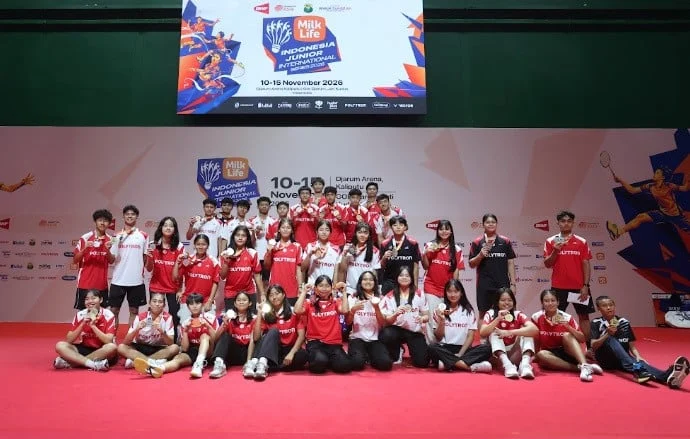
The curtain fell on the highly anticipated MilkLife Indonesia Junior International Series 2026 this past Sunday, November 15, marking a significant milestone for the development of badminton talent in the archipelago. Hosted at the state-of-the-art Djarum Arena in Kudus, Central Java, the tournament served as a crucible for young athletes, culminating in a complete sweep of all championship titles by Indonesian representatives across the U-13, U-15, U-17, and U-19 age categories. The event, which brought together promising talents from eight different nations spanning three continents, underscored Indonesia’s continued dominance in youth badminton while providing a global stage for international competition.
A Strategic Partnership for Grassroots Development
The MilkLife Indonesia Junior International Series 2026 was the result of a collaborative framework established between MilkLife, the All Indonesia Badminton Association (PBSI), and the Badminton World Federation (BWF). This initiative was designed not merely as a competition, but as a strategic development platform aimed at bridging the gap between local training centers and the international circuit. By attracting participants from various countries, the organizers sought to expose young Indonesian players to diverse playing styles, temperaments, and tactical approaches that are often absent in purely domestic tournaments.
The event’s location in Kudus—a city synonymous with the history of Indonesian badminton—provided an atmosphere conducive to high-level performance. The Djarum Arena, known for its world-class facilities, offered the necessary infrastructure to host a multi-category tournament of this scale, ensuring that the logistics met the rigorous standards set by the BWF for international junior series.
Chronology and Competitive Landscape
The tournament, which spanned several days of intense action, began with the qualification rounds, leading to the high-stakes finals on November 15. The breadth of the competition was significant, covering four age divisions for both boys and girls. The early stages saw a mixture of seasoned junior players and emerging talents, with the later rounds serving as a showcase for the tactical maturity of the finalists.
The journey to the podium for many of the champions was fraught with challenges. In the U-19 girls’ doubles final, for instance, the pairing of Atresia Naufa Candani and Aurelia Syakira Putri faced off against their own teammates, Jane Maira Faiza and Hani Miftasari. The internal rivalry between PB Djarum clubmates meant that there were no tactical secrets between the two sides. The match, which ended 21-19, 21-17, highlighted the resilience of the winners, who managed to overcome a slow start in the opening game by maintaining composure and exploiting their opponents’ unforced errors.
Similarly, in the U-17 girls’ singles, Kalia Rahmadani demonstrated the value of international experience. Her decisive victory over Erni Rusliana of PB Jaya Raya Jakarta (21-12, 21-14) served as her third major international title, adding to her previous successes in Thailand and the Pembangunan Jaya Raya tournament. For Rahmadani, the win was a testament to mental conditioning and the ability to capitalize on the psychological fatigue of her opponent.
The Rise of New Partnerships: A Case Study in Adaptation
Perhaps the most compelling narrative of the tournament emerged from the U-13 girls’ doubles category. The victory of the unseeded pair, Putri Marianasari and Bilqis Abigail Mokoginta, over the third-seeded duo of Aqila Sybil Aufa Ilham and Angelice Luigi Nathaniela, highlighted the unpredictability of junior badminton.

For many observers, the success of Marianasari and Mokoginta was particularly striking given that the tournament marked their debut as a pair. Their triumph (21-18, 21-12) was attributed to a "play-safe" strategy that forced their opponents into high-pressure scenarios, resulting in a flurry of unforced errors from the seeded favorites. This serves as a reminder of the rapid development cycle in junior badminton, where chemistry and tactical adaptability can often outweigh established rankings.
Official Perspectives and Institutional Goals
The success of the tournament was met with profound satisfaction from the organizing committee. Yuni Kartika, the Chairperson of the Organizing Committee, emphasized the importance of the event’s return after a period of dormancy. "After being absent for quite some time in Indonesia, we are grateful that this tournament was held successfully," Kartika stated. She underscored that the involvement of eight nations is merely a starting point, with the ultimate goal being to scale the event into a major fixture on the global junior calendar.
From the perspective of regional governance, Akhmad Khafidz Basri Yusuf, Chairman of the Central Java chapter of PBSI, viewed the "clean sweep" not just as a sporting achievement, but as a crucial indicator of the efficacy of current coaching and talent identification programs. "The future of Indonesian badminton is determined by our ability to prepare the next generation today," Basri Yusuf remarked. He advocated for the necessity of regular, high-frequency international competition to ensure that young players are not "shocked" when they inevitably transition into the senior ranks. By providing this exposure early, the federation aims to instill the professional habits and tactical awareness required at the elite level.
Broader Implications for Indonesian Badminton
The outcomes of the MilkLife Indonesia Junior International Series 2026 have several long-term implications for the sport in Indonesia. Firstly, it validates the "club-based" model of development, where internal competition—as seen in the U-19 girls’ doubles—is intense enough to sharpen players for international play. The ability of domestic players to dominate all categories suggests that the foundational training provided by major clubs remains world-class.
However, analysts point out that while a clean sweep is a source of national pride, the long-term goal of such tournaments is to provide a challenge that forces local players to adapt to foreign styles. The presence of players from three continents suggests that the tournament is beginning to achieve this goal, though the objective for 2027 and beyond will be to increase the diversity of the field even further. By hosting more events of this caliber, Indonesia positions itself as a hub for badminton development, reducing the need for young players to travel abroad to gain ranking points and experience.
Furthermore, the participation of international athletes provides a benchmark. When local players face international opponents, the federation can better assess where their junior talent stands compared to global standards in physical conditioning, technical precision, and mental toughness. The feedback loop created by this tournament allows coaches to adjust their training modules to address specific gaps that may have been exposed during the competition.
Conclusion and Future Outlook
The MilkLife Indonesia Junior International Series 2026 has set a high bar for future youth badminton events in the region. Through a combination of rigorous competition, high-level administrative support, and the emergence of fresh talent, the tournament has successfully reinforced Indonesia’s status as a powerhouse in the sport.
As the players return to their respective clubs and training centers, the focus shifts to the upcoming season. For champions like Atresia, Aurelia, and Kalia, the challenge will be to maintain this momentum and avoid the common pitfalls of junior careers, such as burnout or injury. For the governing bodies, the success of this year’s edition provides the mandate to continue investing in the grassroots ecosystem. The 2026 series is not merely a record of victories; it is a blueprint for the sustainable development of the next generation of Indonesian badminton icons. As the international junior circuit continues to evolve, the lessons learned in the Djarum Arena will undoubtedly serve as the foundation for the next wave of Indonesian success on the world stage.