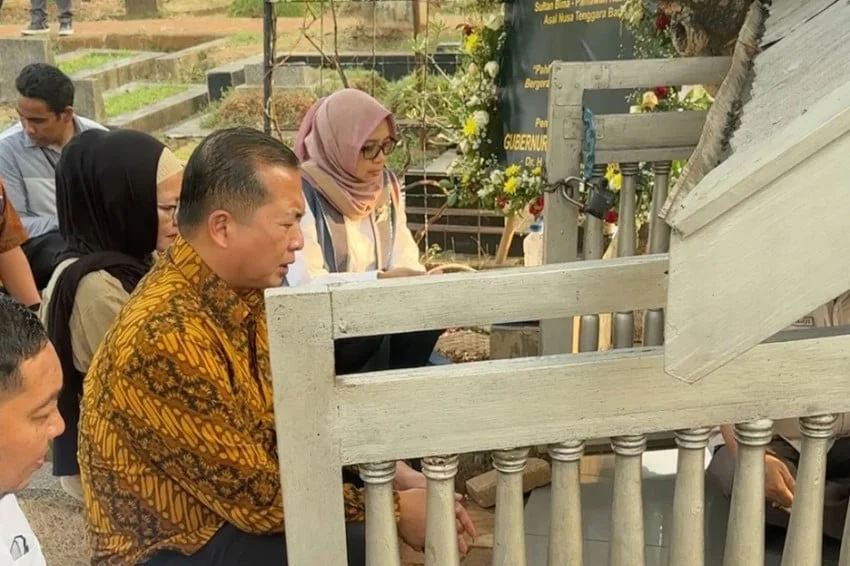
Amidst a demanding official itinerary in the nation’s capital, the Governor of West Nusa Tenggara (NTB), Lalu Muhamad Iqbal, took time out of his schedule to pay a solemn tribute at the final resting place of Sultan Muhammad Salahuddin. The pilgrimage took place at the Karet Bivak Public Cemetery located in Central Jakarta on Wednesday, November 11, 2026. This visit served as a moment of deep national reflection, honoring the legacy of the 14th Sultan of Bima, who was officially conferred the prestigious title of National Hero of the Republic of Indonesia in 2025.
The governor’s visit to the historic cemetery underscores the enduring reverence held by the people of West Nusa Tenggara for leaders who bridged the gap between traditional royal governance and the modern Indonesian republic. Accompanied by members of his administrative entourage, Governor Iqbal laid flowers and offered prayers at the grave, recognizing the profound historical sacrifices made by the late monarch during one of the most turbulent eras in the archipelago’s history.
Historical Significance and the Legacy of a Visionary Monarch
Speaking to reporters at the Karet Bivak cemetery grounds, Governor Lalu Muhamad Iqbal elaborated on the immense cultural and historical weight that Sultan Muhammad Salahuddin carries for the contemporary populace of NTB, particularly the communities residing in Bima and Dompu.
"For the people of NTB, especially in Bima, Sultan Muhammad Salahuddin is not merely a figure of royal history. He is an iconic leader who left behind an indelible legacy of struggle, sacrifice, and selfless public service that we must continuously introduce and instill in the younger generation," Governor Iqbal stated during his visit.
Sultan Muhammad Salahuddin was born in Bima on July 14, 1889, and passed away in Jakarta on July 11, 1951. His tenure as the ruler of the Sultanate of Bima spanned an impressive 36 years, from 1915 to 1951. This prolonged leadership period required extraordinary diplomatic finesse and resilience, as his reign navigated three distinct and challenging geopolitical epochs: the twilight of Dutch colonial rule, the harsh military occupation of the Japanese Empire, and the turbulent, formative years of the newly proclaimed Indonesian independence.
Unlike many traditional rulers of his time who remained insular, Sultan Salahuddin was a visionary who recognized that the future of his people depended heavily on intellectual emancipation. He became a pioneering champion of modern education within the Lesser Sunda Islands region. During his administration, Bima witnessed the establishment of formal modern educational institutions, moving away from exclusively traditional schooling models. Furthermore, he actively facilitated scholarships and opportunities for bright young minds from Bima to travel beyond their local territories to pursue advanced studies in Java and other educational hubs, planting the seeds of intellectual nationalism in the region.
Navigating Political Turmoil and Supporting the Republic
The chronological journey of Sultan Muhammad Salahuddin is intrinsically linked to the broader narrative of Indonesia’s struggle for sovereignty. When the Second World War engulfed Southeast Asia and Japanese forces displaced the Dutch administration, the Sultan had to delicately balance the welfare of his subjects with the oppressive demands of the military occupation. Despite severe constraints, he maintained social cohesion and ensured food security and administrative stability within his domain.
Following the proclamation of Indonesian independence on August 17, 1945, by Sukarno and Mohammad Hatta, the political alignment of local kingdoms across the archipelago became a critical litmus test for national unity. While some traditional rulers hesitated or were co-opted by returning colonial powers seeking to re-establish the federal state structure, Sultan Muhammad Salahuddin demonstrated unwavering foresight. He swiftly and unequivocally declared the Sultanate of Bima’s allegiance to the newly formed unitary Republic of Indonesia.
This decisive political stance helped anchor the eastern regions of the Indonesian archipelago to the republican cause, diffusing potential separatist friction and integrating local administrative structures seamlessly into the national framework. His statesmanship during the National Revolution (1945–1949) ultimately formed the cornerstone of his successful candidacy for the National Hero title decades later.
The Road to National Hero Status: Recognition in 2025
The conferment of the National Hero title upon Sultan Muhammad Salahuddin in 2025 was the culmination of years of rigorous historical research, advocacy, and administrative processing led by the regional government of NTB, academic historians, and local cultural organizations in Bima.
The process required exhaustive documentation of the Sultan’s contributions, proving beyond administrative doubt that his actions met the stringent legal criteria set by the Indonesian government for National Heroes. These criteria include a lifetime of exemplary service, acts of extraordinary courage, leadership that significantly impacted the nation’s independence or development, and an unblemished record of loyalty to the state.
When the central government officially announced the roster of new National Heroes in 2025, the inclusion of Sultan Muhammad Salahuddin was met with widespread jubilation across West Nusa Tenggara. It marked the formal elevation of a regional historical icon into the pantheon of figures who shaped the very soul of the Indonesian nation. The recognition not only validated Bima’s historical contribution to the republic but also provided educators and cultural preservationists with renewed impetus to study and promote local history within the national curriculum.
Broader Implications and Socio-Cultural Impact
Political analysts and historians observing Governor Iqbal’s pilgrimage note that such symbolic actions carry profound contemporary policy implications. In an era marked by rapid globalization and digital distraction, regional leaders face the ongoing challenge of maintaining local cultural identity while fostering national integration.
By personally visiting the grave of Sultan Muhammad Salahuddin, Governor Iqbal bridges the past with contemporary governance, signaling that modern administrative policy in NTB draws its moral strength from historical integrity. The act reinforces the narrative that regional development must be accompanied by cultural preservation and historical awareness.
Furthermore, this high-profile visit is expected to accelerate local government initiatives aimed at preserving historical sites in Bima, such as the Asri Palace (former Sultanate palace) and historical archives documenting the educational and political reforms initiated by the late Sultan. Cultural tourism centered around the heritage of the Sultanate of Bima is also anticipated to receive a boost, drawing domestic and international historians to explore the eastern Indonesian contribution to the national independence movement.
As the commemoration of national figures continues to evolve in Indonesia, the legacy of Sultan Muhammad Salahuddin stands as a testament to the fact that the republic was built through a mosaic of localized struggles, where traditional monarchs could simultaneously be modern nationalists, educators, and steadfast defenders of popular sovereignty. Governor Lalu Muhamad Iqbal’s visit to Karet Bivak ensures that this vital chapter of Indonesia’s historical consciousness remains vibrant, respected, and continuously passed down to future generations.