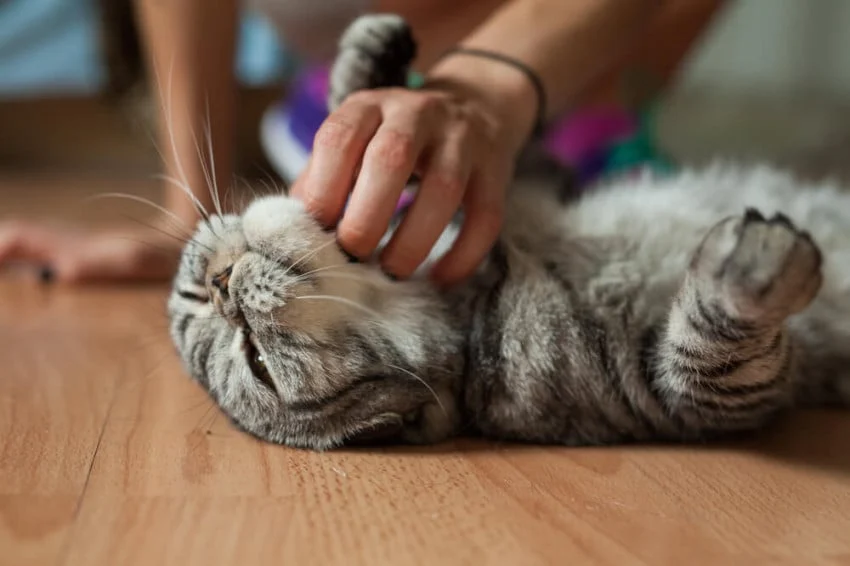
The domestic cat, a creature that has lived alongside humans for thousands of years, remains a study in evolutionary contradictions. While they are cherished companions, their behavioral patterns often baffle even the most dedicated owners. One of the most common points of friction in the human-feline relationship is the feline aversion to having their bellies, paws, or tails touched. Unlike their canine counterparts, which often solicit belly rubs as a sign of submission or enjoyment, cats frequently react to such tactile engagement with withdrawal or, in more extreme cases, aggression. This article explores the biological, evolutionary, and psychological underpinnings of this behavior, supported by experts in animal behavior.
The Evolutionary Imperative: Predators and Prey
To understand why a cat recoils from a belly rub, one must first look at their ancestral history. Sarah Ellis, head of cat mental health and welfare at International Cat Care, emphasizes that the domestic cat’s behavior is deeply rooted in its status as both a predator and a prey animal. In the wild, small felids occupy a delicate position in the food chain. Unlike larger apex predators, smaller cats are constantly at risk of being hunted by larger carnivores.
The belly is the most vulnerable part of a mammal’s anatomy. It houses vital organs—the stomach, liver, intestines, and kidneys—that are not shielded by the protective cage of the ribs, unlike the heart and lungs. In the evolutionary timeline, a cat that allowed its abdomen to be exposed or touched by another creature was, in essence, compromising its own survival. This instinct remains hardwired in the domestic house cat today, regardless of how safe their indoor environment may be. Even a well-fed, pampered indoor cat retains the reflex to guard its underside as a matter of ancestral survival.
The Anatomy of the Primordial Pouch
Beyond the visceral need to protect internal organs, there is a specific anatomical feature that dictates how a cat perceives touch in this region: the primordial pouch. This is the loose, sagging layer of skin and fat located on the belly, which is often mistaken by owners for obesity. This feature is not merely a fat deposit; it serves a functional purpose.
The primordial pouch allows for extreme skin elasticity, enabling the cat to stretch and contort its body while running, jumping, or fighting. If a predator manages to grab the cat by the belly, this loose skin allows the cat to twist its body and strike back with its hind claws, a defensive maneuver essential for survival in the wild. When a human touches this area, they are interfering with a region that the cat has evolved to keep flexible and ready for defensive action. The sensation of being "pinned" or held in this sensitive area can trigger an immediate, involuntary defensive response.
Behavioral Indicators and the Escalation Timeline
Professor Mikel Delgado, an expert in cat behavior at Purdue University, notes that cats rarely resort to aggression without warning. The escalation of feline displeasure follows a specific timeline, often missed by owners who mistake a cat’s recumbency for an invitation to touch.
- Initial Warning: The cat may stop purring or stiffen its posture.
- Avoidance: The cat may turn its head away, look directly at the offending hand, or attempt to move out of reach.
- Active Defense: If the human continues, the cat may use its limbs to push the hand away, often using its claws as a deterrent.
- Aggression: If all prior warnings are ignored, the cat may resort to hissing, biting, or a swift, forceful scratch to end the interaction.
The transition from a "relaxed" cat to an aggressive one can happen in a matter of seconds. It is a misconception that cats are "moody" or "unpredictable." In reality, they are communicating discomfort clearly, but humans often lack the literacy to interpret the subtle shift in ear position, tail twitching, or pupil dilation that precedes a bite.
Statistical Insights into Feline Welfare and Ownership
Recent studies into feline-human interactions suggest that the misunderstanding of these boundaries is a leading cause of stress in household cats. According to data from the American Association of Feline Practitioners (AAFP), a significant percentage of behavioral consults for aggression are linked to "petting-induced aggression."
When owners force interactions that the cat does not desire, the bond between the animal and the human is weakened. Research conducted by Nottingham Trent University in 2021 indicated that cats allowed to initiate contact and dictate the duration of social interactions showed significantly lower cortisol levels (the stress hormone) compared to those who were subjected to uninvited physical handling. The data suggests that for the average domestic cat, "less is more" when it comes to physical touch, particularly in areas like the belly and tail.
Scientific Perspectives on Tactile Sensitivity
The feline nervous system is highly sensitive to tactile stimulation. Cats possess specialized nerve endings called mechanoreceptors that are distributed densely around their faces and backs, but the skin on the belly is more sensitive to pressure and temperature changes. When a human rubs a cat’s belly, they are often applying pressure that the cat interprets as an attempt to restrict movement or a threat to its safety.
Furthermore, cats use scent glands on their cheeks, lips, and ears to establish territory and social bonds. These areas are generally the only parts of the body where a cat truly enjoys being petted. By focusing affection on these "safe" zones, owners can satisfy their desire for interaction while respecting the cat’s biological boundaries.
The Impact on Veterinary Care and Handling
The aversion to belly contact has significant implications for veterinary medicine. Routine physical examinations, which require palpation of the abdomen, are often the most stressful part of a vet visit for a cat. Because the cat has been conditioned to view belly contact as an invasion, the veterinary professional must employ "fear-free" handling techniques.
These techniques involve the use of calming pheromones, minimal restraint, and allowing the cat to remain in positions where they feel secure. Veterinary organizations are increasingly educating staff on how to read feline body language to prevent the "fight-or-flight" response that occurs when a cat feels trapped during an examination. Understanding that this is not "naughty" behavior, but a natural physiological response to a perceived threat, is critical for both clinicians and pet owners.
Broader Implications for Animal-Human Bonds
The modern view of pet ownership is shifting toward a more empathetic model that prioritizes animal consent. Recognizing that a cat’s belly is a "no-go zone" is a vital component of responsible ownership. When an owner respects the cat’s boundaries, the animal is more likely to develop a trusting relationship, often leading to more frequent, voluntary social interactions.
Conversely, ignoring these boundaries can lead to a cycle of anxiety. If a cat learns that its warnings—stiffening, turning away, or growling—are ignored, it may feel forced to escalate directly to biting to achieve the desired space. This creates a dangerous environment for the human and a high-stress environment for the cat.
Conclusion: Redefining Affection
The relationship between humans and cats is unique, characterized by a level of independence that is not found in other domestic pets. The fact that cats do not like their bellies touched is not a flaw; it is a testament to their evolutionary success as highly adapted predators.
By acknowledging the scientific reality behind this behavior, owners can move away from anthropomorphizing the cat—expecting them to behave like dogs—and instead appreciate the cat’s natural behavioral repertoire. Education remains the primary tool for improving the welfare of household cats. As more pet owners become aware of the evolutionary context of their pets’ preferences, the prevalence of stress-related behavioral issues is likely to decline.
The next time a cat rolls onto its back, one should view it not as a request for a belly rub, but as an expression of trust and relaxation—a compliment that should be honored by keeping one’s hands at a respectful distance, or perhaps opting to pet the cat’s cheeks instead. Understanding the "why" behind the behavior is the first step in fostering a harmonious and stress-free domestic environment for both species. Through patience, observation, and respect for the cat’s natural instincts, the human-feline bond can be strengthened in a way that respects the biological autonomy of the animal.