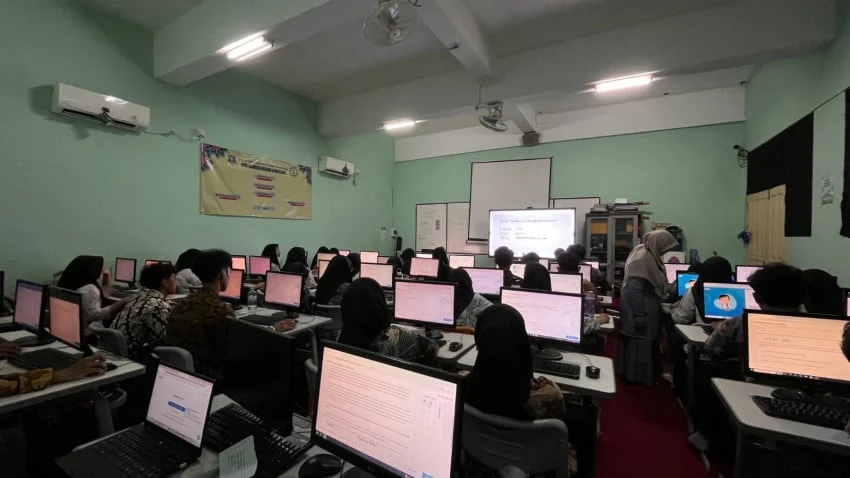
The provincial education landscape in Banten, Indonesia, has recently undergone a significant technological shift as PT Telkom Indonesia (Persero) Tbk, through its digital education arm PIJAR, facilitated a massive Computer Based Test (CBT) initiative for the region’s senior secondary students. This deployment, executed in collaboration with the Banten Provincial Education and Culture Office, represents one of the most substantial digital assessment exercises in the region, involving over 84,000 students across 570 educational institutions. By transitioning traditional academic capability assessments into a secure, centralized digital environment, Telkom and the local government aim to standardize evaluation metrics and prepare students for the rigorous demands of national-level examinations.
The Scope and Scale of the Digital Initiative
The Try Out for the Academic Ability Test (TKA) serves as a critical benchmark for high school (SMA) and vocational school (SMK) students in Banten. Historically, such assessments were plagued by logistical challenges, including physical paper distribution, manual scoring delays, and security risks during the exam process. By leveraging the PIJAR platform, the provincial government has successfully moved these processes into a cloud-based environment.
The scale of this implementation is notable. With 84,000 participants spread across 570 schools, the infrastructure required to maintain stability during peak login times is substantial. The PIJAR platform was selected not only for its scalability but for its ability to handle concurrent traffic, ensuring that the integrity of the data remains intact while minimizing latency for students in diverse geographical locations—ranging from the urban centers of Tangerang to more remote districts within the province.
Chronology of the Digital Assessment Implementation
The initiative follows a strategic roadmap developed by the Banten Education Office to modernize the regional curriculum evaluation process. The timeline of this collaboration can be broken down into three distinct phases:
- Preparation and Infrastructure Setup: Before the event, Telkom conducted a comprehensive assessment of the digital readiness of participating schools. This phase involved verifying internet connectivity, ensuring device compatibility, and performing load tests on the PIJAR platform to prevent potential server crashes.
- Pilot Integration and Training: Prior to the province-wide launch, a select group of schools participated in a pilot program to identify common user interface (UI) issues. Teachers were trained on how to manage the dashboard, monitor student progress in real-time, and troubleshoot common login issues.
- Deployment and Execution: The main event was carried out over a scheduled period, during which students accessed the TKA portal under the supervision of their respective school coordinators. The PIJAR system logged every entry, submission, and status change, providing a granular look at student performance metrics.
Technological Sophistication: Anti-Cheating and Monitoring
At the core of the PIJAR platform’s utility are its security features, which address the primary concern of digital testing: academic integrity. The platform integrates a sophisticated "anti-cheating" protocol. When a student attempts to navigate away from the test window or open external applications, the system triggers an isolation mechanism. This feature effectively freezes or flags the device, forcing the student to re-authenticate or requiring intervention from a proctor.
Furthermore, the real-time monitoring dashboard provides school administrators with a bird’s-eye view of the examination room. Teachers can identify which students are experiencing connectivity issues, who has completed the exam, and which questions are causing the most difficulty. This data-driven approach transforms the role of the teacher from a mere invigilator to an active monitor who can provide immediate support, thereby reducing the stress associated with technical failures.
Perspectives from Educational Stakeholders
The implementation of PIJAR has drawn positive feedback from the field, particularly from institutions that have previously struggled with inconsistent software solutions. Muhammad Imam Darmawan, an Informatics teacher at SMA Muhammadiyah 2 Tangerang, highlighted that while minor issues occurred—largely attributed to user error such as incorrect password inputs—the overall transition was remarkably smooth.
"We have utilized various third-party assessment tools in the past, but PIJAR addresses the gaps that we found in earlier iterations," Darmawan noted. His feedback underscores a critical point in digital education: teachers are looking for platforms that are not only functional but also intuitive enough to minimize the technical barrier for students.
From an administrative standpoint, Mumtahina, the Deputy Head of Facilities and Infrastructure at the same school, emphasized the value of the platform’s control features. For school administrators, the ability to manage the examination environment and audit student activity during the test provides a level of oversight that was previously unattainable in decentralized testing environments. By allowing schools to take direct action on flagged activities, PIJAR empowers institutions to uphold their own internal standards of discipline.
Strategic Vision: Beyond Simple Digitization
Kharim I. G. Siregar, the Director of IT Digital at Telkom, has articulated a broader vision for this partnership. He posits that the digitization of education is a multi-layered endeavor. It is not sufficient to simply move a paper test onto a screen; the technology must actively improve the pedagogical process.
"Digitalization in education should not merely be about the introduction of technology, but about how that technology enables schools to conduct learning and assessment processes that are more effective, secure, and measurable," Siregar stated. This philosophy suggests that Telkom is positioning PIJAR as an ecosystem, rather than a single-use tool. By generating large datasets of student performance, the platform can eventually be used to conduct predictive analytics, helping teachers identify students who may need additional academic support long before they reach their final examinations.
Analysis of Broader Implications for Indonesian Education
The success of the Banten TKA initiative carries significant implications for the national education strategy. As Indonesia moves toward a more digitized academic framework, the lessons learned from this large-scale deployment are invaluable.
Data-Driven Policy Making
The ability to aggregate data from 84,000 students in real-time provides the Banten Education Office with unprecedented insights into the academic health of the region. Policy makers can now identify trends—such as subjects where students consistently underperform—and adjust training or curriculum resources accordingly. This shifts the provincial government from a reactive stance to a proactive, data-informed strategy.
Bridging the Digital Divide
While the initiative was successful, it also serves as a diagnostic tool for the digital divide. Schools that struggled with stable connectivity or hardware requirements are now clearly identified in the system’s logs. This data allows the provincial government to prioritize infrastructure grants and internet upgrades for schools that need them most, ensuring that the digital transition does not exacerbate existing educational inequalities.
The Evolution of the Assessment Model
The shift to CBT platforms like PIJAR reflects a wider trend in the global education sector. As artificial intelligence and machine learning continue to evolve, the capacity for these platforms to provide personalized feedback—where the difficulty of the test adjusts based on the student’s ability (Adaptive Testing)—becomes a feasible next step. By establishing a robust digital foundation today, Banten is positioning its schools to adopt these advanced capabilities in the near future.
Conclusion: A Collaborative Future
The collaboration between Telkom and the Banten Provincial Education and Culture Office serves as a blueprint for public-private partnerships in the education sector. By combining Telkom’s technical infrastructure with the regulatory and operational expertise of the local government, the initiative has successfully demonstrated that large-scale digital transformation is both achievable and beneficial.
As the program moves forward, the ongoing challenge will be the long-term maintenance of the system and the continued professional development of teachers. The success of digital tools is ultimately tied to the competency of the educators who wield them. With the positive reception of the PIJAR platform’s initial rollout, there is a clear mandate for continued investment in digital literacy and infrastructure. This initiative is a testament to the fact that when technology is purpose-built to address the specific pain points of educational institutions—security, scalability, and ease of use—it can profoundly enhance the quality and reliability of student assessment.