On May 20, 1998, a pivotal moment in Indonesia’s modern history unfolded as 14 ministers collectively tendered their resignations from the Seventh Development Cabinet (Kabinet Pembangunan VII). This unprecedented mass defection, occurring in the throes of a devastating economic crisis and intense political upheaval, served as a decisive catalyst that dramatically accelerated the downfall of President Soeharto’s three-decade-long authoritarian regime. The act of defiance by these key government officials underscored a profound loss of confidence in Soeharto’s ability to navigate the nation out of its multifaceted crises, signaling to both domestic and international observers that the New Order era was drawing to an inevitable close. This historical event, revisited through the lens of CNBC Insight, offers crucial lessons in understanding the dynamics of political transitions and the imperative of robust disaster mitigation, even in the face of profound systemic challenges.
Indonesia on the Precipice: The Asian Financial Crisis and Its Devastating Impact
The backdrop to this dramatic political development was the devastating Asian Financial Crisis (AFC), which had begun to sweep across Southeast Asia in mid-1997. Indonesia, heavily reliant on foreign capital and suffering from systemic weaknesses, including a fragile banking sector and rampant corruption, was particularly vulnerable. The crisis began with a sharp devaluation of the Thai baht in July 1997, quickly spreading to other regional economies. For Indonesia, the rupiah, which had traded around Rp 2,500 to the US dollar for years, entered a freefall, plummeting to over Rp 15,000 by early 1998—a depreciation of more than 500%.
This currency collapse triggered a cascade of economic catastrophes. Businesses, many heavily indebted in US dollars, faced immediate bankruptcy as their liabilities multiplied overnight. Banks struggled with non-performing loans, leading to a liquidity crunch and widespread insolvencies. The Jakarta Stock Exchange crashed, wiping out billions in market value. The nation’s Gross Domestic Product (GDP) contracted by a staggering 13.1% in 1998, pushing millions into poverty. Inflation soared, reaching an annual rate of 77.6% by December 1998, making basic necessities unaffordable for many ordinary Indonesians. Unemployment skyrocketed as companies laid off workers en masse.
The government’s initial responses were widely perceived as inadequate and inconsistent. Despite receiving a multi-billion dollar bailout package from the International Monetary Fund (IMF) in October 1997 and a subsequent, more stringent agreement in January 1998, the prescribed structural reforms, including banking sector consolidation and subsidy cuts, were met with resistance and skepticism. Many viewed Soeharto’s administration as unwilling or unable to implement the necessary changes due to entrenched cronyism and a lack of transparency. The crisis exposed the deep-seated vulnerabilities of Indonesia’s economic model, revealing how decades of unchecked power and patronage had created a brittle system unable to withstand external shocks.
A Nation in Turmoil: Escalating Protests and Demands for Reform
Beyond the economic meltdown, Indonesia was simultaneously grappling with an escalating political crisis. For over three decades, Soeharto’s New Order regime had maintained stability through a combination of economic development and strict political control, suppressing dissent and limiting democratic freedoms. However, the economic crisis shattered the implicit social contract where stability and prosperity were exchanged for political quietude. As economic hardship deepened, public frustration boiled over, fueling widespread social unrest and demands for fundamental political change.
Student movements, long a critical voice against the New Order, re-emerged with renewed vigor. Universities across the archipelago became hotbeds of protest, with students demanding Soeharto’s resignation, an end to corruption, collusion, and nepotism (KKN), and the implementation of democratic reforms. These protests, initially peaceful, grew in size and intensity throughout early 1998. The re-election of Soeharto for a seventh consecutive term in March 1998, in an election widely seen as a mere formality, only served to exacerbate public anger and disillusionment.
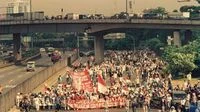
The situation reached a tragic boiling point on May 12, 1998, when security forces opened fire on student protesters at Trisakti University in Jakarta, killing four students. This brutal act ignited unprecedented outrage, triggering widespread riots, looting, and arson across Jakarta and other major cities from May 13-15. These riots, which targeted ethnic Chinese communities and caused significant loss of life and property damage, plunged the nation into a state of near-anarchy. The government’s inability to control the escalating violence further eroded its legitimacy and control, demonstrating the profound breakdown of order. As the capital descended into chaos, hundreds of thousands of students occupied the parliamentary complex (DPR/MPR building) from May 18, transforming it into a symbolic center of resistance and demanding Soeharto’s immediate resignation. The military, which had been the backbone of Soeharto’s power, appeared increasingly hesitant to use full force against the protesters, further isolating the beleaguarto.
The Ill-Fated Cabinet: Kabinet Pembangunan VII
It was into this maelstrom of economic collapse and political unrest that President Soeharto had, just two months prior, formed his Seventh Development Cabinet (Kabinet Pembangunan VII) on March 14, 1998. This cabinet, comprising 36 ministers, was intended to project an image of continuity and stability, despite the tumultuous environment. Many of its members were technocrats and professionals, some with international experience, tasked with steering the nation through the economic crisis. However, its formation was met with skepticism from the public and international community, who questioned its capacity to enact meaningful reforms under Soeharto’s continued leadership.
Among the key figures in this cabinet was Ginandjar Kartasasmita, the Coordinating Minister for Economy, Finance, and Industry. Ginandjar, a respected economist, found himself at the forefront of the government’s attempts to address the economic crisis. Yet, the cabinet’s brief existence was marked by a deepening sense of despair and the growing realization among its members that the root causes of the crisis—political legitimacy and public trust—could not be solved by economic policies alone, especially not under a leadership that had lost its mandate.
The Pivotal Meeting at Bappenas
The crucial turning point came on May 19, 1998, when Ginandjar Kartasasmita convened an urgent meeting at the National Development Planning Agency (Bappenas) building in Jakarta. The meeting brought together a diverse group of ministers, prominent journalists, and leading business figures. As documented in his book, Managing Indonesia’s Transformation (2013), Ginandjar described the atmosphere as grim, filled with a shared sense of urgency and foreboding.
During the discussion, Ginandjar presented a stark and unvarnished assessment of the national economy. He laid bare the gravity of the situation, warning that Indonesia was on the brink of total collapse if the current trajectory was allowed to continue unchecked. The data, the analysis, and the testimonies from business leaders painted a dire picture: the economy was spiraling downwards, social order was fracturing, and the political system was paralyzed.
The consensus among the majority of those present was clear and unanimous: Indonesia was heading towards an economic and political crisis with no discernible way out under the existing leadership. The only dissenting voice came from Minister of Agrarian Affairs/Head of BPN, Ary Mardjono, who reportedly held a differing view on the severity of the situation or the appropriate course of action. However, his opinion was largely overshadowed by the overwhelming sentiment of despair and the urgent need for radical change.
It was in this charged atmosphere that Ginandjar Kartasasmita made his momentous decision. He declared his intention to resign from the cabinet, a move that sent shockwaves through the room. His decision was not made lightly; it was a deeply personal and professional judgment that the cabinet, as constituted, and the leadership it served, were no longer capable of resolving the nation’s predicament. This bold declaration catalyzed a chain reaction among his peers.
The Collective Resignation: A Blow to Soeharto’s Authority
Following Ginandjar’s lead, one by one, other ministers began to express their solidarity and their own intentions to resign. The wave of resignations grew throughout the day, culminating in a collective announcement on May 20, 1998, where 14 ministers publicly declared their withdrawal from the Seventh Development Cabinet. This was not merely a protest; it was a calculated political maneuver by senior officials who understood the immense symbolic and practical weight of their actions.
The group of resigning ministers represented a cross-section of the cabinet, including key economic portfolios and influential political figures. They were:
- Akbar Tandjung (Minister of Public Housing)
- A.M. Hendropriyono (Minister of Transmigration and Forest Squatters Resettlement)
- Giri Suseno Hadihardjono (Minister of Mines and Energy)
- Haryanto Dhanutirto (Minister of Communications)
- Ginandjar Kartasasmita (Coordinating Minister for Economy, Finance, and Industry)
- Kuntoro Mangkusubroto (Minister of State for Mines and Energy/Director of Pertamina)
- Justika Baharsjah (Minister of Social Affairs)
- Rachmadil Bambang Sumadhijo (Minister of Trade and Industry)
- Rahardi Ramelan (Minister of State for Food and Horticulture/Head of BULOG)
- Subiakto Tjarawerdaya (Minister of Cooperatives and Small and Medium Enterprises)
- Sanyoto Sastrowardoyo (Minister of State for Investment/Head of BKPM)
- Sumahadi (Minister of Forestry and Plantations)
- Theo L. Sambuaga (Minister of State for Public Housing and Settlement)
- Tanri Abeng (Minister of State for State-Owned Enterprises Empowerment)
In their joint statement, these 14 ministers unequivocally stated that "the formation of a new cabinet would not solve the root problems of the crisis." This declaration was a damning indictment of Soeharto’s leadership. It conveyed a powerful message: the crisis was not merely economic or social, but fundamentally political, stemming from a profound crisis of confidence in the top leadership. The elite within the government itself had lost faith, making it clear that a superficial cabinet reshuffle or cosmetic changes would be insufficient to restore stability or trust.
Soeharto’s Reaction and Failed Counter-Measures
The collective resignation blindsided President Soeharto. According to historian Robert Edward Elson in Soeharto: A Political Biography (2017), the mass defection was entirely "outside Soeharto’s political calculations." At that very moment, Soeharto was still attempting to cling to power, reportedly planning to announce a "Cabinet Reformasi" (Reform Cabinet) on May 21, 1998, in a desperate bid to regain legitimacy and placate the surging demands for change. The resignations, therefore, not only preempted his move but also stripped it of any potential credibility.
An attempt to avert the mass resignation was reportedly made by then-Vice President B.J. Habibie. In his memoir, Detik-detik yang Menentukan (Decisive Moments, 2006), Habibie revealed that he had personally appealed to the ministers to remain in their posts, emphasizing the importance of continuity during a national crisis. However, the ministers’ decision was firm and irrevocable. Their resolve underscored the depth of their conviction that Soeharto’s continued leadership was no longer tenable for the nation’s future. The refusal to reconsider, even at the request of the Vice President, highlighted the unbridgeable chasm that had opened between So President and a significant portion of his own government.
The Final Days: Habibie’s Role and Soeharto’s Departure
The loss of support from these key ministers, coupled with the relentless pressure from student protests, public unrest, and a deteriorating economy, rendered Soeharto’s position utterly unsustainable. The once unshakeable foundation of his power had crumbled. The military, which had been his primary pillar of support for decades, was also showing signs of wavering, unable or unwilling to fully suppress the widespread dissent.
Barely 24 hours after the mass resignations, on the morning of May 21, 1998, Soeharto appeared on national television from the Merdeka Palace. With a somber expression, he announced his immediate resignation as President of the Republic of Indonesia. He formally handed over the presidency to Vice President B.J. Habibie, bringing an abrupt end to his 32-year reign, an era commonly known as the New Order. The announcement was met with a mix of relief, jubilation, and uncertainty across the nation. The streets that had been filled with protesters and riot police suddenly erupted in celebration.
Aftermath and the Dawn of Reformasi
Soeharto’s resignation marked the official beginning of the Reformasi (Reformation) era in Indonesia. The transition was far from smooth, with significant challenges ahead. B.J. Habibie, thrust into the presidency, faced the daunting task of stabilizing a fractured nation, restoring economic confidence, and initiating democratic reforms while grappling with the lingering influence of the New Order and widespread public distrust.
Among Habibie’s immediate actions were the release of political prisoners, the lifting of restrictions on the press, and the promise of free and fair elections. He moved swiftly to address the economic crisis, implementing IMF-mandated reforms and establishing new institutions to tackle corruption. His government also took steps to address long-standing regional grievances, notably authorizing a referendum on independence for East Timor in 1999.
The ministers who resigned played varied roles in the subsequent years. Some continued to be active in politics, serving in later cabinets or in parliament, while others moved into business or academia. Ginandjar Kartasasmita, for instance, became a prominent figure in the post-Soeharto era, continuing his work in economic development and reform. Their collective action, though initially seen as an act of personal integrity, profoundly reshaped Indonesia’s political landscape, paving the way for a more democratic and open society.
Legacy and Lessons Learned
The events of May 1998 stand as a powerful testament to the fragility of authoritarian rule when faced with a combination of economic crisis, popular unrest, and the erosion of elite support. The collective resignation of the 14 ministers was more than just a symbolic gesture; it was a concrete act that removed a critical layer of administrative and political legitimacy from Soeharto’s regime. It sent an unmistakable signal to the military, the international community, and the Indonesian people that the system was no longer viable.
The crisis underscored the vital importance of good governance, transparency, and accountability. The devastating economic and social costs of the 1998 crisis served as a stark reminder of how unchecked power, corruption, and a lack of institutional resilience can quickly unravel decades of progress. For Indonesia, the path to democracy has been complex and challenging, but the events of May 1998 laid the groundwork for a more pluralistic political system, characterized by regular elections, greater freedom of expression, and a stronger emphasis on human rights.
The legacy of the 1998 crisis and Soeharto’s fall continues to shape Indonesia’s political discourse, emphasizing the ongoing need for robust democratic institutions and effective disaster mitigation strategies—not just for natural calamities, but also for political and economic upheavals. The courage of those 14 ministers, who chose to stand down in a moment of profound national crisis, remains a powerful symbol of integrity and a reminder that even within authoritarian structures, the seeds of change can be sown through collective action and a commitment to the nation’s greater good.