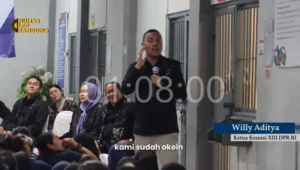
JAKARTA – The Indonesian Corruption Eradication Commission (KPK) has confirmed the return of luxury vehicles, including a BAIC BJ40 Plus SUV, to Immanuel Ebenezer, the former Deputy Minister of Manpower (Wamenaker), after he fully settled the court-mandated fines and restitution payments totaling over IDR 3.6 billion. The decision, announced by KPK Spokesperson Budi Prasetyo on Tuesday, July 21, 2026, underscores the legal mechanism for asset recovery in corruption cases once financial obligations are met, even for convicted individuals.
The return of the assets comes less than a month after the verdict against Ebenezer, widely known as Noel, became legally binding on June 4, 2026. Noel had been sentenced to four years and six months in prison, a fine of IDR 200 million, and a restitution payment of IDR 3.435 billion for his involvement in an extortion scheme related to occupational safety and health (K3) certification.
"The convict has fully paid the criminal fine of IDR 200 million and has also fulfilled the obligation to pay restitution amounting to IDR 3.435 billion in less than one month, in accordance with the court’s decision," Budi Prasetyo stated. He further clarified that, "In connection with the fulfillment of all restitution payment obligations by the convict, the BAIC BJ40 Plus car, which was previously stated in the court’s verdict to be confiscated for the state and calculated as part of the restitution payment, has now been returned to the convict in accordance with the provisions of the court’s decision because the person concerned has settled all obligations." This development highlights a crucial, albeit often debated, aspect of Indonesia’s anti-corruption legal framework: the conditions under which confiscated assets can be returned.
Understanding the Corruption Case: The K3 Certification Scandal
The case against Immanuel Ebenezer revolved around allegations of extortion linked to the processing of Occupational Safety and Health (K3) certifications. K3 certification is a critical regulatory requirement in Indonesia, designed to ensure safe working conditions and minimize workplace hazards across various industries. Companies must comply with K3 standards and often require certifications for their operations, equipment, and personnel. The process typically involves audits, inspections, and approvals from relevant government bodies or authorized institutions.
The very nature of K3 certification, being mandatory and crucial for business operations, makes it a vulnerable point for corruption. Officials in positions of power can exploit the bureaucratic process, demanding illicit payments in exchange for expedited approvals, favorable assessments, or simply to avoid delays and complications. Ebenezer, as Deputy Minister of Manpower, held a significant position that could directly or indirectly influence K3 certification processes, making him capable of orchestrating or facilitating such an extortion scheme.
The specific details of the extortion scheme, as revealed during the trial, likely involved Noel or his associates leveraging his authority to pressure companies or individuals seeking K3 certifications into making unofficial payments. These payments would bypass official channels and enrich the perpetrators, undermining the integrity of the K3 system and potentially compromising workplace safety standards if certifications were granted improperly. The amount of restitution, IDR 3.435 billion, suggests a substantial scale of illegal gains from this illicit activity. This case serves as a stark reminder of how corruption can permeate essential regulatory frameworks, impacting not only economic fairness but also public safety.
Profile of Immanuel Ebenezer: From Activist to Convict
Immanuel Ebenezer, often referred to as Noel, had a notable public profile before his conviction. He was known as a political activist and a prominent figure in various social and political movements in Indonesia. His career trajectory saw him transition from civil society engagement to a significant government role, culminating in his appointment as Deputy Minister of Manpower. This position placed him within the executive branch, responsible for assisting the Minister in formulating and implementing policies related to labor and employment, including critical areas like K3.
Ebenezer’s appointment to such a high-ranking position was a reflection of his perceived influence and connections within the political landscape. However, his tenure was marred by the corruption allegations that eventually led to his downfall. His case underscores the challenges of maintaining integrity in public office, particularly for individuals who transition from activist roles, where they might have advocated against corruption, into positions of power. The public often holds such figures to higher standards, making their involvement in corruption cases particularly damaging to public trust. His journey from a seemingly principled public figure to a convicted official highlights the pervasive nature of corruption and the constant vigilance required to combat it.
Chronology of Events Leading to Asset Return
The journey from investigation to the return of assets for Immanuel Ebenezer followed a precise legal and procedural timeline:
- Investigation and Designation as Suspect: While the exact date of the initial investigation is not provided, it can be inferred that the KPK began its inquiry into the K3 certification extortion allegations sometime prior to Noel being named a suspect. This phase would have involved intelligence gathering, witness interviews, and collection of preliminary evidence.
- Arrest and Detention (Inferred): Once sufficient evidence was gathered, Noel would have been arrested and detained, a standard procedure for high-profile corruption suspects in Indonesia, to prevent flight and obstruction of justice.
- Trial Proceedings: The case then moved to the anti-corruption court. The trial would have involved multiple sessions, presenting evidence from both the prosecution (KPK) and the defense, including witness testimonies, forensic evidence, and expert opinions. This is typically a lengthy process, often spanning several months.
- Verdict and Sentencing (June 4, 2026): On June 4, 2026, the court delivered its verdict, finding Immanuel Ebenezer guilty. He was sentenced to four years and six months imprisonment, a fine of IDR 200 million, and ordered to pay restitution of IDR 3.435 billion. Crucially, the court also ordered the confiscation of certain assets, including the BAIC BJ40 Plus, to be calculated towards the restitution payment if not fully paid.
- Legal Force (Inkracht): The verdict became legally binding (inkracht) on the same date, June 4, 2026. This means all appeals processes, if any were pursued, had been exhausted or the deadline for appeal had passed without action, making the judgment final and enforceable.
- Payment of Fines and Restitution (Before July 4, 2026): According to KPK, Noel paid the full IDR 200 million fine and the IDR 3.435 billion restitution in "less than one month" after the verdict became legally binding. This means the payment was made sometime between June 4, 2026, and early July 2026. This swift payment was a key factor in the subsequent return of assets.
- Return of Assets (July 21, 2026): With all financial obligations met, the KPK proceeded with the return of the confiscated assets, including the BAIC BJ40 Plus, on July 21, 2026. This action was a direct consequence of Noel fulfilling the court’s financial requirements.
This detailed chronology illustrates the meticulous process by which the Indonesian legal system handles corruption cases, from prosecution to the enforcement of sentences and the management of confiscated assets.
KPK’s Mandate and the Dynamics of Asset Recovery

The Komisi Pemberantasan Korupsi (KPK) or Corruption Eradication Commission is Indonesia’s primary anti-graft agency, established in 2002 following widespread public demand for a dedicated body to tackle systemic corruption. Its mandate is broad, encompassing investigation, prosecution, and prevention of corruption, with significant powers to wiretap, arrest, and detain suspects. The KPK has been instrumental in prosecuting numerous high-profile corruption cases involving government officials, politicians, and businesspeople, earning a reputation for its independence and effectiveness.
Asset recovery is a critical component of the KPK’s mission. Beyond punishing corrupt individuals, the agency aims to reclaim illicit gains and return them to the state, thereby mitigating the financial damage caused by corruption. The Indonesian Anti-Corruption Law (Law No. 31 of 1999 as amended by Law No. 20 of 2001) explicitly provides for the confiscation of assets derived from corruption. The concept of "uang pengganti" or restitution payment, as seen in Noel’s case, is a legal mechanism to ensure that convicts pay back the amount of state losses or illicit wealth they acquired through corrupt acts.
In cases where convicts fail to pay the restitution, the state has the right to confiscate and auction off their assets to cover the amount. However, if the convict makes the full payment, as Noel did, the assets that were initially earmarked for confiscation and sale to cover the restitution are then returned. This legal provision serves multiple purposes: it incentivizes convicts to fulfill their financial obligations quickly, reduces the burden on state agencies to manage and liquidate confiscated assets, and ensures that the state ultimately recovers the ill-gotten gains. While some might view the return of luxury cars to a convicted corrupt official as lenient, it is strictly in line with the legal framework designed to prioritize the recovery of state losses.
Legal Framework and Precedent: A Balancing Act
The legal basis for the return of assets in Noel’s case is rooted in the principles of Indonesian criminal law, specifically the Anti-Corruption Law. Article 18 of Law No. 31 of 1999 (as amended) states that in addition to imprisonment and fines, a convict may be ordered to pay restitution equal to the amount of wealth obtained from corruption. If the convict fails to pay within a specified period, their property can be confiscated and auctioned to cover the restitution. If the confiscated property is insufficient, additional imprisonment may be imposed. Conversely, if the payment is made, any assets held by the state for the purpose of covering restitution, but not yet liquidated, must be returned.
This framework creates a clear precedent: the primary objective regarding financial penalties in corruption cases is the recovery of state losses. Once this objective is achieved, either through direct payment or through the liquidation of confiscated assets, the legal obligation is considered fulfilled. The return of the BAIC BJ40 Plus to Immanuel Ebenezer is therefore not an act of leniency but a strict application of the law. It underscores the legal distinction between punitive measures (imprisonment, fines) and restorative measures (restitution). While the imprisonment serves as punishment for the crime, the restitution aims to restore the financial integrity of the state.
This mechanism, while legally sound, can sometimes be a source of public debate. On one hand, it ensures that the state recovers stolen funds efficiently. On the other hand, the sight of a convicted corrupt official regaining possession of luxury items can evoke public skepticism about the true severity of justice, especially if the assets were acquired through illicit means in the first place. However, from a purely legal standpoint, once the financial debt to the state is paid, the assets previously designated for its settlement are no longer subject to confiscation.
Public Perception and Deterrence: A Complex Message
The public reaction to such developments in corruption cases is often complex and varied. On one hand, the swift payment of over IDR 3.6 billion in fines and restitution can be seen as a success for the KPK and the legal system in ensuring accountability and recovering state losses. It demonstrates that financial penalties for corruption are indeed enforceable and can lead to significant asset recovery. This might reinforce the perception that corruption does not pay in the long run.
However, the return of luxury vehicles to a convicted individual, even if legally justified, can also send a mixed message. Some members of the public might perceive it as a loophole or a sign that wealth can mitigate the full consequences of corruption. The idea that someone who committed a crime, served a portion of their sentence (even if still incarcerated), and then had their luxury items returned, might not align with the public’s expectation of absolute punitive justice. This perception could potentially undermine public trust in the justice system, especially among those who believe that ill-gotten gains should be permanently seized regardless of subsequent payments.
From a deterrence perspective, the case presents both positive and potentially negative aspects. The heavy sentence (4.5 years in prison) and substantial financial penalties (over IDR 3.6 billion) serve as a clear deterrent against future corruption. The fact that assets were initially confiscated also signals that corrupt officials risk losing their possessions. However, the subsequent return of these assets after payment might reduce the psychological impact of permanent forfeiture, which could be a stronger deterrent for some. The overall effectiveness of deterrence hinges on a balanced communication from authorities, emphasizing both the punitive measures and the restorative justice achieved through asset recovery.
Future Outlook and Ongoing Anti-Corruption Efforts
For Immanuel Ebenezer, the immediate future involves serving the remainder of his four-and-a-half-year prison sentence. While his financial obligations have been met, his freedom remains restricted by the criminal conviction. The return of his assets, while legally significant, does not absolve him of the societal and political stigma associated with a corruption conviction.
For the KPK and Indonesia’s broader anti-corruption efforts, this case serves as another data point in the ongoing fight against graft. It highlights the agency’s capacity to enforce court judgments effectively and recover substantial amounts of state losses. The focus on asset recovery is crucial, as it directly addresses the financial incentives for corruption. The KPK continues to face challenges, including political pressures, internal reforms, and the sheer pervasiveness of corruption in various sectors.
Moving forward, public education about the nuances of anti-corruption laws, particularly regarding asset recovery mechanisms, will be vital to manage public expectations and maintain confidence in the justice system. The goal remains not only to punish corrupt individuals but also to create a robust system where corruption is both costly and ultimately unprofitable, ensuring that public resources are used for the benefit of all citizens. The case of Immanuel Ebenezer, with its clear demonstration of financial accountability and the application of asset recovery laws, will undoubtedly contribute to the evolving narrative of Indonesia’s battle against corruption.