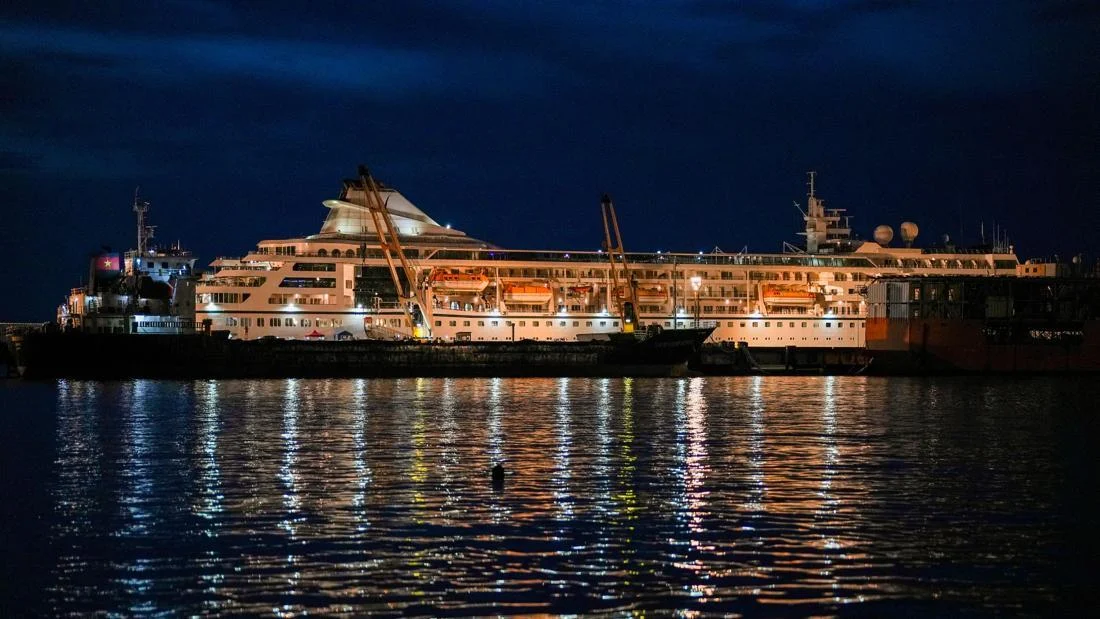
The Villa Vie Odyssey, once marketed as a revolutionary residential cruise vessel offering a permanent life at sea, has officially departed the Port of Sihanoukville in Cambodia under the control of its creditors. The departure marks a definitive end to the ship’s ambitious global circumnavigation project, which had promised residents a lifetime of luxury travel. Instead of continuing its journey across the oceans, the vessel is currently steaming toward Singapore, manned by a skeleton crew of 85 individuals, with all former passengers long disembarked.
According to maritime tracking data analyzed by industry observers at Cruise Hive, the vessel is maintaining a sluggish pace of approximately 7 knots, or 13 kilometers per hour. This speed is significantly below the ship’s maximum operational capacity of 17 knots (31 kilometers per hour), a disparity that industry analysts attribute to fuel conservation efforts and the mechanical limitations imposed by the current management transition. The arrival in Singapore, while confirmed as the immediate destination, remains shrouded in uncertainty regarding the vessel’s long-term future.
A Rapid Decline: From Dream to Bankruptcy
The collapse of the Villa Vie Odyssey project was swift and devastating for its residents. On October 27, 2026, the company abruptly halted operations while docked in Sihanoukville. In a move that shocked the onboard community, the management issued an immediate directive requiring all remaining passengers to vacate their cabins and remove their personal belongings within 24 hours.
The primary driver behind this sudden cessation of business was an unsustainable escalation in operational costs, specifically the surging price of bunker fuel. Villa Vie’s management had previously attempted to mitigate these rising expenses by implementing a "slow steaming" strategy and extending the duration of port stays to minimize fuel consumption. However, these austerity measures proved insufficient. In a formal statement released to stakeholders, the company admitted, "We are no longer able to bear the operational losses incurred by the current financial structure of the voyage."
Chronology of the Crisis
The dissolution of the project follows a series of financial hurdles that plagued the company throughout its short-lived tenure:
- Initial Launch: The ship, originally constructed in 1993, was repurposed to offer a unique, long-term living experience, drawing in hundreds of investors and residents who sought an alternative to traditional retirement.
- Early 2026: Initial reports surfaced regarding mounting operational debts and the inability of the management to maintain the vessel’s required safety and maintenance standards.
- October 27, 2026: Operational suspension declared in Sihanoukville; passengers ordered to evacuate.
- Late October/Early November 2026: Sagar Capital, the primary lender, officially takes control of the vessel to protect its financial interests.
- November 4, 2026: The vessel departs Cambodia for Singapore, under the custody of the creditors, with no passengers on board.
Financial Instability and Failed Rescue Attempts
The underlying financial instability of the venture became clear once lenders gained access to the company’s internal books. Sagar Capital, the investment firm that acted as the primary creditor, revealed that the actual debt load of the operating company was significantly higher than initial disclosures had suggested.
In a desperate bid to save the voyage, a group of 169 residents attempted to organize a collective buyout of the vessel. This initiative, however, was flatly rejected by Sagar Capital. The creditors cited that the financial burden of a formal restructuring, such as a Chapter 11 bankruptcy filing in the United States, would require an immediate infusion of approximately $3 million USD (roughly 54 billion Indonesian Rupiah) just to cover the initial 60-day stabilization period. Given the opacity of the company’s financial health, the lenders deemed the risk of continued operation untenable.
"The lenders have taken possession of the vessel, but this does not necessarily mean the end of the Odyssey’s story," a representative for the former management team stated in a message to passengers. However, this sentiment has been met with skepticism by industry experts, who note that the lack of a clear, funded recovery plan suggests the ship is likely headed for liquidation.
Historical Context and Vessel Legacy
The Villa Vie Odyssey is no stranger to the volatile nature of the cruise industry. Originally christened the Crown Dynasty in 1993 for Crown Cruise Line, the 24,344-ton ship has undergone several rebrandings and ownership transfers over its three-decade lifespan. It has operated under the banners of Majesty Cruise Line, Norwegian Cruise Line, and Fred. Olsen Cruise Lines, among others.
This long history, while highlighting the ship’s endurance, also underscores the challenges of maintaining an aging vessel. As ships age, the cost of compliance with increasingly stringent international maritime environmental and safety regulations rises. For a startup operation like Villa Vie, these fixed costs—compounded by the unpredictable nature of global fuel markets—created a "perfect storm" that made the residential model economically unviable.
Implications for the Residential Cruise Sector
The failure of the Villa Vie Odyssey serves as a cautionary tale for the burgeoning sector of "residential cruising." While the concept of owning a cabin on a ship that permanently circles the globe holds immense appeal for a specific demographic, the business model relies heavily on consistent cash flow and high liquidity. When unexpected costs arise, the lack of traditional corporate backing leaves individual residents, who often invest their life savings, highly vulnerable.
Maritime legal experts suggest that the situation in Singapore will be the final arbiter of the ship’s fate. Singapore is a global hub for maritime law and ship finance, making it the most logical location for the inevitable liquidation process. Should the creditors decide to sell the vessel, they face three primary options:
- Auction: Selling the vessel to the highest bidder, likely another cruise operator or a hospitality group.
- Private Sale: Negotiating a deal with a smaller regional cruise line looking to expand their fleet.
- Shipbreaking: If the hull and mechanical systems are deemed too costly to refurbish, the vessel may be sold for scrap.
Crucially, as noted by observers, Singapore does not operate heavy-duty shipbreaking facilities. If the ship is slated for dismantling, it would need to be towed to a specialized yard, likely in South Asia, where environmental and labor regulations for ship recycling are strictly managed under international conventions.
Future Outlook
As the Odyssey continues its slow transit toward the Singapore Strait, the residents who were once promised a home on the high seas are left with the daunting task of seeking legal recourse and recovering their investments. The company maintains that no official schedule for the sale of the ship has been finalized, and that they are still working on a potential "recovery plan."
However, for the industry at large, the Villa Vie case provides a stark reminder of the complexities inherent in long-term cruise operations. The intersection of maritime logistics, international finance, and consumer protection creates a high-stakes environment where even the most romanticized ventures can sink under the weight of fiscal reality. For now, the Odyssey remains a vessel in limbo—a ghost ship carrying only the cargo of broken promises and the uncertainty of what lies beyond the horizon of its next port of call.
The global maritime community, along with the affected passengers, remains in a state of watchful waiting. The transition of the vessel into the hands of Sagar Capital marks the transition from a human-centric residential project to a clinical exercise in debt recovery and asset liquidation. While the formal proceedings are expected to drag on for months, the immediate reality for the Villa Vie Odyssey is that its voyage, as a home to its residents, has come to a premature and final close.