The Metropolitan Police of Bekasi City have officially placed the driver of a cement mixer truck under arrest following a catastrophic traffic accident that left six people dead and six others severely injured. The harrowing incident unfolded on Sunday afternoon, November 1, 2026, along the busy thoroughfare of Jalan Cut Mutia, located within the administrative jurisdiction of Sepanjang Jaya Village, Rawalumbu District, Bekasi. The crash, which involved a sudden loss of vehicle control, has sent shockwaves through the local community and reignited intense public discourse surrounding the safety standards of heavy commercial vehicles operating within dense urban environments.
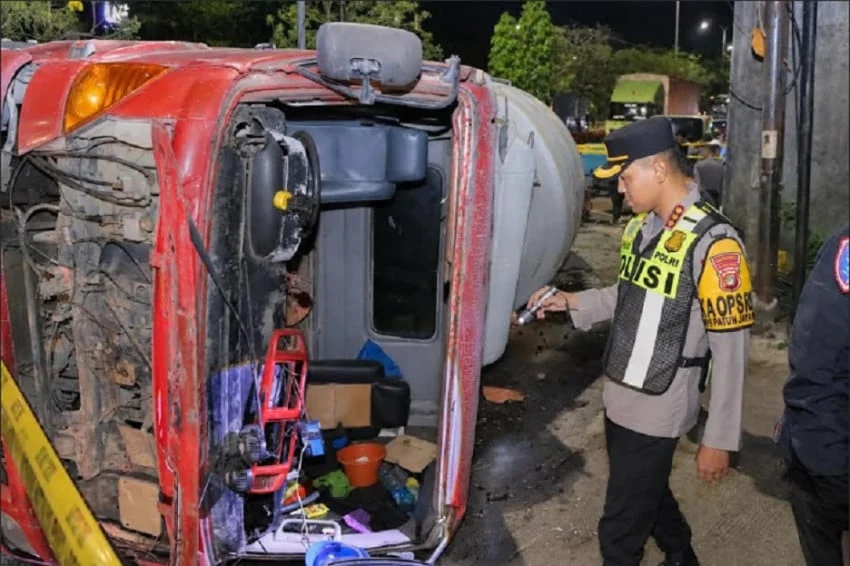
According to preliminary investigative findings released by law enforcement agencies, the tragic event was primarily triggered by a mechanical failure—specifically, suspected brake failure—which caused the heavy-duty concrete mixer to veer off its trajectory. The runaway vehicle ultimately careened onto the roadside, abruptly plowing into a dense crowd of pedestrians and bystanders before violently overturning. The sheer weight and momentum of the commercial vehicle resulted in immediate casualties, devastating families and prompting a massive emergency response from local medical and rescue personnel.
Swift Law Enforcement Action and Custody of the Suspect
In the immediate aftermath of the disaster, the Traffic Directorate (Satlantas) of the Metro Bekasi City Police mobilized specialized units to secure the perimeter, manage the chaotic scene, and expedite the evacuation of the deceased and the wounded to nearby medical facilities. The driver of the offending vehicle, identified by the initials TM, was apprehended at the scene without offering significant resistance.
During a formal press briefing held on Monday, November 2, 2026, the Chief of the Metro Bekasi City Police, Senior Commissioner Putu Kholis Aryana, confirmed the apprehension of the suspect and the confiscation of the heavy vehicle as primary physical evidence.
"The Law Enforcement Unit (Gakkum) of the Metro Bekasi City Traffic Police has successfully apprehended the suspected perpetrator, namely the truck driver identified as TM, and has secured the cement mixer truck as key evidence for our ongoing investigation," stated Commissioner Putu Kholis.
Authorities have emphasized that while the driver is currently in custody, his definitive legal status and formal charges will be determined only after a thorough, comprehensive investigative process reaches its conclusion. The police are exercising due diligence to evaluate whether negligence, inadequate maintenance, or operational overload contributed to the sudden mechanical failure.
Chronology of the Disaster
Piecing together the exact sequence of events on Sunday afternoon requires examining statements from eyewitnesses, preliminary police reports, and initial closed-circuit television (CCTV) footage recovered from commercial establishments lining Jalan Cut Mutia.
The incident began during the peak afternoon hours when traffic along Jalan Cut Mutia was experiencing moderate to heavy activity. The cement mixer truck, heavily laden with construction materials, was transiting the route from the direction of Bekasi Cyber Park toward Narogong. As the vehicle approached a slight incline near the Rawalumbu area, witnesses reported hearing a distinct mechanical screech, indicative of severe strain or pressure loss within the braking system.
Within seconds, the driver appeared to lose directional control. Unable to decelerate or safely guide the massive truck, the vehicle drifted toward the left shoulder of the road, where a cluster of pedestrians, street vendors, and commuters were gathered. The truck struck the group with devastating force before tipping onto its side, trapping several victims underneath the chassis and spilling residual concrete mix across the asphalt.
Emergency services received the first distress call at approximately 3:45 PM local time. Within minutes, multiple ambulances, fire rescue units, and traffic police patrols were dispatched to the scene. First responders engaged in a grueling rescue operation, utilizing hydraulic lifting equipment to stabilize the overturned truck and extricate victims trapped beneath the wreckage. Despite swift medical triage, six individuals succumbed to their injuries at the scene or shortly after arrival at local hospitals, while another six sustained severe polytrauma and fractures, requiring intensive medical intervention.
Scientific Crime Investigation and Advanced Reconstruction
Recognizing the gravity of the incident and the intense public scrutiny surrounding heavy vehicle safety, the Metro Bekasi City Police have opted for a multidisciplinary, evidence-based investigative approach. Commissioner Putu Kholis underscored that the investigation relies heavily on scientific methodology rather than circumstantial assumptions.
As part of this rigorous protocol, specialized teams conducted an exhaustive crime scene investigation (TKP) on Sunday evening, deploying forensic mapping tools to chart skid marks, vehicle resting angles, and point-of-impact coordinates. Furthermore, investigators seized multiple angles of CCTV footage from nearby buildings to reconstruct the precise speed and trajectory of the truck in the moments leading up to the collision.
To elevate the technical precision of the inquiry, the Traffic Accident Analysis (TAA) unit of the Metro Rizal/Metro Jaya Regional Police Traffic Directorate was scheduled to deploy to the site on Monday, November 2, 2026. The TAA team utilizes 3D laser scanning and physics-based simulation software to mathematically reconstruct the accident, providing an irrefutable timeline and vector analysis that will substantiate the final investigative dossier.
"This tragedy will be investigated thoroughly and transparently through the application of scientific crime investigation approaches. Every determination we make will be anchored strictly in verified facts, serving as a concrete manifestation of our professional responsibility to the victims’ families and the broader community," Commissioner Putu Kholis asserted.
Broader Implications for Urban Commercial Transport Safety
The devastating crash on Jalan Cut Mutia has catalyzed urgent discussions among urban planners, transportation authorities, and civil society organizations regarding the governance of heavy commercial vehicles in metropolitan areas like Bekasi and greater Jakarta. Commercial trucks, including cement mixers, dump trucks, and logistics carriers, frequently share congested urban corridors with vulnerable road users, including pedestrians, cyclists, and motorcyclists.
Industry analysts point out that recurrent accidents involving commercial fleets often stem from systemic vulnerabilities, including deferred vehicle maintenance, circumvention of mandatory Periodic Motor Vehicle Testing (KIR), operator fatigue resulting from unregulated work hours, and the unauthorized operation of heavy vehicles during peak daytime hours. While municipal regulations frequently restrict heavy transport to specific overnight windows, enforcement gaps often allow large vehicles to navigate congested arteries during high-density periods.
Traffic safety advocates are calling for immediate, stringent policy adjustments. These recommendations include mandatory implementation of telematics and real-time brake-monitoring systems on all commercial freight and construction vehicles, stricter roadside inspections by transportation departments in coordination with local police, and the establishment of dedicated freight corridors that physically separate heavy logistics traffic from pedestrian-heavy zones.
Moreover, the psychological and economic impact on the families of the victims cannot be overstated. Local community leaders in Rawalumbu have mobilized support networks to assist the bereaved families and those undergoing intensive medical treatment for their injuries. Public sentiment remains focused on demanding accountability from both the immediate operator and the corporate entity responsible for the maintenance and dispatch of the vehicle.
As the judicial process moves forward, the outcome of the Metro Bekasi City Police investigation is expected to set a critical legal precedent for how vehicular manslaughter resulting from mechanical failure is prosecuted. For the residents of Bekasi, the tragedy serves as a grim reminder of the urgent need for uncompromising regulatory oversight and safety compliance across the commercial transport sector.