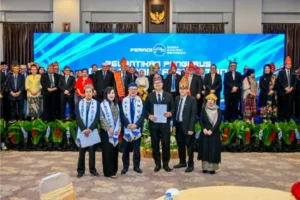
JAKARTA — In an effort to shift regional governance toward a more analytical and evidence-based paradigm, the Agency for Domestic Policy Strategy (Badan Strategi Kebijakan Dalam Negeri – BSKDN) of the Indonesian Ministry of Home Affairs has formally urged the Riau Provincial Government to aggressively integrate scientific research and technological innovation into its municipal planning frameworks.
The appeal was issued by the Acting Head of BSKDN, Raden Gani Muhamad, during a high-level coordination meeting held virtually on Monday, November 23, 2026. Speaking directly from the BSKDN headquarters in Jakarta, Gani emphasized that modern governance can no longer rely solely on intuition or administrative tradition. Instead, policy formulation must be deeply rooted in empirical data, structured research, and scalable innovations to effectively target socioeconomic vulnerabilities, stimulate regional economic growth, and achieve fiscal independence.
The virtual gathering, titled the Coordination Meeting on the Transformation of Regional Research and Innovation Governance to Support Evidence-Based Policy and Development Planning via BARISTA Policy Intelligence in Riau Province, served as a strategic platform to introduce advanced digital governance tools to local bureaucrats and policy architects.
The Strategic Vision of BARISTA Policy Intelligence
At the heart of BSKDN’s recent push for administrative modernization is the implementation of BARISTA Policy Intelligence, a specialized digital ecosystem designed to bridge the historical gap between academic research, municipal data analytics, and executive decision-making.
During his keynote address, Raden Gani detailed how the platform functions as an operational bridge connecting vital streams of information. According to Gani, comprehensive raw data allows local governments to accurately identify and isolate systemic problems within their jurisdictions; rigorous scientific research explains the root causes behind those socioeconomic challenges; and practical innovation serves as the primary mechanism to test, execute, and scale viable solutions while measuring tangible public benefits.
"The launch and integration of BARISTA Policy Intelligence mark a pivotal momentum for regional administrations," Gani stated during the virtual conference. "We are moving away from guesswork. Data points us to the problem, research tells us why it happens, and innovation provides the tested solution to resolve it for the betterment of the public."
Gani further underscored that regional autonomy, while granting local governments the freedom to govern their internal affairs, also demands higher standards of accountability and performance. Without leveraging localized research, regional budgets risk being misallocated toward programs that fail to address fundamental structural issues. By utilizing data-driven intelligence, local development plans (Rencana Pembangunan Daerah) can be systematically aligned with actual community needs, optimizing both capital expenditure and public service delivery.
Fostering a Pentathelix Collaboration Model
Beyond digital infrastructure and data integration, BSKDN’s strategic framework emphasizes the necessity of collaborative ecosystems. Gani noted that regional governments cannot operate in a vacuum. Addressing complex contemporary challenges—ranging from climate resilience and environmental degradation in Sumatra to regional unemployment and inflation control—requires active cooperation across multiple sectors of society.
Gani advocated for the strengthening of the Pentathelix collaboration model, which brings together five core pillars of development: government institutions, academic bodies (universities), the private business sector, civil society organizations, and the mass media.
"Collaboration among regional governments, higher education institutions, the business community, and the general public must be strategically directed," Gani asserted. "Innovations developed in university laboratories or corporate incubators cannot remain isolated theoretical concepts. They must be adapted, developed, and successfully replicated according to the specific geographic, cultural, and economic needs of each territory."
In the context of Riau Province—a region historically rich in natural resources such as palm oil, petroleum, and forestry, yet vulnerable to environmental pressures and commodity price volatility—such cross-sector partnerships are deemed critical. Academic institutions in Riau, such as Universitas Riau and Universitas Islam Riau, are expected to play a more prominent role in supplying empirical data and policy recommendations to the provincial administration. Meanwhile, private enterprises are anticipated to help commercialize and scale technological innovations that can diversify the local economy away from heavy reliance on extractive industries.
Background Context and the Evolution of BSKDN’s Policy Push
The push for evidence-based policymaking in Riau is part of a broader, sustained campaign by the Ministry of Home Affairs to overhaul how local governments across Indonesia manage public funds and design regional regulations. Over the past several years, BSKDN has intensified its oversight and advisory roles, shifting from a purely administrative regulator to a strategic intelligence hub for municipal governance.
Historically, regional development planning in Indonesia has occasionally suffered from administrative inertia, where programs are repeated annually without rigorous post-implementation evaluations or reliance on empirical data. This structural weakness
often leads to suboptimal budget execution, low capital investment efficiency, and delayed progress toward regional fiscal independence.
Recognizing these systemic challenges, the Ministry of Home Affairs introduced various administrative reform initiatives, culminating in digital governance platforms like BARISTA. These tools are designed to institutionalize innovation as a mandatory key performance indicator (KPI) for regional heads. The annual Innovative Government Award (IGA), hosted by the ministry, serves as a competitive incentive mechanism to encourage local governments to continuously upgrade their public services through creative, research-backed policies.
Riau Province, given its strategic economic weight in the Sumatra region, has been designated as one of the focal areas for this digital and administrative transformation. The provincial government’s ability to transition toward an innovation-driven economy will serve as an important benchmark for other resource-rich provinces facing similar developmental transitions.
Chronology of the Transformation Initiative
The integration of BARISTA Policy Intelligence into Riau’s governance structure did not happen overnight. It represents the culmination of a multi-phase strategic rollout spearheaded by the central government:
- Early 2024–2025: BSKDN initiates national audits and evaluations concerning regional research and innovation boards (Badan Riset dan Inovasi Daerah – BRIDA) across Indonesian provinces. Findings reveal a disparity in research utilization, with many regions possessing untapped academic potentials that are disconnected from municipal policymaking.
- Late 2025: Development and beta-testing of the BARISTA Policy Intelligence platform by the Ministry of Home Affairs, aimed at aggregating regional innovation indexes, research repositories, and economic performance metrics into a single dashboard.
- Early 2026: BSKDN rolls out introductory programs targeting provincial and district-level planning agencies (Bappeda) to familiarize bureaucrats with empirical research methodologies.
- November 23, 2026: The official virtual coordination meeting led by Plt. Head of BSKDN Raden Gani Muhamad specifically focuses on Riau Province, laying down the operational roadmap for integrating BARISTA intelligence into the upcoming fiscal year’s regional development planning cycle.
Implications for Riau Province’s Economic and Fiscal Future
The practical implications of adopting BARISTA Policy Intelligence and deepening research-based governance in Riau are profound. Economists and public policy experts suggest that if the Riau Provincial Government successfully institutionalizes these recommendations, several long-term structural benefits can be anticipated.
First, enhanced targeting of public investments will likely improve the efficiency of the Regional Revenue and Expenditure Budget (APBD). By relying on accurate data rather than political assumptions, infrastructure projects, agricultural assistance, and educational programs can be directed to areas with the highest marginal returns, thereby accelerating poverty reduction and reducing regional disparities within the province’s districts and municipalities.
Second, the push toward innovation and research is expected to bolster Riau’s journey toward fiscal independence. Currently, many resource-rich regions in Indonesia remain heavily dependent on central government transfer funds (Dana Alokasi Umum and Dana Alokasi Khusus). By leveraging research to foster local technological innovations—particularly in downstream processing of agricultural and forestry commodities—Riau can expand its local revenue base (Pendapatan Asli Daerah – PAD), creating a more resilient economic cushion against external global commodity shocks.
Third, institutionalizing evidence-based policymaking enhances bureaucratic transparency and administrative accountability. When policies are backed by transparent data and open research, public scrutiny and civil society oversight become more constructive, fostering greater trust between citizens and local government institutions.
Challenges Ahead in Implementation
Despite the promising strategic framework outlined by BSKDN, administrative analysts caution that several hurdles remain on the path to full implementation at the local level. Institutional resistance to change, gaps in digital literacy among municipal civil servants, and bureaucratic silos between different regional agencies (such as Bappeda, the regional research agencies, and sectoral technical offices) historically hinder seamless policy integration.
To overcome these obstacles, experts emphasize that continuous capacity building, rigorous technical training for local apparatuses, and strong political will from the leadership of the Riau Provincial Government will be indispensable. The central government, through BSKDN, is expected to provide ongoing technical assistance and monitoring to ensure that the transition toward evidence-based governance moves beyond mere rhetorical commitment and translates into measurable, ground-level improvements for the people of Riau.
As the virtual coordination meeting concluded, the consensus among participants underscored a shared commitment to modernize Riau’s bureaucratic machinery. With BARISTA Policy Intelligence now serving as a navigational compass, the regional administration faces both the opportunity and the responsibility to redefine regional development through the lenses of science, data, and collaborative innovation.