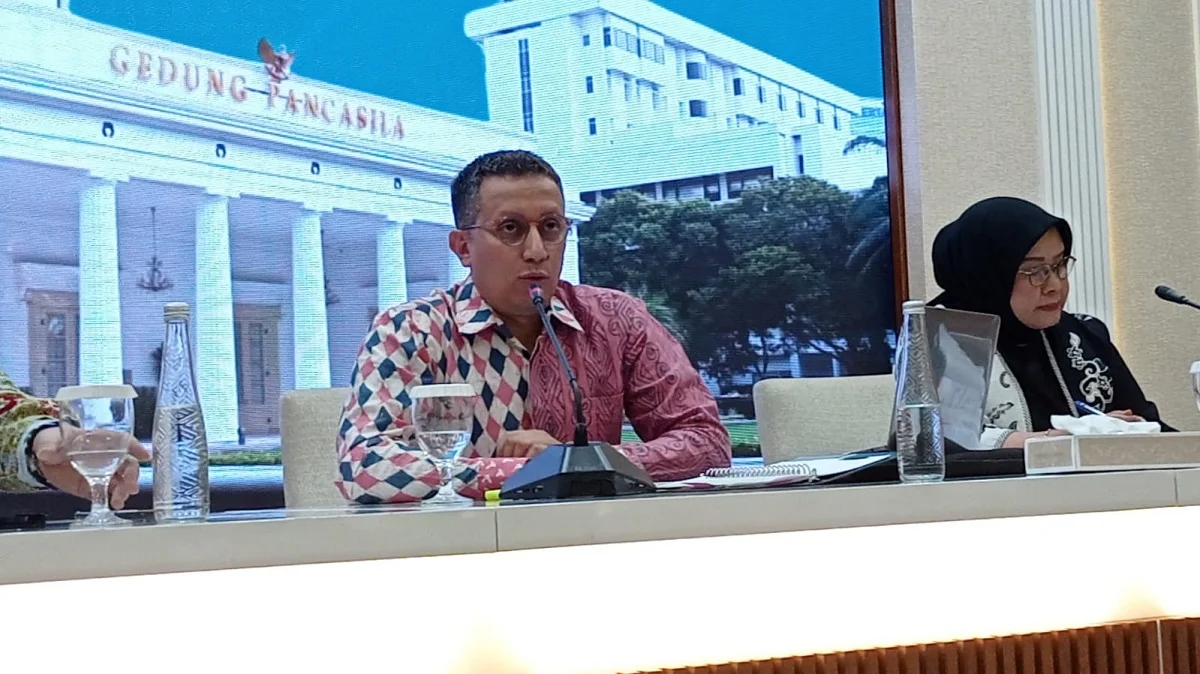
JAKARTA – The Indonesian Ministry of Foreign Affairs (Kemlu RI) has unequivocally stated that the arrest and subsequent deportation of Palestinian national Abdul Karim Raeq Miqdad by the National Police (Polri) was an entirely criminal matter, asserting that the incident holds no bearing on Indonesia’s steadfast support for the Palestinian struggle for independence. This definitive clarification was delivered by Kemlu spokesperson Vahd Nabyl Achmad Mulachela in Jakarta on Thursday, July 23, 2026, echoing and reinforcing previous statements made by Coordinating Minister for Legal, Human Rights, Immigration, and Correctional Affairs, Yusril Ihza Mahendra. The pronouncement seeks to dispel any potential misinterpretations or attempts to link the individual’s legal status with Indonesia’s deeply ingrained foreign policy stance on Palestine.
Clarifying the Deportation’s Nature
The core message from the Indonesian government is one of strict adherence to legal procedure and international cooperation, entirely separate from its diplomatic principles. Spokesperson Nabyl emphasized the government’s position, stating, "As has been conveyed by Bapak Menko Yusril (Coordinating Minister for Legal, Human Rights, Immigration, and Correctional Affairs, Yusril Ihza Mahendra), this issue is purely a criminal matter and is not related to our relationship with Palestine." This statement serves to draw a clear demarcation between an individual’s alleged criminal activities, which fall under the purview of law enforcement, and the nation’s unwavering commitment to a long-standing foreign policy objective.
Nabyl further reiterated Indonesia’s consistent and unchanging stance on the Palestinian cause. "And we know that Indonesia’s position in supporting the Palestinian struggle has not changed. As the focal point ministry handling this matter, Bapak Menko has provided a sufficiently clear explanation, and we from Kemlu adhere to that," he added. This robust assertion underlines Indonesia’s commitment to its principles, which have long been a cornerstone of its international relations. The government’s carefully worded statements aim to ensure that while it fulfills its international legal obligations, its moral and political support for Palestine remains unimpeachable in the eyes of both its domestic populace and the international community.
Indonesia’s Unwavering Stance on Palestine: A Diplomatic Cornerstone
Indonesia’s support for Palestine is not merely a policy; it is a fundamental pillar of its foreign relations, deeply rooted in its constitution and historical identity. Since its independence, Indonesia has been a vocal advocate for the self-determination of nations and has consistently championed the rights of the Palestinian people. This stance originates from the Bandung Conference in 1955, a seminal event in the Non-Aligned Movement, where newly independent nations collectively voiced their opposition to colonialism and imperialism. The Indonesian constitution explicitly mandates the abolition of colonialism worldwide, a principle that successive governments have applied directly to the Israeli-Palestinian conflict.
Over decades, Indonesia has consistently expressed its solidarity through various diplomatic channels. At the United Nations, Indonesia has routinely voted in favor of resolutions supporting Palestinian statehood, condemning Israeli settlements, and advocating for a just and lasting peace. It has also provided substantial humanitarian aid to Palestinians, particularly in Gaza and the West Bank, often through government initiatives and robust public engagement. Indonesian civil society organizations and religious bodies frequently organize fundraising campaigns and solidarity actions, reflecting the widespread public sentiment that views the Palestinian struggle as a universal fight for justice. This deep-seated commitment ensures that any action taken by the Indonesian government, particularly concerning a Palestinian national, is scrutinized through the lens of its broader foreign policy framework. Therefore, the government’s swift and clear communication regarding Abdul Karim Raeq Miqdad’s case was crucial to prevent any misrepresentation of its core principles.
The Case of Abdul Karim Raeq Miqdad: From Allegations to Deportation
The specifics surrounding Abdul Karim Raeq Miqdad’s arrest and deportation paint a picture distinct from the narrative of a political activist or religious leader. According to Indonesian authorities, Miqdad was not a humanitarian worker or an Islamic scholar, as some initial, unverified reports might have suggested. Instead, he was identified as a fugitive wanted by international law enforcement agencies.
-
The Interpol Red Notice Explained:
The crux of the matter lies in an Interpol Red Notice issued by the National Central Bureau (NCB) in Nicosia, Cyprus. An Interpol Red Notice is a request to law enforcement worldwide to locate and provisionally arrest a person pending extradition, surrender, or similar legal action. It is based on a valid national arrest warrant or court order issued by the requesting country. It is not an international arrest warrant itself but a notification that an individual is wanted by a national jurisdiction. In Miqdad’s case, the Red Notice was issued on suspicion of his involvement in alleged acts of terrorism. This designation is serious and triggers an obligation for Interpol member countries, including Indonesia, to act upon verifiable information regarding the fugitive’s whereabouts. The specific nature of the alleged terrorist activities for which Cyprus sought Miqdad remains undisclosed in detail by Indonesian authorities, but the gravity of the charge underscores the legal basis for his apprehension. -
The Arrest and Verification Process:
Upon receiving intelligence regarding Miqdad’s presence within Indonesian territory and cross-referencing it with the Interpol Red Notice, the Indonesian National Police initiated an operation. Polri’s Divisi Hubungan Internasional (International Relations Division) played a pivotal role in verifying his identity and confirming his status as an internationally wanted individual. The process likely involved meticulous data verification, coordination with Interpol channels, and surveillance to ensure proper identification before any arrest was made. This careful approach is standard procedure in cases involving international fugitives to avoid wrongful arrests and to uphold due process. -
Deportation to Cyprus:
Following his arrest and the confirmation of his Interpol fugitive status, Abdul Karim Raeq Miqdad was not prosecuted in Indonesia for the alleged crimes. Instead, the decision was made to deport him to Cyprus, the country that issued the Red Notice and where the alleged crimes originated. This action aligns with international legal protocols, where a country apprehending an international fugitive often deports or extradites them to the requesting jurisdiction for trial. The deportation to Cyprus, rather than direct extradition to Palestine or any other country, further solidifies the narrative that this was a purely legal and criminal matter, dictated by international law enforcement agreements.
Official Narratives: Countering Misinformation
The Indonesian government’s concerted effort to clarify the situation highlights its commitment to transparency and its proactive approach to managing public perception, especially given the sensitive nature of the individual’s origin and the charges against him.
-
Statements from the Coordinating Minister:
Coordinating Minister Yusril Ihza Mahendra was the first high-ranking official to publicly address the matter, providing crucial details that immediately countered any emerging alternative narratives. He explicitly stated that Abdul Karim Raeq Miqdad was neither an ulama (Islamic scholar) nor a humanitarian activist working for Gaza. This direct refutation was essential in preventing the spread of misinformation that could potentially inflame public sentiment or create diplomatic complications. Minister Mahendra’s authority as the head of the Coordinating Ministry for Legal, Human Rights, Immigration, and Correctional Affairs lends significant weight to these statements, as his office oversees the very agencies involved in the arrest and deportation. His emphasis on Miqdad being an "Interpol Nicosia fugitive related to alleged acts of terrorism" firmly established the legal and criminal basis for the government’s actions. -
The Ministry of Foreign Affairs’ Reinforcement:
Vahd Nabyl Achmad Mulachela, as the spokesperson for the Ministry of Foreign Affairs, subsequently reinforced Minister Mahendra’s statements. The Kemlu’s role is critical in communicating Indonesia’s foreign policy and ensuring that domestic actions are understood in their proper international context. By reiterating that the case was "purely a criminal issue" and had "no relation to our relationship with Palestine," Nabyl strategically decoupled the individual’s legal status from the nation’s broader diplomatic commitments. This dual confirmation from both the coordinating legal ministry and the foreign affairs ministry presented a united and consistent front, leaving little room for ambiguity. -
Polri’s Role in Law Enforcement:
The Indonesian National Police (Polri) also played a crucial role in substantiating the government’s narrative. The Divisi Hubungan Internasional Polri explicitly refuted claims of Miqdad being a Palestinian activist, confirming that his arrest was solely based on his status as an Interpol fugitive. This statement from the operational law enforcement agency provided factual ground truth, reinforcing the purely criminal nature of the case. Polri’s involvement underscores Indonesia’s commitment to upholding international law and cooperating with global security efforts, regardless of the individual’s nationality or the political sensitivities surrounding their origin.
The Mechanism of International Cooperation: Interpol’s Role
The case of Abdul Karim Raeq Miqdad serves as a practical example of Indonesia’s engagement with international law enforcement mechanisms, particularly through Interpol.
-
Indonesia’s Commitment to International Justice:
As a member state of Interpol, Indonesia is bound by certain obligations to cooperate in the pursuit of international fugitives. This cooperation is vital for global security, as it prevents criminals from evading justice by crossing national borders. Indonesia’s action in apprehending and deporting Miqdad demonstrates its commitment to these international agreements and its role as a responsible member of the global community. It signifies that Indonesia will not become a safe haven for individuals wanted for serious crimes, including terrorism, regardless of where those allegations originate. -
Navigating Sovereignty and Global Security:
Cases involving Interpol Red Notices often require a delicate balance between national sovereignty and international cooperation. While Indonesia maintains full sovereign authority over its borders and legal processes, it also recognizes the importance of collaborative efforts to combat transnational crime and terrorism. The decision to deport Miqdad to Cyprus, rather than engaging in a lengthy extradition process that might involve more complex legal and diplomatic hurdles, indicates a pragmatic approach aimed at efficiently addressing the Interpol warrant. This also highlights the trust placed in the requesting nation’s legal system to handle the subsequent proceedings. Such actions reinforce Indonesia’s image as a reliable partner in the global fight against crime and terrorism, without compromising its deeply held foreign policy principles.
Broader Implications: Diplomacy, Public Perception, and Legal Precedent
The handling of the Abdul Karim Raeq Miqdad case carries several significant implications for Indonesia, both domestically and internationally.
-
Maintaining Diplomatic Credibility:
By swiftly and decisively acting on the Interpol Red Notice while simultaneously reaffirming its support for Palestine, Indonesia effectively managed to uphold its diplomatic credibility on two fronts. It demonstrated its adherence to international law enforcement obligations, which is crucial for fostering trust with global partners. Concurrently, it ensured that its unwavering commitment to the Palestinian cause remained clear, safeguarding its long-standing foreign policy and moral standing, particularly among Muslim-majority nations and the Non-Aligned Movement. This careful balancing act reinforces Indonesia’s position as a principled actor on the international stage, capable of distinguishing between individual criminal liability and broader geopolitical solidarities. -
Managing Domestic Sentiment:
Indonesia has a large and vocal pro-Palestine population, and any perceived action against a Palestinian national could potentially ignite strong public reactions. The government’s immediate and unequivocal statements from high-ranking officials were crucial in pre-empting and countering any narratives that might attempt to portray Miqdad as a victim or a political prisoner. By emphasizing the "purely criminal" nature of the case and his status as an Interpol fugitive for alleged terrorism, the government aimed to manage domestic sentiment, ensuring that public understanding aligned with the factual and legal basis of the deportation. This proactive communication strategy is vital for maintaining social cohesion and preventing the politicization of a law enforcement matter. -
Setting a Precedent for Future Cases:
This case could potentially set a precedent for how Indonesia handles similar situations involving foreign nationals with international warrants, especially those from politically sensitive regions. It signals that Indonesia prioritizes its international legal obligations regarding fugitives, irrespective of their nationality or the political context of their country of origin, provided the legal grounds are robust. This approach establishes a clear operational framework for its law enforcement and immigration agencies, ensuring consistency and predictability in future cases of international cooperation. It reinforces the principle that Indonesia’s territory will not be a sanctuary for individuals wanted for serious crimes.
Conclusion: A Clear Message on Principle and Law
The deportation of Abdul Karim Raeq Miqdad stands as a testament to Indonesia’s nuanced yet firm approach to international affairs. The government, through the coordinated efforts of the Ministry of Foreign Affairs, the Coordinating Ministry for Legal, Human Rights, Immigration, and Correctional Affairs, and the National Police, has delivered a clear message. It underscores that Indonesia rigorously upholds its commitments to international law enforcement and the global fight against terrorism by acting on legitimate Interpol Red Notices. Simultaneously, it reaffirms that such actions do not, and will not, diminish its unwavering and deeply rooted support for the Palestinian people’s struggle for self-determination and an independent state. This incident, while specific to an individual’s alleged criminal activities, has served to highlight the enduring principles that guide Indonesian foreign policy and its commitment to both justice and solidarity on the global stage.