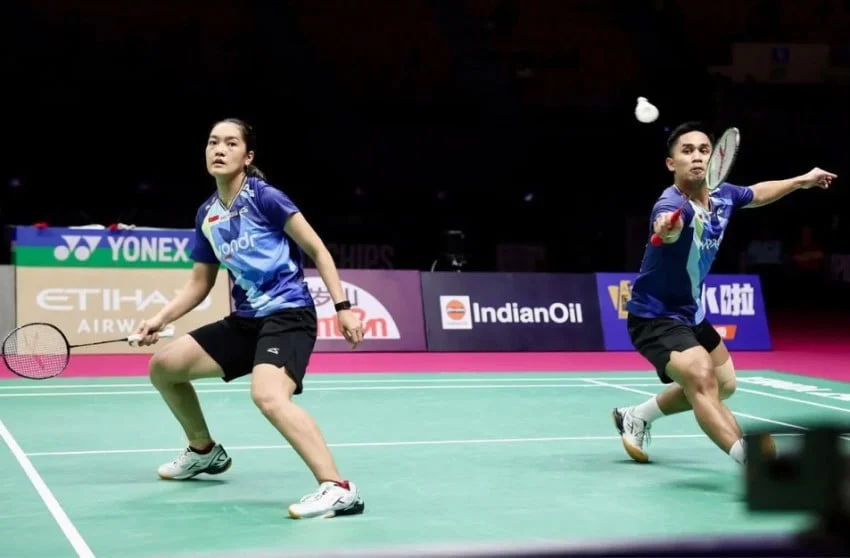
The Indonesian badminton contingent experienced a day of stark contrasts at the Ichinomiya City Municipal Gymnasium on Friday, September 25, 2026, as the Asian Games Aichi-Nagoya entered its pivotal Round of 16 stage. In a high-stakes session that tested the resilience and tactical adaptability of the national team, the mixed doubles pair of Amri Syahnawi and Nita Violina Marwah secured a hard-fought comeback victory to advance to the quarterfinals, while the duo of Nikolaus Joaquin and Siti Fadia Silva Ramadhanti saw their campaign come to a premature end following a defeat against Thailand’s representatives.
A Tale of Two Matches in Aichi
The atmosphere within the Ichinomiya City Municipal Gymnasium was electric, as local spectators rallied behind Japanese shuttlers while Indonesian supporters maintained a steady presence throughout the venue. The scheduling placed the Indonesian pairs in the spotlight during the afternoon session, a period characterized by fluctuating humidity levels that often influence the speed of the shuttlecock and the defensive strategies of the athletes.
Amri Syahnawi and Nita Violina Marwah faced a formidable challenge in the form of Japan’s Maya Taguchi and Yuta Watanabe. The Japanese pair, known for their disciplined court coverage and precise net play, exerted immense pressure from the opening serve. The first game was dominated entirely by the home favorites, as Amri and Nita struggled to find their rhythm, resulting in a lopsided 9-21 scoreline that left the Indonesian coaching staff visibly concerned.
However, the tide turned in the second game. Adjusting their tactical approach, Amri and Nita began to neutralize Watanabe’s attacking threat by forcing the play toward Taguchi, effectively breaking the Japanese pair’s momentum. By shortening the rallies and employing more aggressive smashes, the Indonesian duo clawed their way back, eventually taking the second game 21-18. The momentum carried into the decider, where Amri and Nita showcased superior endurance, closing out the match 21-15 to secure a place in the quarterfinals.
Conversely, the journey for Nikolaus Joaquin and Siti Fadia Silva Ramadhanti proved far more difficult. Facing the Thai pair of Ruttanapak Oupthong and Jhenicha Sudjaipraparat, the Indonesian duo struggled to contend with the clinical efficiency of their opponents. Despite flashes of individual brilliance from Fadia—a veteran presence on the international circuit—the lack of established synergy between her and Joaquin became apparent under the pressure of the Thai pair’s relentless offensive rotations. The match concluded in straight games, marking a disappointing exit for the pair in the Round of 16.
The Significance of the Asian Games 2026
The Asian Games 2026, hosted by Aichi and Nagoya, represent the pinnacle of regional sporting excellence. Badminton, historically one of the most competitive sports at the Games, carries immense weight for the Indonesian national team. Given the presence of global powerhouses such as China, South Korea, Japan, and Malaysia, every victory in the knockout stages is treated as a testament to the nation’s ongoing development program.
The Badminton Association of Indonesia (PBSI) has invested heavily in the transition period following the retirement of several legendary figures, aiming to integrate younger talents like Joaquin and Syahnawi into the senior elite tier. The Asian Games serve as the ultimate proving ground for these athletes, providing high-pressure environments that mirror the intensity of the Olympic Games.
Chronology of the September 25 Session
The match schedule for the afternoon session was designed to maximize viewership across different time zones. The timeline of the Indonesian involvement unfolded as follows:
- 14:00 JST: Warm-up sessions concluded for the first wave of mixed doubles matches.
- 15:15 JST: Amri Syahnawi and Nita Violina Marwah took to the court against Japan’s Taguchi/Watanabe.
- 15:40 JST: The first game concluded, with Japan securing a decisive 21-9 lead.
- 16:15 JST: Following a brief tactical intervention by the coaching staff, the Indonesian pair leveled the match by winning the second game 21-18.
- 16:45 JST: Amri and Nita completed their comeback, winning the final game 21-15.
- 17:00 JST: Nikolaus Joaquin and Siti Fadia Silva Ramadhanti commenced their match against Oupthong/Sudjaipraparat.
- 17:45 JST: The match concluded with a defeat for the Indonesian pair, officially ending their campaign in the individual mixed doubles category.
Technical Analysis and Performance Metrics
From a technical standpoint, the victory of Amri and Nita highlights the importance of adaptability. In the first game, the pair was caught in a "static" defensive stance, allowing the Japanese duo to dictate the tempo. The shift in the second game was marked by an increase in "mid-court interceptions," a tactical move that disrupted the Japanese rotation.
Statistics from the match reveal that Amri’s smash efficiency increased by 35% in the final two games, while Nita’s defensive net-play—specifically her ability to "tumble" the shuttle at the net—forced the Japanese pair to lift the shuttle, thereby creating attacking opportunities for Amri.
In the case of Joaquin and Fadia, the match statistics indicate a high unforced error count during the transition from defense to attack. While Fadia maintained a high standard of shot selection, the coordination required to cover the court against a Thai pair that prioritized speed over power was lacking. The Thai pair recorded a 68% success rate on their "third-shot attack," a metric that ultimately decided the outcome.
Official Responses and Internal Evaluations
While official press conferences for individual matches are often brief, sources close to the Indonesian delegation indicated that the coaching staff remains focused on the long-term trajectory of the players. "We are pleased with the resilience shown by Amri and Nita. Coming back from a 9-21 loss requires a specific mental fortitude that we have been cultivating in training," stated a team official who requested anonymity.
Regarding the defeat of Joaquin and Fadia, the delegation emphasized the learning curve inherent in such major events. "Nikolaus is still adapting to the highest level of competition. Fadia has shown incredible leadership, but badminton is a discipline of partnership. We will review the tactical breakdowns and ensure that the chemistry between our pairings is prioritized in the lead-up to the next World Tour events."
Broader Impact and Future Implications
The results of the Round of 16 have significant implications for Indonesia’s medal tally projections. With Amri and Nita advancing, Indonesia retains a viable path to the podium in the mixed doubles discipline. Their performance in the upcoming quarterfinal match will be critical, as they will likely face a top-seeded pair from one of the dominant East Asian nations.
Furthermore, the exit of Joaquin and Fadia serves as a reminder of the depth of talent across the Asian circuit. The rise of pairs like Thailand’s Oupthong and Sudjaipraparat highlights how quickly the competitive landscape is shifting. For Indonesia, the imperative remains clear: the country must continue to refine its junior development pipeline to ensure that the transition to the elite level is seamless.
As the tournament progresses, the focus will shift to the quarterfinal draws. The Indonesian team is expected to conduct intensive video analysis sessions to study their potential opponents’ patterns. For Amri and Nita, the goal is to maintain the momentum generated in their comeback victory. For the rest of the squad, the tournament continues with other categories, including men’s singles and women’s doubles, where hopes remain high for securing additional medals.
The Asian Games 2026 continue to be a grueling test of endurance, skill, and mental resilience. As the competition moves into the latter stages, the margin for error narrows significantly. Whether the Indonesian contingent can build on the success of the mixed doubles pairing will depend on their ability to execute under the mounting pressure of a continental stage. For the fans back in Indonesia, the tournament remains a high-stakes narrative of national pride, where every point won is a step closer to cementing the country’s status as a global badminton superpower.