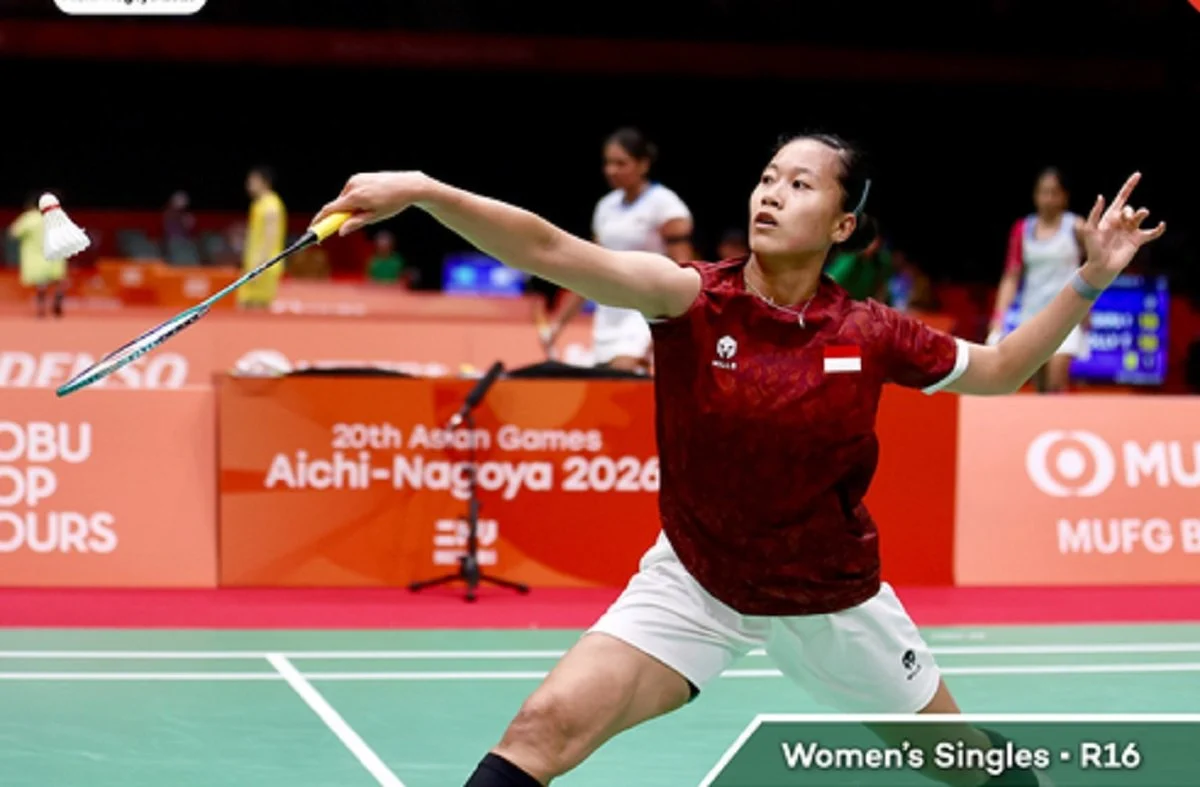
The Indonesian national badminton team experienced mixed fortunes on Saturday, September 26, 2026, during the individual event of the Asian Games Aichi-Nagoya 2026. Competing at the Ichinomiya City Municipal Gymnasium in Aichi, Japan, the Red and White contingent saw two of their remaining three representatives secure hard-fought victories to advance to the quarterfinal round. However, the campaign came to a premature end for Indonesia’s sole remaining women’s singles competitor, marking a challenging day for the coaching staff and athletes as they navigate the rigorous tournament structure.
The day’s fixtures highlighted the intense competitive atmosphere of the quadrennial multi-sport event, which brings together the finest badminton talent across the Asian continent. With the tournament entering its crucial knockout stages, physical endurance, tactical adaptability, and mental resilience proved to be the decisive factors on the court. While the men’s double pairs demonstrated exceptional dominance and composure under pressure, the women’s singles division dealt with a bittersweet exit that underscores the fierce global competition in contemporary badminton.
Dominant Display by Indonesia’s Men’s Doubles Pairs
The standout performances of the day undoubtedly belonged to Indonesia’s dynamic men’s doubles combinations. Fajar Alfian paired with Muhammad Shohibul Fikri, alongside the formidable duo of Leo Rolly Carnando and Daniel Marthin, carried the nation’s hopes forward with commanding displays of skill and tactical execution.
Fajar Alfian and Muhammad Shohibul Fikri took to the court first in the Round of 16 against Hong Kong’s Cheung Sai Shing and Deng Chi Fai. Displaying a masterclass in swift rotational play and aggressive net control, the Indonesian pair completely neutralized their opponents’ offensive strategies. Fajar and Fikri cruised through the opening game with a comfortable 21-10 margin, dictating the pace and capitalizing on unforced errors from the Hong Kong duo. Although Cheung and Deng mounted a stronger resistance in the second game, adjusting their defensive structure and finding pockets of space in the backcourt, Fajar and Fikri maintained their composure. Closing out the match 21-17 in the second game, the Indonesian pair secured a straight-games victory in just under 40 minutes, stamping their authority as serious medal contenders in Aichi-Nagoya.
Shortly after, their compatriots Leo Rolly Carnando and Daniel Marthin—affectionately known by fans as "The Babies"—delivered an equally compelling performance against Thailand’s Paeratchai Sukphun and Pakkapon Teeraratsakul. Leo and Daniel tore through the first game with explosive smashes and tight defensive retrieves, overwhelming the Thai pair 21-8. However, the second game proved to be a vastly different narrative. Sukphun and Teeraratsakul recalibrated their game plan, cutting down on errors and launching a relentless wave of attacks that pushed the Indonesian pair to their absolute limits. The scoreline reflected the tension, stretching deep into extra points. Demonstrating immense mental fortitude, Leo and Daniel saved multiple game points before converting their own opportunities to seal the second game 24-22, securing a straight-games sweep and booking their ticket to the quarterfinals alongside Fajar and Fikri.
Putri Kusuma Wardani Falls Short in the Round of 16

In contrast to the success witnessed in the men’s division, Indonesia’s campaign in the women’s singles category suffered a major setback. Putri Kusuma Wardani, who carried the nation’s final hopes in the discipline following earlier tournament eliminations, was forced to bow out in the Round of 16.
Putri KW faced an uphill battle against a high-caliber opponent on the neighboring court of the Ichinomiya City Municipal Gymnasium. Despite displaying flashes of her trademark agility, rapid footwork, and deep baseline clears, Putri struggled to sustain momentum against an opponent who capitalized on tactical variations and exceptional defensive retrievals. The exhaustion of a grueling tournament schedule, combined with the immense pressure of representing a badminton-crazed nation on the international stage, appeared to take a toll during the crucial phases of the match.
The defeat marks the end of Putri Kusuma Wardani’s individual campaign at the 2026 Asian Games, leaving Indonesia without representation in the latter stages of the women’s singles bracket. While the loss is undeniably disappointing for the athlete and the national coaching staff, sports analysts note that Putri’s journey at the Games provides valuable data and experiential growth as she prepares for upcoming World Tour events and the broader Olympic qualification pathway.
Broader Context and Historical Significance of Badminton at the Asian Games 2026
The badminton tournament at the Asian Games Aichi-Nagoya 2026 holds immense prestige, often regarded by athletes and experts as second only to the Olympic Games and the World Championships in terms of competitive intensity and emotional weight. Historically, badminton has been a core medal factory for Indonesia within the multi-sport regional games, with legendary names carving their legacies into the annals of the sport.
The 2026 edition in Japan has presented unique challenges, ranging from acclimatization to the specific drift conditions inside the Ichinomiya City Municipal Gymnasium to the rigorous mental demands of competing in a multi-sport village environment. Unlike standard Badminton World Federation (BWF) World Tour events, the Asian Games carry the distinct honor of representing an entire nation before a massive audience of government officials, sports ministers, and millions of television viewers back home.
The pressure to deliver podium finishes is perpetually high for the Indonesian contingent, given the nation’s rich historical pedigree in the sport. Consequently, every victory is celebrated as a step toward national glory, while every defeat is scrutinized by analysts and fans alike, driving a continuous cycle of expectation and athletic ambition.
Strategic Analysis and Implications for the Quarterfinals

With Fajar/Fikri and Leo/Daniel advancing to the quarterfinal round, the Indonesian coaching staff faces a critical window of recovery and tactical preparation. The transition from the Round of 16 to the quarterfinals at a major multi-sport event demands rigorous physical recovery regimens, including ice baths, physiotherapy, and nutritional optimization, given the accumulating fatigue of a dense tournament schedule.
From a strategic perspective, the advancement of two men’s doubles pairs significantly boosts Indonesia’s medal prospects. In modern international badminton, the men’s doubles division is arguably the most fiercely contested category globally, with negligible margins separating the top ten pairs in the world rankings. The depth of talent means that tactical discipline, unyielding stamina, and psychological resilience under pressure will dictate who ultimately climbs the podium.
Fajar Alfian and Muhammad Shohibul Fikri have demonstrated a potent blend of senior experience and fresh tactical synchronization, while Leo Rolly Carnando and Daniel Marthin bring raw power and unpredictable creativity. If both pairs can maintain their focus and minimize unforced errors in the upcoming matches, Indonesia stands in a strong position to secure valuable medals for the national contingent.
Official Responses and Team Outlook
Following the conclusion of Saturday’s fixtures, representatives from the Indonesian Badminton Association (PBSI) coaching staff evaluated the day’s performances, emphasizing the need for continuous evaluation and focus. While acknowledging the disappointment surrounding Putri Kusuma Wardani’s exit, the management praised her fighting spirit and commitment throughout the tournament.
Attention now shifts squarely to the quarterfinal matchups scheduled for the following days. The remaining athletes are set to undergo closed-door video analyses of their potential opponents, dissecting tactical tendencies, service patterns, and preferred attacking zones. As the nation watches with bated breath, the focus remains firmly fixed on the court in Aichi, where the pursuit of Asian Games glory continues for Indonesia’s finest badminton ambassadors.