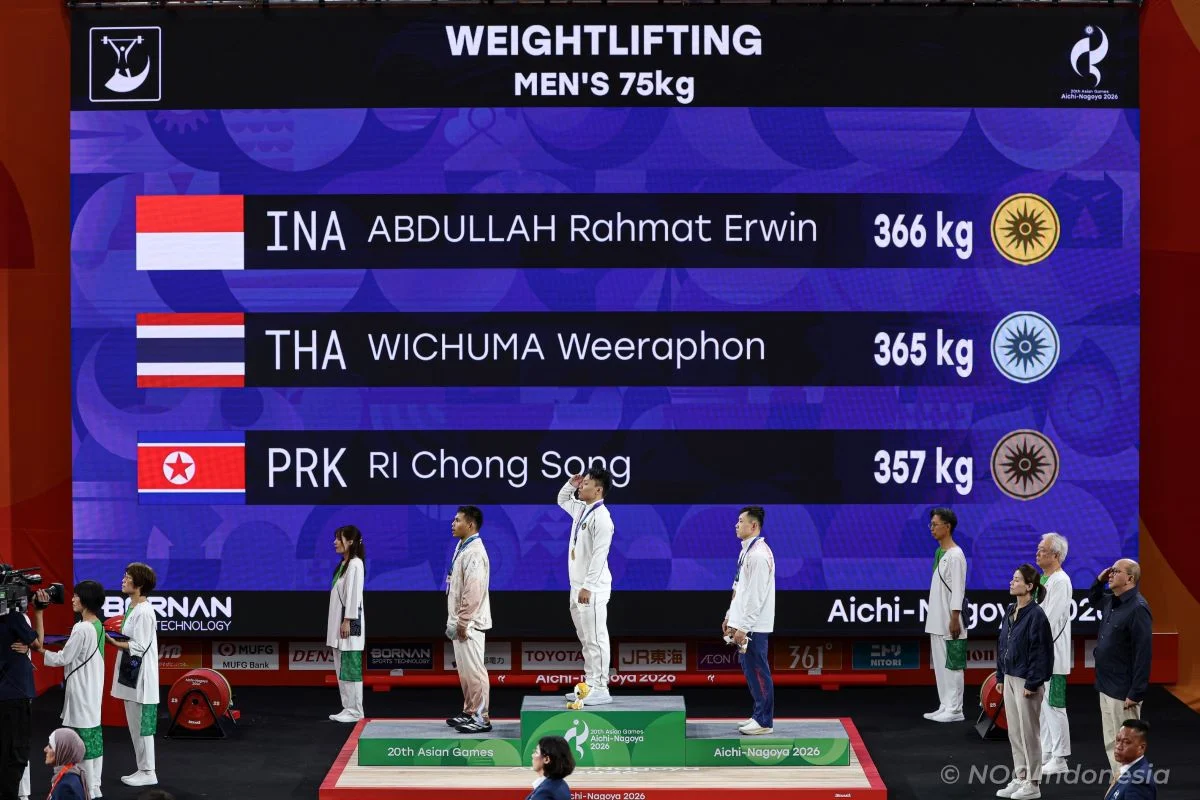
Indonesian weightlifting sensation Rahmat Erwin Abdullah has once again etched his name into global sporting history, delivering a masterclass performance at the Asian Games Aichi-Nagoya 2026. Competing at the Fukigae Hall in Aichi-Nagoya, Japan, on Saturday, September 26, 2026, the 25-year-old powerhouse triumphed in the fiercely contested men’s 75-kilogram division. His victory not only marked the second gold medal for the Indonesian contingent at the ongoing multi-sport quadrennial event but also culminated in a breathtaking moment of national pride as the Indonesian national anthem, Indonesia Raya, echoed through the arena.
Rahmat’s path to the top of the podium was defined by exceptional technical precision and sheer physical dominance. The athlete, originally from Makassar, South Sulawesi, laid a formidable foundation in the snatch portion of the competition by successfully hoisting 160 kilograms. He then returned to the platform for the clean and jerk discipline, where he cemented his dominance by lifting a staggering 206 kilograms. This combined effort yielded a total cumulative lift of 366 kilograms, a performance that proved insurmountable for his international competitors and single-handedly altered the competitive landscape of the division.
Beyond securing the coveted gold medal, Rahmat’s remarkable feat extended into the record books. With his phenomenal lifts in Japan, the Indonesian lifter officially shattered two world records simultaneously: one in the clean and jerk category and another for the overall total weight lifted. This double-record milestone further solidifies his status as one of the preeminent figures in modern international weightlifting, adding another illustrious chapter to a career already decorated with global accolades.
The Road to Aichi-Nagoya: Context and Chronological Build-Up
The journey to the Fukigae Hall platform on September 26 was the result of years of rigorous preparation, international competition, and strategic conditioning overseen by the national coaching staff and the Indonesian Weightlifting Association (PABSI). Coming into the Asian Games Aichi-Nagoya 2026, the Indonesian contingent faced immense pressure to deliver medals early in the tournament to build momentum against formidable Asian powerhouses such as China, Kazakhstan, and host nation Japan.
Weightlifting has historically been one of Indonesia’s most reliable sources of international glory, and expectations rested heavily on Rahmat’s shoulders. The build-up to the 2026 Games involved intensive training camps, stringent weight-management protocols, and tactical adjustments to peak at the exact moment of competition. As the schedule unfolded, the anticipation surrounding the men’s 75kg category reached a fever pitch, with sports analysts and fans alike eyeing Rahmat as a prime candidate for the podium.

On the day of the event, the atmosphere inside Fukigae Hall was electric. Delegations from across the continent watched as elite athletes tested their limits. Rahmat’s entry into the competition immediately signaled intent. While spectators and media observers noted his outward composure and unflappable demeanor under the blinding arena lights, the champion later revealed that the reality of the situation was far more intense than it appeared from the stands.
Unveiling the Mental Fortress: Rahmat’s Post-Victory Reflections
For fans and analysts observing from the outside, elite athletes often appear impervious to the pressures of high-stakes international competition. Rahmat’s seemingly effortless transitions between heavy lifts fostered an image of absolute serenity. However, in an official statement released by the Indonesian Olympic Committee (NOC Indonesia) following his triumph, the gold medalist offered a candid look into the psychological battle that accompanied his physical dominance.
"Alhamdulillah, I am extremely grateful," Rahmat stated in the official NOC Indonesia release on Saturday, September 26, 2026. "Actually, it wasn’t calmness that I felt, but focus. I was nervous too."
The admission highlights the psychological tightrope that athletes walk at the Asian Games, where years of preparation culminate in mere minutes of execution. When asked about the specific mental strategies or formulas he utilized to maintain his composure while staring down record-breaking barbell weights, Rahmat admitted that there was no secret psychological blueprint. Instead, it was an instinctive ability to tunnel-vision his attention entirely onto the physical task at hand while screening out external noise, expectations, and the weight of national anticipation.
"You have to focus, whether you want to or not," Rahmat explained. "I can’t even explain how I did it. Basically, the focus just came to me. I wasn’t thinking about anything else."
This ability to compartmentalize pressure has become a defining hallmark of Rahmat’s career. By narrowing his cognitive focus strictly to the bar, his footing, and his biomechanics, he effectively neutralized the distractions that often cause athletes to falter on the grandest stages.

Broader Implications for Indonesian Sports and the 2026 Asian Games
Rahmat Erwin Abdullah’s gold medal performance carries profound implications for the Indonesian contingent at the Asian Games Aichi-Nagoya 2026. In multi-sport events of this magnitude, early gold medals serve as vital psychological catalysts, boosting morale across all competing sports disciplines and inspiring teammates to push past their own limits.
Securing a gold medal while simultaneously breaking two world records places Indonesian weightlifting firmly in the global spotlight. It validates the long-term investment made by sports authorities in talent identification, sports science, coaching infrastructure, and athlete welfare. Programs that support regional talents from areas like Makassar and other sporting hubs across the archipelago have clearly yielded world-class results, proving that Indonesia can produce athletes capable of rewriting global record books.
Furthermore, this triumph significantly strengthens Indonesia’s standing in the overall medal standings of the 2026 Asian Games. As nations vie for supremacy across dozens of sports, high-value disciplines like weightlifting offer crucial points of separation in the table. Beyond the numerical tally, Rahmat’s success serves as an inspiration for a new generation of young Indonesian athletes who witness firsthand how dedication, mental resilience, and rigorous training can translate into global dominance.
Looking ahead, the achievements in Aichi-Nagoya will undoubtedly shift strategic planning toward upcoming international qualifiers and future global championships, keeping the nation’s elite weightlifters on a continuous trajectory of high-performance excellence. As Rahmat continues to recover, celebrate, and analyze his historic performance, the sports world acknowledges that a new benchmark has been set in the men’s 75-kilogram division—one established by an Indonesian athlete who conquered both the weights and his own nerves on the grandest stage in Asia.