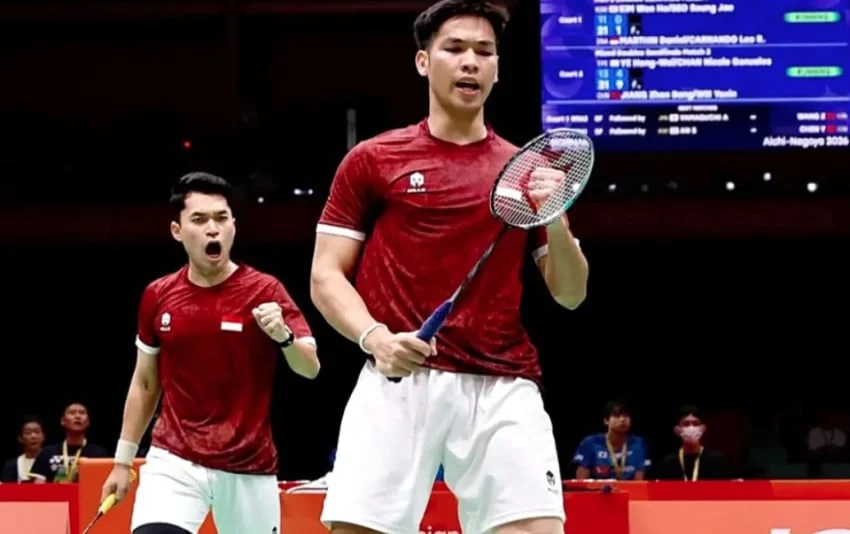
NAGOYA — The Indonesian badminton contingent has solidified its status as a formidable force at the 2026 Asian Games in Nagoya, Japan, successfully clinching two coveted spots in the individual event finals. The progression of the mixed doubles pair Amri Syahnawi and Nita Violina Marwah, alongside the men’s doubles duo Leo Rolly Carnando and Daniel Marthin, marks a significant milestone for the national team, which continues to uphold Indonesia’s storied legacy in the sport on the continental stage.
While the celebration in the Indonesian camp is tempered by the bittersweet elimination of other top-tier prospects, the overall performance remains a testament to the depth of the national training program. The path to the podium has been rigorous, reflecting the high stakes and world-class caliber of competition synonymous with the Asian Games—a multisport event often described as the "Mini Olympics" due to the intense concentration of global badminton powerhouses.
Chronology of the Semifinal Clashes
The atmosphere at the tournament venue in Nagoya was electric as the semifinal round commenced, featuring a blend of established veterans and emerging talent. The Indonesian campaign experienced a mixture of tactical triumphs and challenging setbacks.
The day’s narrative began with the men’s singles category, where rising star Alwi Farhan faced a formidable hurdle in Thailand’s Kunlavut Vitidsarn. Despite his recent meteoric rise in the BWF rankings, Alwi found himself struggling to counter the tactical precision and defensive stability of the Thai player. The match concluded in a straight-games defeat for the Indonesian, with scores of 13-21 and 15-21. While the loss precludes him from the gold medal match, his performance throughout the tournament highlights his potential as a future mainstay in the elite ranks.
In the men’s doubles, the anticipation of an "All-Indonesian Final" was high, as two pairs were in contention to dominate the bracket. Fajar Alfian and Muhammad Shohibul Fikri stepped onto the court against the formidable Chinese pair of Liang Wei Keng and Wang Chang. The match was a grueling tactical battle. After dropping the first game 17-21, Fajar and Fikri demonstrated resilience by commanding the second game with a 21-13 scoreline. However, the decider proved difficult, as the Chinese duo exploited minor lapses in the Indonesian defense to pull away, ultimately handing Fajar and Fikri a 9-21 loss in the final game.
Conversely, the success of Amri Syahnawi and Nita Violina Marwah provided a much-needed boost for the team. Their strategic cohesion in the mixed doubles event has been a revelation, as they navigated a challenging field to secure their berth in the final. Similarly, Leo Rolly Carnando and Daniel Marthin continued their dominant run in the men’s doubles, showcasing the explosive power and speed that have made them one of the most dangerous pairings on the international circuit.
Supporting Data and Statistical Context
The 2026 Asian Games badminton competition has been characterized by extreme parity. With world rankings in the men’s and women’s categories tighter than ever, the margins for error are razor-thin. For Indonesia, the bronze medals secured by Alwi Farhan and the pair of Fajar Alfian and Muhammad Shohibul Fikri are essential contributors to the national medal tally.
In accordance with Asian Games regulations, there is no third-place play-off match. Consequently, all athletes who reach the semifinal stage are automatically awarded bronze medals. This structure ensures that the intensity of the competition is focused entirely on the gold and silver medal outcomes in the final round.
Data from the BWF World Tour circuit leading up to the 2026 Asian Games suggests that the Indonesian team has undergone a transition period. The emergence of younger pairings like Carnando and Marthin, combined with the strategic restructuring of mixed doubles units, has yielded dividends. Analytical metrics from the tournament indicate that the Indonesian men’s doubles output remains the most consistent across the Asian region, even as the Chinese and South Korean pairs continue to challenge the top spots.
Perspectives from the Coaching Staff and Players
While official statements from the Indonesian Badminton Association (PBSI) are pending detailed debriefs, insiders familiar with the team’s performance in Nagoya suggest that the coaching staff remains focused on the "process-oriented" development of the athletes.
"The Asian Games represents a unique pressure environment," noted an official familiar with the team’s preparation. "Every point counts, and the mental fatigue accumulated over the week is significant. We are proud of the resilience shown by all our representatives. The goal was to secure medals and reach finals, and we have accomplished those primary objectives."
For athletes like Alwi Farhan, the loss to a player of Kunlavut Vitidsarn’s caliber—a former World Champion—serves as a vital learning experience. Analysts note that for a young player, the ability to reach the podium at an event as prestigious as the Asian Games is a major indicator of future success. The focus for the remainder of the season will be on identifying the tactical gaps that were exploited during the semifinal loss to ensure future consistency.
Broader Implications for Indonesian Badminton
The implications of these results extend beyond the current medal count. As Indonesia prepares for the upcoming 2028 Olympic cycle, the performance at the 2026 Asian Games serves as a critical benchmark. The success of the mixed doubles category is particularly significant, as it indicates a resurgence in a discipline where Indonesia has historically faced difficulty in maintaining world-class depth.
Furthermore, the rivalry between the Indonesian men’s doubles pairs and their counterparts from China and Japan continues to define the sport. The failure to secure an All-Indonesian final this year is a reminder that the global field is rapidly evolving, with new training methodologies and high-performance technologies being integrated by rival nations.
For the sport of badminton in Indonesia, which is often regarded as the national pride, these results are met with both celebration and constructive criticism. The media and fans remain deeply invested in the sport, and the discourse surrounding these results will likely influence future funding and talent identification programs within the PBSI.
Looking Ahead to the Final
As the tournament moves toward its conclusion, all eyes are on the final matches. For Amri Syahnawi and Nita Violina Marwah, the final represents an opportunity to cement their names in the history books. Their performance will be scrutinized not just for the win, but for the tactical maturity they display against their opponents.
Similarly, the men’s doubles final featuring Leo Rolly Carnando and Daniel Marthin is expected to be one of the highlights of the Asian Games. Their explosive playstyle is well-suited for the quick court conditions in Nagoya, and their ability to execute under pressure will be tested to the absolute limit.
The broader impact of these Games will be measured by the total number of medals brought home, but for the badminton squad, the focus is singular: gold. Whether they succeed or fall short, the experience gained in Nagoya will be instrumental in shaping the trajectory of Indonesian badminton for years to come. As the final sets are played, the nation waits with bated breath, hopeful that the hard work of the last four years will culminate in the national anthem playing in the Nagoya arena.
The 2026 Asian Games have once again proven that badminton remains a central pillar of Asian sports. With the level of competition rising, Indonesia’s ability to remain in the upper echelon of the sport remains a source of immense pride. The dedication shown by the athletes, the support from the technical staff, and the unwavering enthusiasm of the fans ensure that badminton will continue to be the sport that defines Indonesia’s presence on the international stage. As the curtain falls on the semifinal stage, the focus shifts entirely to the champions who will emerge from the final matches, carrying the weight and the hopes of an entire nation.