The maintenance of high-rise structures has long been considered one of the most hazardous tasks in the industrial and commercial sectors. For decades, the skyline of major metropolises has been defined by the presence of workers dangling from gondolas, rappelling down glass facades, or operating complex pulley systems to ensure the aesthetic and structural integrity of skyscrapers. However, a paradigm shift is underway as the integration of Unmanned Aerial Vehicles (UAVs), commonly known as drones, begins to redefine the standards of facade cleaning and maintenance. In Indonesia, this technological evolution is gaining traction, with local innovators like Frogs Indonesia spearheading the transition toward automated, safer, and more efficient cleaning solutions.
The Evolution of Facade Maintenance
Historically, building maintenance has relied heavily on the "Human-in-the-Loop" model. This approach involves significant operational costs, including the rental of heavy-duty gondolas, the implementation of complex fall-protection systems, and, most importantly, the exposure of personnel to high-risk environments. High-altitude work carries inherent dangers—ranging from sudden weather changes and wind turbulence to mechanical failure of support equipment.
For years, the industry has sought ways to mitigate these risks. The introduction of industrial drones—specifically designed for heavy-lift tasks and precise fluid application—represents the most significant technological leap in this sector since the invention of the motorized cradle. By shifting the worker from the precarious heights of a building facade to the safety of the ground, the industry is effectively moving toward a "Safety-First" operational philosophy.
Technological Architecture: How Drone Cleaning Operates
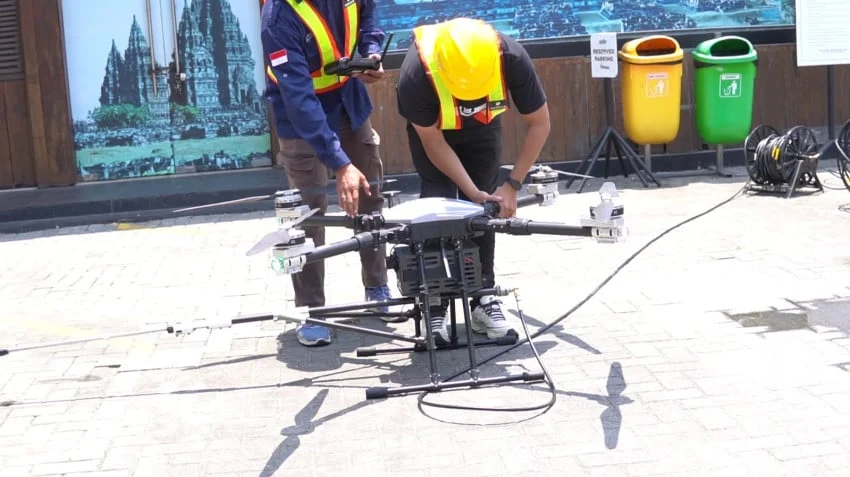
Unlike recreational drones, the specialized equipment currently being deployed by companies like Frogs Indonesia—such as the Nakula Series—is purpose-built for industrial utility. The technical configuration of these drones is distinct from standard aerial photography platforms.
The system operates via a tethered mechanism. A high-capacity pump stationed on the ground supplies water and cleaning agents through a reinforced, lightweight hose connected directly to the drone. This setup allows for continuous operation without the need to land for battery changes or liquid refills, which are the primary limiting factors for traditional battery-operated drones.
The nozzle configuration on the drone allows for high-pressure or mist-based spraying, depending on the surface material. By utilizing automated flight paths, the drone can maintain a consistent distance from the building, ensuring uniform cleaning while avoiding structural collisions. This level of precision is often difficult for human operators to replicate manually, especially under fluctuating wind conditions at high altitudes.
Chronology of Adoption and Industry Shifts
The transition to aerial cleaning did not happen overnight. It is the result of a multi-year convergence of battery technology improvements, sensor miniaturization, and software sophistication.
- Pre-2018: The market relied almost exclusively on manual labor using gondolas and rope access. Research into automated cleaning was largely restricted to theoretical models or expensive, building-integrated robotic arms.
- 2019-2021: The proliferation of heavy-lift agricultural drones provided the hardware baseline. Companies began experimenting with mounting sprayers to these platforms.
- 2022-2024: Industry standards began to emerge. Regulatory bodies in various countries started drafting guidelines for "Aerial Work Platforms," acknowledging that drones would soon replace some, if not all, of the manual labor required for facade washing.
- 2026 (Current Context): As demonstrated by the ongoing pilot projects in Jakarta, the technology has moved beyond the prototype phase and is now being integrated into the maintenance cycles of major commercial hotels and office complexes.
Official Perspectives and Industry Insights
Adhitya Chandra, CEO of Frogs Indonesia, has been a vocal advocate for the safety implications of this technology. During recent industry assessments, Chandra highlighted the gravity of the current labor conditions in the building maintenance sector. "If we look at the traditional method, cleaning high-rise buildings is a manual endeavor involving workers in gondolas, which poses substantial occupational risks," Chandra stated.
The move toward the Nakula Series and similar technologies is not merely about convenience; it is about risk management. For property management firms, the cost of insurance premiums for high-altitude workers is significant. Automating these tasks can theoretically reduce insurance liabilities and improve the safety record of the facility management firm.
From a regulatory standpoint, the adoption of drones also necessitates a new framework for civil aviation authorities. In Indonesia, the use of drones in urban environments requires strict adherence to flight zone regulations and safety protocols to ensure that no harm comes to pedestrians or property in the event of a technical malfunction.
Economic and Operational Implications
The economic impact of drone cleaning is multifaceted. While the initial capital expenditure for a professional-grade cleaning drone system is higher than purchasing standard cleaning supplies, the long-term operational costs are markedly lower.
- Labor Efficiency: A single drone team can often cover the same surface area as a three-person manual crew in a fraction of the time, as there is no need for the time-consuming setup of gondola tracks or rappelling equipment.
- Operational Continuity: Drones do not require the building to be shut down or restricted in the same way as traditional cleaning, which often involves blocking off sidewalks or access points for safety.
- Environmental Impact: Modern drone cleaning systems are designed to recycle water or use more efficient, concentrated cleaning agents, potentially reducing the overall water footprint of a building’s maintenance cycle.
Challenges and Future Limitations
Despite the clear advantages, the industry faces several hurdles before drone cleaning becomes the universal standard.
Firstly, atmospheric conditions remain a primary constraint. Drones, regardless of their power, are limited by wind speeds at higher altitudes. A building in a coastal city with high, gusty winds may not be suitable for current-generation drone cleaning. Secondly, the complexity of building architecture poses a challenge. While flat-surfaced glass facades are ideal for drones, ornate buildings with intricate carvings, deep recesses, or overhanging structures require advanced sensors and flight software to avoid collisions.
Furthermore, there is the issue of public perception and privacy. Drones equipped with cameras flying near office windows raise concerns about data privacy and surveillance. Developers and cleaning service providers must implement strict data-wiping policies and software locks to ensure that drones are only capturing the data necessary for flight navigation and cleaning monitoring.
A Data-Driven Analysis of Safety
Statistical data from the global construction and maintenance industry indicates that falls from heights remain the leading cause of fatal accidents among maintenance workers. By removing the worker from the "high-risk zone," the application of drone technology is statistically likely to reduce incident rates by a significant margin.
Industry analysts suggest that as the adoption of these technologies scales, the cost of the hardware will decrease, leading to an "industrial democratization" of the technology. We are likely to see a shift where drone cleaning becomes a standard requirement in the bidding process for skyscraper maintenance contracts. Building owners, increasingly sensitive to Environmental, Social, and Governance (ESG) criteria, will prioritize firms that utilize automated, safer, and more environmentally friendly cleaning solutions.
Conclusion: The Future of Urban Maintenance
The integration of drones into the maintenance of high-rise buildings in Indonesia is a microcosm of a broader, global shift toward industrial automation. As companies like Frogs Indonesia continue to refine the Nakula Series, the focus will likely expand from simple facade cleaning to include structural integrity inspections, thermal imaging for energy loss detection, and window repair diagnostics—all performed by a single aerial platform.
The skyline of the future will not only be taller and more complex, but it will also be cleaner, maintained by silent, precise, and remotely operated fleets. This evolution marks the end of an era where human life was a necessary component of routine maintenance, signaling a new age of safety, efficiency, and technological integration in the heart of our urban centers. As the industry moves forward, the synergy between human oversight and robotic execution will define the new standard for the high-rise landscape, ensuring that the architectural marvels of our time remain pristine without placing human operators in harm’s way.