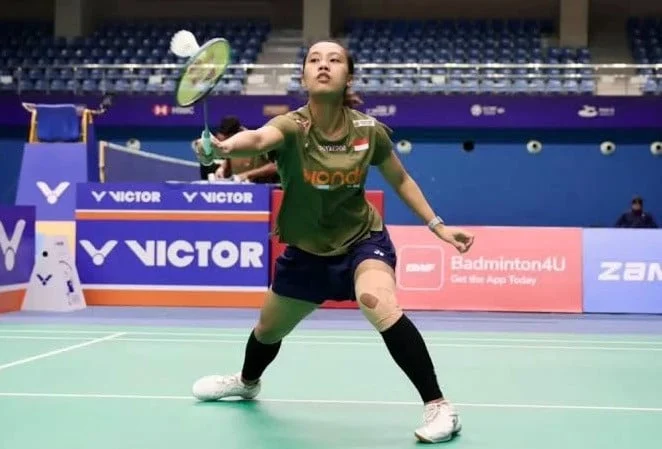
The Indonesian badminton campaign at the Korea Open 2026 reached a difficult juncture on Thursday, November 5, as two of the nation’s rising talents, Alwi Farhan and Mutiara Ayu Puspitasari, were eliminated during the Round of 16. Competing at the Jinnam Stadium in Yeosu, both athletes were defeated in grueling three-game matches against formidable opponents from Chinese Taipei, effectively ending their hopes of securing a podium finish in this BWF World Tour Super 500 event.
The results serve as a sobering reminder of the fierce competition levels currently present on the international circuit, particularly among the younger generation of shuttlers aiming to break into the world’s top 20 rankings.
A Heartbreaking Exit for Alwi Farhan
Alwi Farhan, one of Indonesia’s most promising men’s singles prospects, entered the court at Jinnam Stadium with high expectations following a solid performance in the previous round. His opponent, Wang Po-Pei of Chinese Taipei, proved to be a tactical adversary who excelled in defensive transitions.
The match began with clinical precision from the Indonesian side. Alwi displayed tactical maturity, maintaining a disciplined rhythm that forced Wang into unforced errors. By effectively utilizing the full width of the court, Alwi successfully closed out the first game with a score of 21-17. At this stage, the momentum appeared to be firmly in his favor, as he successfully mitigated Wang’s net-play attempts.
However, the second game witnessed a significant tactical shift. Wang increased the intensity of his rallies, forcing long, exhausting exchanges that tested Alwi’s physical endurance. As the score climbed into the high teens, the pressure intensified. The game pushed into deuce territory, a scenario where experience and mental fortitude often dictate the outcome. Despite Alwi’s best efforts to capitalize on his lead, Wang displayed remarkable composure, ultimately securing the second game 25-23.
The fatigue of the extended second game clearly impacted the final frame. In the decider, Alwi struggled to regain his rhythm as Wang seized control of the front court. Unable to sustain the pace, Alwi conceded the final game 15-21. The defeat marked a premature end to his campaign, underscoring the necessity for further physical conditioning when facing high-intensity opponents in back-to-back tournament cycles.
Mutiara Ayu Puspitasari’s Gallant Effort
In the women’s singles category, Mutiara Ayu Puspitasari faced a similarly difficult challenge against Lin Hsiang Ti of Chinese Taipei. Known for her technical versatility, Mutiara was expected to provide a stern test for her opponent.
The first game was a tightly contested affair that could have swung in either direction. Both players demonstrated high-level court coverage, leading to a close finish. Lin Hsiang Ti, however, showed superior focus during the closing moments, edging out Mutiara 22-20.
Showing the resilience that has characterized her career thus far, Mutiara responded with vigor in the second game. She altered her approach, opting for more aggressive smashes and cutting down the trajectory of her clears to limit Lin’s defensive options. Her efforts paid off as she leveled the match by winning the second game 21-19.
Despite the momentum swing, the third game saw a collapse in efficiency for the Indonesian representative. Lin capitalized on a series of errors from Mutiara, building a comfortable lead that proved insurmountable. Mutiara eventually bowed out with a 13-21 scoreline in the final game. While the loss is undoubtedly disappointing, the match highlighted Mutiara’s ability to compete with top-tier international opponents, provided she can maintain consistency across all three games.
Contextualizing the Korea Open 2026
The Korea Open 2026 is a critical stop on the BWF World Tour, offering substantial ranking points that are vital for players attempting to qualify for the end-of-year BWF World Tour Finals. Being a Super 500 level tournament, it attracts a deep field of competitors, ranging from established world champions to emerging stars looking to make their mark on the international stage.
For the Indonesian Badminton Association (PBSI), the tournament serves as a benchmark for the development of their young squad. With senior players transitioning out of the international circuit, the onus has fallen on talents like Alwi and Mutiara to uphold Indonesia’s tradition of excellence in the sport. The conditions at Jinnam Stadium, often characterized by high-speed shuttles and a drafty arena, have historically tested the adaptability of all participating nations, making the exits of Alwi and Mutiara a shared struggle among many international delegations this year.
Performance Analysis and Future Implications
From a technical perspective, both matches highlighted a recurring trend in modern badminton: the decreasing gap between top-tier players and the chasing pack. Both Alwi and Mutiara exhibited the skills required to compete at the highest level—sharp net play, effective movement, and strong defensive foundations. However, the inability to close out matches in two straight games remains a significant hurdle.
Physical durability is likely the next frontier for these athletes. In the current BWF schedule, which demands peak physical output over several consecutive weeks, the ability to recover between grueling three-game matches is essential. Analytical observers suggest that while the skill set is present, the tactical decision-making in the final games—specifically when under physical fatigue—needs refinement.
Coaching staff will likely look at these results to adjust training loads and tactical preparation. For Alwi Farhan, the focus will likely shift to improving his stamina during high-pressure late-game scenarios. For Mutiara, the emphasis may be placed on maintaining psychological consistency after losing a closely contested opening game.
Looking Ahead: The Road to Ranking Improvement
While the elimination of Alwi and Mutiara is a setback, it is not a defining failure. In the landscape of professional badminton, progression is rarely linear. Both players remain young, and the experience gained from facing high-caliber opponents in a competitive environment like the Korea Open is invaluable for their long-term development.
The focus for the Indonesian contingent now shifts to upcoming tournaments in the East Asian circuit. The lessons learned in Yeosu regarding court management, opponent analysis, and mental resilience will be integrated into their training programs. With the 2026 season entering its final months, every match serves as a building block for the following year, where these athletes will aim for more consistent deep-round appearances.
The defeat of these two players also brings to light the rising strength of players from Chinese Taipei, who have clearly invested heavily in their youth programs. The success of Wang Po-Pei and Lin Hsiang Ti is a testament to the global nature of the sport and the increasing difficulty of reaching the quarterfinals in major tournaments.
Official Statements and Coaching Perspective
While formal press conferences following the matches were brief, the prevailing sentiment within the Indonesian team camp is one of constructive evaluation. Coaching staff noted that both players showed flashes of world-class play, but ultimately lacked the "finishing touch" required to overcome the mental fatigue associated with long rallies.
"It is a tough loss for both," a team spokesperson noted. "Both Alwi and Mutiara have the technical tools. The challenge now is to bridge the gap between playing well and winning under pressure. We will review the match footage, identify the specific points where the momentum shifted, and work on these technical aspects before the next training camp."
The Indonesian delegation, while disappointed, remains committed to the long-term vision of nurturing this cohort of players. The defeat is viewed not as a finality, but as an essential part of the professional evolution of these athletes.
Conclusion: A Stepping Stone for Development
The 2026 Korea Open will be remembered by the Indonesian camp as a tournament of missed opportunities, but also as a venue for significant learning. As Alwi Farhan and Mutiara Ayu Puspitasari pack their gear and prepare for the next leg of the tour, they do so with a clear understanding of the areas requiring immediate improvement.
The reality of professional badminton is that even the most talented players must endure periods of transition and defeat. For the Indonesian team, the focus remains on the broader horizon. The path to the elite tier of world badminton is demanding, requiring not just talent, but an unwavering commitment to refinement and recovery. As the tournament in Yeosu continues toward its conclusion, the Indonesian team will turn its attention to analysis, rest, and the next challenge on the world stage. The ambition to return to the podium remains, and the journey toward that goal continues in the upcoming weeks of competition.