
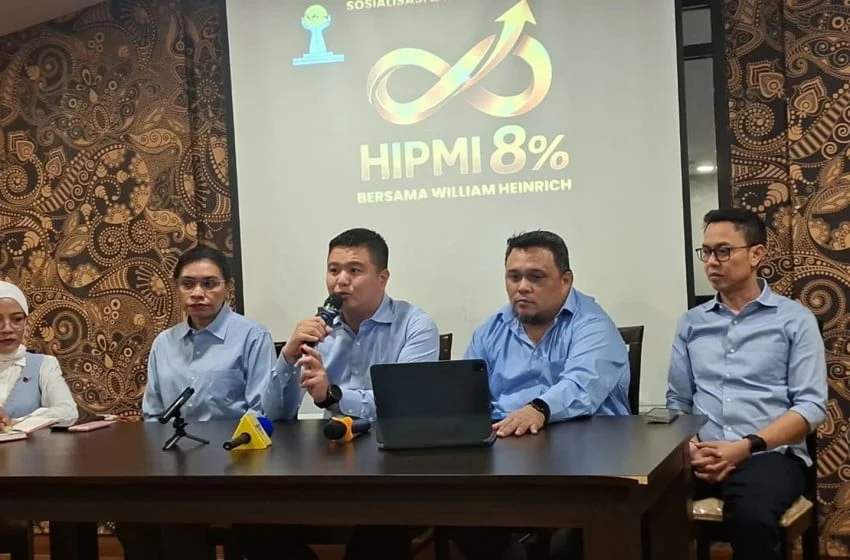
JAKARTA – William Heinrich, a leading candidate for the chairmanship of the Indonesian Young Entrepreneurs Association (BPP HIPMI), has voiced strong optimism that robust collaboration between the government and the private sector will be the indispensable cornerstone for achieving Indonesia’s ambitious "Indonesia Emas 2045" (Golden Indonesia 2045) vision. Speaking at a press conference held in the heart of Jakarta’s bustling SCBD district on Wednesday, April 15, 2026, Heinrich unveiled his strategic proposal, dubbed "HIPMI 8%," designed to galvanize national economic growth and align directly with the policy directives of President-elect Prabowo Subianto’s incoming administration.
Heinrich emphasized that an aggressive target of 8 percent economic growth is not merely aspirational but an urgent necessity for Indonesia to successfully navigate and ultimately escape the pervasive "middle-income trap." He underscored the critical importance of capitalizing on the nation’s demographic bonus, a window of opportunity that, if missed, could have profound long-term repercussions. This crucial period, he argued, demands unprecedented synergy between state apparatus and the entrepreneurial ecosystem, with a particular focus on empowering young business leaders. In his detailed exposition, Heinrich highlighted that given the inherent limitations of government fiscal capacity, the real sector, spearheaded by dynamic entrepreneurs, must assume a significantly expanded role in driving economic prosperity and innovation.
The Strategic Imperative of "HIPMI 8%": Accelerating National Growth
The "HIPMI 8%" initiative represents a bold and meticulously crafted economic agenda, positioning the Indonesian Young Entrepreneurs Association at the forefront of the nation’s developmental aspirations. Heinrich articulated that achieving a sustained 8 percent annual economic growth rate is paramount to transforming Indonesia from a middle-income country into a high-income nation by 2045, thereby fulfilling the "Indonesia Emas" vision. This growth target, he elaborated, is meticulously designed to create millions of new jobs, foster widespread innovation, and significantly enhance the overall welfare of the Indonesian populace.
Central to the "HIPMI 8%" proposal is the recognition that conventional growth models may no longer suffice. Instead, Heinrich advocates for a multi-pronged approach that includes stimulating domestic investment, attracting foreign direct investment, enhancing productivity through technological adoption, and nurturing a vibrant ecosystem for small and medium-sized enterprises (SMEs) and startups. He envisions HIPMI members acting as catalysts for this transformation, leveraging their agility, entrepreneurial spirit, and innovative capabilities across various sectors, from digital economy to manufacturing and agriculture. The initiative also emphasizes skill development and vocational training, ensuring that Indonesia’s burgeoning youth population is equipped with the competencies required by a rapidly evolving global economy.
Background: The Vision of "Indonesia Emas 2045"
The "Indonesia Emas 2045" vision is a national long-term development framework that projects Indonesia as a sovereign, advanced, just, and prosperous nation by its centenary of independence in 2045. This ambitious vision encompasses several key pillars, including robust human capital development, comprehensive economic transformation, sustainable and equitable development, and resilient national governance. The overarching goal is for Indonesia to become one of the world’s top five economies, characterized by high per capita income, advanced infrastructure, and a globally competitive workforce.
The genesis of this vision can be traced back to various national development plans and strategic blueprints, reflecting a concerted effort across successive administrations to chart a clear path for Indonesia’s future. It recognizes the country’s immense potential, driven by its vast natural resources, strategic geographical location, and a large, young population. Achieving "Indonesia Emas" requires sustained economic growth, structural reforms, and a synchronized effort from all societal components, including the government, private sector, academia, and civil society. Heinrich’s "HIPMI 8%" proposal directly aligns with and seeks to provide a crucial private-sector engine for this overarching national aspiration, particularly in the critical two decades leading up to 2045.
Navigating the Middle-Income Trap and Seizing the Demographic Dividend
Indonesia’s current economic trajectory places it at a critical juncture, facing the challenge of the "middle-income trap" while simultaneously being presented with a significant demographic opportunity. The middle-income trap refers to a phenomenon where a country achieves middle-income status but then struggles to transition to high-income status due to a loss of competitiveness, inadequate institutional development, or failure to innovate. Countries like Malaysia and Thailand have experienced similar challenges, while others, such as South Korea and Singapore, successfully navigated this phase through strategic investments in human capital, technology, and robust governance.
For Indonesia, escaping this trap necessitates a fundamental shift from reliance on natural resources and low-cost labor to an economy driven by innovation, high-value manufacturing, and advanced services. This requires significant improvements in productivity, a more skilled workforce, and an environment conducive to research and development. Heinrich’s call for 8% growth directly targets this challenge, aiming to provide the necessary momentum to propel Indonesia beyond this economic plateau.
Concurrently, Indonesia is experiencing a "demographic bonus," a period when the proportion of its working-age population is exceptionally large relative to its dependents. This window, which is expected to peak in the coming years, offers an unprecedented opportunity for accelerated economic growth, provided that the working-age population is productive, well-educated, and gainfully employed. If this bonus is not effectively utilized through job creation, skill development, and entrepreneurial empowerment, it risks turning into a demographic burden, leading to social and economic instability. Heinrich’s emphasis on youth entrepreneurs and the private sector’s role in job creation directly addresses this critical aspect, highlighting the urgency of transforming potential into prosperity.
The Pivotal Role of HIPMI and Young Entrepreneurs
HIPMI, established in 1972, stands as one of Indonesia’s most influential business organizations, dedicated to fostering entrepreneurship and promoting the interests of young Indonesian business leaders. With a vast network spanning across provinces and districts, HIPMI plays a crucial role in shaping the national economic discourse and nurturing the next generation of business innovators. Its mandate extends beyond mere advocacy, encompassing mentorship programs, networking opportunities, and active engagement in policy formulation.
Young entrepreneurs, the core constituency of HIPMI, are increasingly recognized as vital engines of economic growth. Their propensity for innovation, adaptability to new technologies, risk-taking ability, and capacity for job creation make them indispensable for a dynamic economy. Heinrich’s vision for HIPMI under his leadership is to transform it into a more proactive and impactful force, directly contributing to the national economic agenda. He envisions HIPMI as a platform for developing high-growth enterprises, facilitating access to capital and markets for young business owners, and actively participating in the digital transformation of the Indonesian economy. By empowering young entrepreneurs, HIPMI aims to unlock new sources of growth, diversify the economy, and build a more resilient and competitive private sector.
Government-Business Synergy: A Blueprint for Success
The concept of robust government-business synergy is a universally acknowledged prerequisite for sustainable national development. Successful economies worldwide demonstrate that effective collaboration between the public and private sectors leads to more coherent policies, efficient resource allocation, accelerated infrastructure development, and a more predictable investment climate. In Indonesia’s context, such synergy is crucial for several reasons:
- Policy Effectiveness: Government policies, particularly those related to investment, trade, and industry, are significantly more effective when informed by insights and feedback from the private sector.
- Resource Mobilization: The private sector possesses vast capital, technological expertise, and managerial acumen that can complement government resources, especially in large-scale infrastructure projects or strategic industries.
- Innovation and Competitiveness: Collaboration fosters an environment where innovation can flourish, driving industries to become more competitive globally. Public-private partnerships in R&D, for instance, can yield significant breakthroughs.
- Trust and Stability: A strong relationship built on mutual trust between government and business reduces uncertainties, encourages long-term investments, and contributes to overall economic stability.
While Indonesia has made strides in improving its business environment, challenges such as bureaucratic inefficiencies, regulatory complexities, and issues related to legal certainty sometimes hinder optimal collaboration. Heinrich’s proposal implicitly seeks to address these by advocating for a more streamlined and responsive partnership, where the private sector is not just a recipient of policies but an active co-creator. His alignment with President-elect Prabowo Subianto’s focus on national strength and economic self-reliance further underscores the potential for a unified approach to economic development.
Chronology of the Announcement and Campaign Context
The press conference, held on Wednesday, April 15, 2026, at the prestigious SCBD complex in South Jakarta, served as a pivotal moment in William Heinrich’s campaign for the BPP HIPMI chairmanship. This event followed earlier announcements where Heinrich demonstrated his serious intent to contest the leadership position, including the formation of a dedicated winning committee. The timing of this strategic announcement is particularly significant, occurring in the post-election period and as the nation gears up for the formal transition of power to the new administration under President-elect Prabowo Subianto.
By presenting the "HIPMI 8%" initiative, Heinrich effectively positioned his campaign not merely as a bid for organizational leadership but as a comprehensive vision for national economic contribution. His public address was carefully crafted to resonate with both the entrepreneurial community and national policymakers, emphasizing the alignment of his proposed agenda with the broader national goals encapsulated in "Indonesia Emas 2045." The event underscored the intensity and strategic depth of the ongoing HIPMI leadership race, with candidates vying to demonstrate their capacity for impactful leadership and their ability to contribute meaningfully to Indonesia’s future prosperity.
Potential Implications and Way Forward
William Heinrich’s "HIPMI 8%" initiative, coupled with his strong emphasis on government-business collaboration, carries significant implications across several dimensions of Indonesia’s development:
- For the Economy: If successfully implemented, the proposal could indeed accelerate Indonesia’s economic growth trajectory, diversify its economic base, and create substantial employment opportunities, particularly for the youth. Achieving 8% growth would necessitate robust investment, increased productivity, and a dynamic entrepreneurial landscape.
- For Policy: Heinrich’s advocacy could prompt the incoming administration to prioritize policies that foster greater private sector participation, simplify regulatory frameworks, and enhance the ease of doing business. It could also encourage more targeted incentives for sectors identified as key growth drivers.
- For HIPMI: Under Heinrich’s potential leadership, HIPMI could elevate its national profile and solidify its position as a critical stakeholder in national economic planning. This could lead to increased influence in policy advocacy, expanded membership, and greater opportunities for its members to contribute to high-impact projects.
- Challenges: The ambitious 8% growth target faces numerous potential hurdles, including global economic volatility, geopolitical uncertainties, the need for deep structural reforms, and the consistent political will to implement potentially challenging policies. Effective coordination across multiple government ministries and agencies, as well as overcoming entrenched bureaucratic inertia, will be crucial.
The path forward will require not only ambitious targets but also concrete action plans, measurable milestones, and a robust monitoring and evaluation framework. The success of "HIPMI 8%" will ultimately depend on the ability of HIPMI, in collaboration with the government, to translate these strategic aspirations into tangible results on the ground.
Inferred Statements and Reactions from Related Parties
While specific reactions were not detailed in the initial report, based on the nature of Heinrich’s proposal and the current economic climate, several responses can be logically inferred:
- Government Officials: Representatives from economic ministries, such as the Coordinating Ministry for Economic Affairs and the Ministry of Finance, would likely welcome such private sector initiatives. They would probably reiterate the government’s commitment to achieving "Indonesia Emas 2045" and emphasize the importance of private sector investment and job creation. Statements would likely focus on maintaining macroeconomic stability, improving the investment climate, and ensuring a predictable regulatory environment to support business growth.
- Other Business Leaders and Economists: General consensus would likely support the call for increased government-business collaboration and the need for higher economic growth. However, some economists might express cautious optimism regarding the feasibility of a sustained 8% growth rate without more fundamental structural reforms, particularly in areas like education, infrastructure quality, and institutional efficiency. Other business leaders might emphasize the need for specific policy adjustments, such as tax incentives, reduced bureaucracy, and improved access to financing for SMEs, to truly unlock the private sector’s potential.
- Youth and Academia: Young professionals and academics would likely view the "HIPMI 8%" initiative positively, especially its focus on job creation and entrepreneurial opportunities. There would be an expectation for concrete programs that support skill development, foster innovation ecosystems, and provide mentorship for aspiring entrepreneurs.
In conclusion, William Heinrich’s unveiling of the "HIPMI 8%" initiative marks a significant moment in the ongoing discourse surrounding Indonesia’s economic future. His unwavering optimism in the power of government-business collaboration as the primary catalyst for achieving the "Indonesia Emas 2045" vision provides a compelling blueprint for accelerated growth. As Indonesia stands at a critical juncture, poised to either capitalize on its demographic dividend or succumb to the middle-income trap, Heinrich’s proposal injects a renewed sense of urgency and a clear call to action for all stakeholders. The coming years will reveal whether this ambitious vision can be translated into the sustained, high-impact economic transformation that Indonesia needs to secure its place among the world’s leading nations.
