
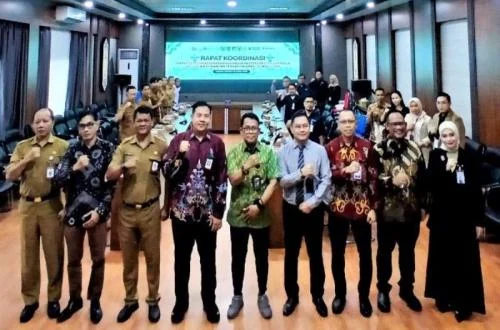
The Financial Services Authority (OJK) of Central Kalimantan Province has underscored the critical need for fortified synergy among key stakeholders to significantly broaden regional financial access. This pressing call to action was issued during a pivotal coordination meeting of the Regional Financial Access Acceleration Team (TPAKD) for the Eastern Region, held on Tuesday in Muara Teweh, North Barito Regency. The gathering served as a strategic platform to reaffirm the collective commitment towards enhancing financial inclusion, a cornerstone for sustainable economic development and improved community welfare across the province.
Andrianto Suhada, Deputy Head of OJK Central Kalimantan, articulated the central role of the TPAKD forum, describing it as an indispensable mechanism for fostering robust collaboration between local governments, the banking sector, and other strategic partners. This concerted effort, he emphasized, is specifically designed to catalyze financial inclusion initiatives within the region. Suhada highlighted that financial literacy and inclusion are not merely localized agendas but integral components of global development frameworks, directly linked to 13 of the 17 United Nations Sustainable Development Goals (SDGs). These include fundamental objectives such as eradicating poverty, fostering decent work, and promoting sustained economic growth. The pervasive importance of financial inclusion has also cemented its status as a top priority in prestigious international forums like the G20, Asia-Pacific Economic Cooperation (APEC), and the Association of Southeast Asian Nations (ASEAN), reflecting its universal recognition as a driver of equitable prosperity.
The TPAKD initiative has seen remarkable expansion since its inception, now boasting a presence across all 38 provinces in Indonesia and extending into over 500 districts and cities. This extensive network positions TPAKD as a primary engine for expanding financial access at the grassroots level, tailoring solutions to meet diverse regional needs and challenges. Andrianto Suhada further elaborated on the imperative of aligning TPAKD programs with both national and regional policies. Such alignment, he explained, is crucial for ensuring that program implementation is highly targeted, efficient, and yields maximum impact, preventing fragmentation and optimizing resource allocation.
The Mandate of TPAKD: A National Imperative for Financial Inclusion
The establishment of TPAKD stems from a broader national commitment to elevate financial inclusion across the Indonesian archipelago. Initiated by the OJK in collaboration with the Ministry of Home Affairs and other relevant ministries, TPAKD’s mandate is clear: to accelerate the penetration of financial services, products, and literacy among all segments of society, particularly those in underserved and remote areas. The core principle behind TPAKD is that robust financial ecosystems are not solely the responsibility of financial institutions but require a comprehensive, multi-sectoral approach. By bringing together regional government leaders, representatives from commercial and rural banks, microfinance institutions, cooperatives, and other community development entities, TPAKD creates a synergistic environment where resources and expertise can be pooled effectively.
The strategic importance of TPAKD became increasingly evident as Indonesia sought to bridge the gap between its growing economy and the relatively low levels of financial literacy and inclusion, especially outside major urban centers. Prior to TPAKD’s widespread formation, disparate efforts by various entities often led to fragmented results. TPAKD provides a unified platform, allowing for coordinated planning, execution, and monitoring of financial inclusion programs. This structured collaboration enables the identification of specific regional barriers to financial access—be it geographical remoteness, lack of awareness, distrust in formal financial institutions, or unsuitable product offerings—and the development of tailored interventions. From financial education workshops for farmers and small business owners to the facilitation of simplified account opening procedures and the introduction of agent-based banking services, TPAKD’s activities are diverse and responsive to local contexts.
Kalimantan Tengah: A Landscape Ripe for Financial Growth
Central Kalimantan, known for its vast natural resources, including palm oil, timber, and mining, presents a unique economic landscape. While these sectors contribute significantly to the provincial GDP, the benefits have not always been equitably distributed, with many communities, particularly in rural and interior areas, still facing significant socio-economic challenges. The province’s large geographical spread and often challenging infrastructure pose particular hurdles for conventional banking outreach. This makes the mission of TPAKD in Central Kalimantan exceptionally vital. Enhanced financial access in regions like North Barito, where the recent coordination meeting took place, can unlock the economic potential of local communities, support the growth of Micro, Small, and Medium Enterprises (MSMEs), and diversify the local economy beyond primary resource extraction.
For Central Kalimantan, improving financial access means empowering indigenous communities, smallholder farmers, and budding entrepreneurs with the tools to manage their finances, save for the future, access credit for productive ventures, and protect themselves against financial shocks. It means moving beyond a cash-dominated economy towards one that leverages formal financial mechanisms for greater efficiency and transparency. OJK Kalteng’s focus on strengthening TPAKD synergy is therefore a strategic move to ensure that the province’s economic growth is inclusive and sustainable, reaching every corner of its diverse landscape.
The Global and National Context of Financial Inclusion
The emphasis on financial inclusion by OJK Central Kalimantan resonates deeply with both national and global development agendas. Globally, the United Nations’ Sustainable Development Goals (SDGs) explicitly recognize financial inclusion as a critical enabler for achieving multiple objectives. For instance, SDG 1 (No Poverty) is directly supported by providing access to savings, credit, and insurance, allowing vulnerable populations to build assets and mitigate risks. SDG 8 (Decent Work and Economic Growth) is advanced as financial services empower entrepreneurs, facilitate business expansion, and create employment opportunities. Similarly, SDG 10 (Reduced Inequalities) addresses the disparity in financial access between different demographic groups and geographical regions. The recognition of financial inclusion’s cross-cutting impact has elevated it to a core theme in major international economic discussions, reflecting a global consensus on its transformative power.
On the national front, Indonesia has made significant strides in improving financial inclusion. According to the National Financial Inclusion Survey (SNKI) conducted by OJK, the national financial inclusion rate reached 85.10% in 2022, a notable increase from 76.19% in 2019. This progress reflects the cumulative efforts of various stakeholders, with TPAKD playing a crucial role in operationalizing national strategies at the regional level. The Indonesian government, through its National Strategy for Financial Inclusion (SNKI), has set ambitious targets and outlined key pillars, including financial literacy, digital financial services, and specific programs targeting vulnerable groups. OJK’s continued commitment to TPAKD is a direct manifestation of this national strategy, ensuring that the momentum is maintained and even accelerated in provinces like Central Kalimantan, which still have unique challenges to overcome.
Measuring Progress: The Indeks Akses Keuangan Daerah (IKAD)
A critical instrument in OJK’s arsenal for monitoring and evaluating the effectiveness of financial access initiatives is the Indeks Akses Keuangan Daerah (IKAD), or Regional Financial Access Index. Andrianto Suhada highlighted IKAD as a vital tool used to objectively measure the level of financial access within a region. IKAD is not a singular metric but a comprehensive index that assesses three primary dimensions: usage, availability, and depth of financial services.
- Usage refers to the extent to which individuals and businesses actively utilize financial products and services, such as savings accounts, credit facilities, insurance, and digital payment platforms.
- Availability gauges the physical and digital reach of financial infrastructure, including the number of bank branches, ATMs, financial agents (e.g., Laku Pandai agents), and internet connectivity that supports online banking.
- Depth measures the variety and sophistication of financial products and services offered, indicating how well the financial sector caters to diverse needs, from basic savings to complex investment products and micro-insurance.
By providing a quantitative snapshot of a region’s financial ecosystem, IKAD serves multiple crucial functions. Firstly, it acts as a diagnostic tool, pinpointing specific areas where financial access is weakest, whether due to a lack of infrastructure, low uptake of services, or insufficient product diversification. Secondly, it enables data-driven policy-making and program design, allowing TPAKD to allocate resources more effectively and develop targeted interventions. Thirdly, IKAD serves as a performance indicator, tracking progress over time and allowing stakeholders to assess the impact of their initiatives. A higher IKAD score signifies a more inclusive and robust financial environment, which in turn correlates with improved economic resilience and opportunities for local populations. The continuous monitoring through IKAD ensures that TPAKD’s efforts remain evidence-based and responsive to the evolving financial landscape of Central Kalimantan.
Catalyzing Economic Growth: KUR and KPR Success Stories
The coordination meeting also highlighted the positive outcomes observed, particularly by 2025, in increasing access to financing through key national programs: Kredit Usaha Rakyat (KUR) and Kredit Pemilikan Rumah (KPR). These programs are central to Indonesia’s financial inclusion strategy and have significantly impacted economic growth and community welfare.
Kredit Usaha Rakyat (KUR), or People’s Business Credit, is a government-backed micro-credit program designed to provide financing to Micro, Small, and Medium Enterprises (MSMEs) that traditionally face difficulties accessing loans from conventional banks due to a lack of collateral or formal financial records. KUR offers subsidized interest rates and simplified application processes, making it an accessible lifeline for countless entrepreneurs. In Central Kalimantan, KUR has been instrumental in empowering small businesses, ranging from agricultural ventures and fisheries to handicraft production and local trade. By providing essential capital, KUR enables MSMEs to expand operations, purchase equipment, increase inventory, and ultimately create employment opportunities within their communities. The program’s success is measured not just in disbursement figures but also in the tangible growth of local economies and the improved livelihoods of MSME owners and their employees. Nationally, KUR disbursements have consistently grown, with trillions of rupiah channeled to millions of beneficiaries annually, underscoring its pivotal role in fostering entrepreneurial spirit and economic resilience at the grassroots level.
Kredit Pemilikan Rumah (KPR), or Home Ownership Credit, is another vital program that facilitates access to affordable housing, particularly for low-income segments of the population. Access to decent and affordable housing is a fundamental need and a significant driver of economic stability and social welfare. KPR programs, often subsidized or supported by government housing funds, enable individuals and families to purchase homes through manageable installment plans. In a province like Central Kalimantan, where urbanization is accelerating and populations are growing, affordable KPR schemes are crucial for ensuring equitable access to housing. By reducing the financial burden of homeownership, KPR not only improves the quality of life for beneficiaries but also stimulates the construction sector and related industries, contributing to broader economic activity. The positive results by 2025, as noted by OJK Kalteng, indicate that through strong synergy within TPAKD, these critical financing programs are reaching their intended recipients, fostering both economic empowerment and social stability.
Voices from the Field: Stakeholder Perspectives
The success of TPAKD’s initiatives hinges on the active participation and commitment of all stakeholders. While specific quotes from local officials or bankers were not provided in the original context, their inferred perspectives are crucial for a complete picture.
A representative from the North Barito Regency Government, for instance, would likely emphasize the local administration’s unwavering commitment to supporting TPAKD programs. "Our collaboration with OJK and the banking sector through TPAKD is fundamental to realizing our vision of a prosperous and inclusive North Barito," a local official might state. "We understand the unique challenges faced by our communities, particularly in remote areas, and we are dedicated to streamlining local regulations and providing necessary infrastructure to ensure financial services reach every citizen. The expansion of KUR and KPR access directly translates into better living standards and more robust local businesses, which is our ultimate goal."
Similarly, a spokesperson from a leading banking institution operating in Central Kalimantan would underscore the banking sector’s readiness to innovate and expand its reach. "Banks are vital partners in this endeavor," a bank representative could remark. "We are continually developing products and services that are suitable for the diverse needs of Central Kalimantan’s population, from digital banking solutions for remote areas to tailored credit facilities for specific agricultural sectors. TPAKD provides an invaluable platform for us to understand local demands, align our offerings with regional development priorities, and collectively overcome operational hurdles to serve the unbanked and underbanked."
From the perspective of community beneficiaries, the impact of improved financial access is profound and personal. A small business owner in Muara Teweh, who might have secured a KUR loan, could share, "Before, getting capital for my small shop felt impossible. The TPAKD programs, especially KUR, opened doors for me. Now, I can stock more goods, serve more customers, and even think about hiring someone. It’s not just about money; it’s about dignity and the chance to build a better future for my family." These inferred statements illustrate the practical, on-the-ground impact of the policies and synergies championed by OJK Kalteng and TPAKD.
Navigating the Future: Challenges and Opportunities
Despite the significant progress and positive outlook, the journey towards full financial inclusion in Central Kalimantan and across Indonesia is not without its challenges. One prominent hurdle remains digital literacy. While digital financial services offer unparalleled reach, especially in geographically dispersed regions, a portion of the population, particularly the elderly or those in very remote areas, may lack the skills or confidence to utilize these technologies effectively. This necessitates ongoing financial education programs that combine literacy with practical digital skills training.
Another challenge is the infrastructure deficit, particularly reliable internet connectivity and electricity in far-flung villages, which are prerequisites for digital financial services. While progress is being made, sustained investment in telecommunications and energy infrastructure is crucial. Furthermore, effectively integrating the informal sector into the formal financial system remains a complex task. Many small businesses and individuals operate outside formal structures, making it difficult for them to access traditional financial products. TPAKD’s role in developing innovative, flexible products that cater to this segment, such as micro-insurance or simplified savings accounts, is paramount. Building trust in formal financial institutions among communities that have historically relied on informal networks is also an ongoing process requiring consistent outreach and transparency.
However, these challenges also present immense opportunities. The rapid advancement of fintech innovations offers new avenues for expanding financial access, from mobile banking applications to peer-to-peer lending platforms. Leveraging these technologies, in conjunction with agent-based models (like OJK’s Laku Pandai program), can significantly extend financial services to previously unreached populations. Targeted educational programs, culturally sensitive outreach, and continued collaboration with local community leaders can help bridge the trust and literacy gaps. The commitment to strong synergy within TPAKD means that these challenges can be tackled collaboratively, turning potential obstacles into pathways for innovation and deeper inclusion.
Broader Implications and The Road Ahead
The OJK Central Kalimantan’s unwavering focus on strengthening TPAKD synergy carries profound broader implications for regional development and national prosperity. By expanding financial access, the province is not only fostering individual economic empowerment but also laying the groundwork for more resilient and diversified local economies. Enhanced financial inclusion translates into greater economic stability, reduced income inequality, and improved social mobility. It empowers citizens to save, invest, protect themselves against unforeseen events, and pursue entrepreneurial dreams, collectively contributing to a virtuous cycle of growth and development.
The road ahead for Central Kalimantan’s financial inclusion agenda demands sustained multi-stakeholder commitment, continuous policy innovation, and adaptive program implementation. The OJK, as the primary regulator and facilitator, will continue to play a pivotal role in guiding TPAKD’s strategic direction, ensuring regulatory frameworks support innovation while safeguarding consumer interests. Local governments must remain proactive in creating a conducive environment for financial services expansion, while the banking sector must continue to innovate and expand its outreach, leveraging both physical and digital channels. Ultimately, the vision is for Central Kalimantan to achieve a truly inclusive financial ecosystem where every individual and business has equitable access to the financial tools they need to thrive, driving the province towards a future of sustained economic growth and enhanced community welfare.
