
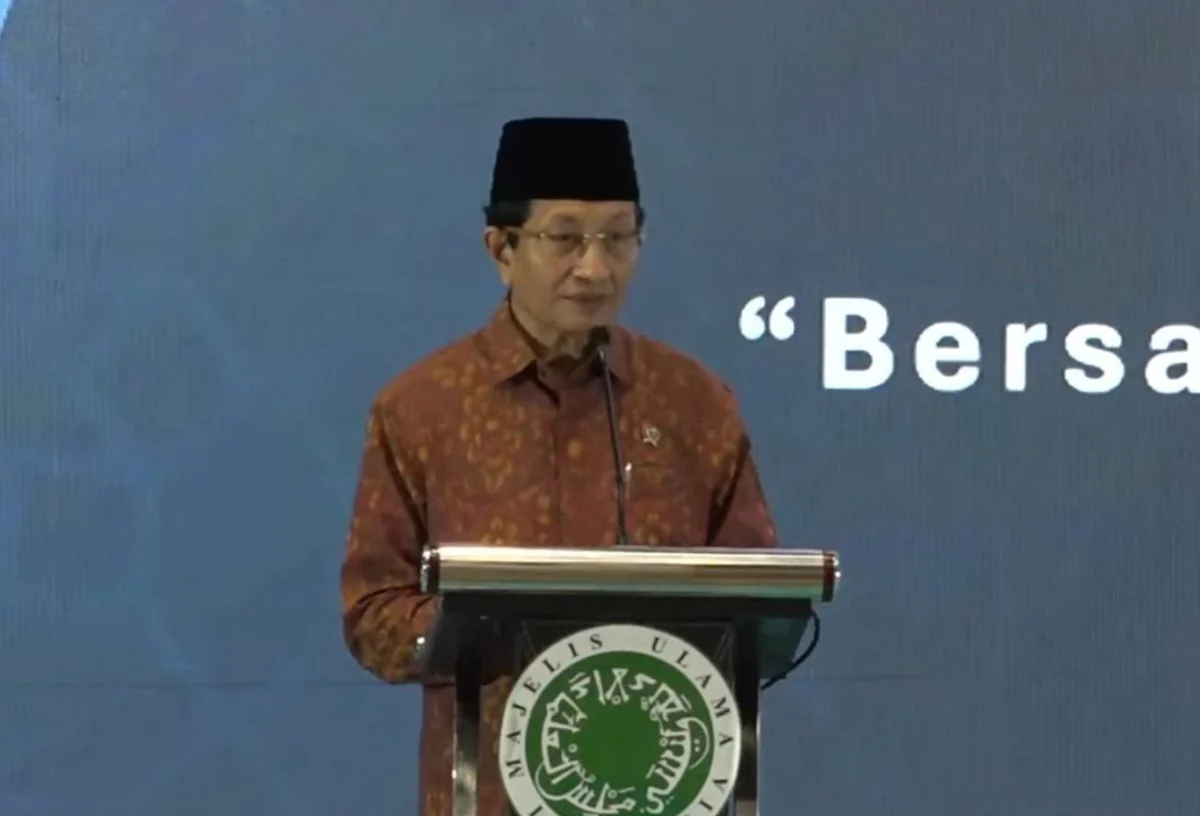
JAKARTA – Indonesia’s Minister of Religious Affairs, Nasaruddin Umar, has issued a compelling call to the Majelis Ulama Indonesia (MUI) and various Islamic community organizations (Ormas Islam) to intensify their active roles within society, particularly as guiding and calming forces amidst an increasingly unpredictable global landscape and the pervasive challenges of information disruption. Speaking at the National Silaturahmi of Islamic Organizations and the Eid al-Fitr 1447 H Halalbihalal hosted by the MUI in Jakarta on Wednesday, April 15, 2026, Minister Umar underscored the critical importance of these institutions in maintaining social cohesion and providing clarity in turbulent times.
“The Majelis Ulama must stand as a beacon, guiding direction, safeguarding balance, and serving as a soothing reference point amidst various differences,” Minister Umar articulated in his address, emphasizing the indispensable nature of religious leadership in fostering national unity and resilience. The government, he further elaborated, views MUI and Islamic organizations not merely as stakeholders but as irreplaceable strategic partners in navigating the complexities of modern society. This partnership, he noted, is founded on a shared vision for a harmonious and prosperous Indonesia, underscoring the government’s profound yet fundamental expectations for these influential bodies.
The Significance of the Silaturahmi Nasional and Halalbihalal
The event itself, a National Silaturahmi (a gathering to strengthen kinship and ties) combined with a Halalbihalal (a post-Eid al-Fitr tradition of seeking and granting forgiveness), held immense cultural and religious significance. Occurring shortly after the conclusion of Eid al-Fitr 1447 H, it provided a vital platform for leaders and representatives from diverse Islamic organizations across Indonesia to convene, reconcile, and reaffirm their collective commitment to the nation. These gatherings are deeply embedded in Indonesian culture, symbolizing renewal, solidarity, and the collective spirit of the Muslim community. For the Ministry of Religious Affairs (Kemenag) and the MUI, it was an opportune moment to consolidate efforts and outline strategies for addressing pressing national and global issues. The annual Halalbihalal tradition serves not only as a religious obligation but also as a powerful tool for social integration, fostering mutual understanding and diffusing potential tensions that might have arisen over the preceding year.
Navigating Global Volatility and Information Disruption
Minister Umar’s emphasis on "uncertain global dynamics" and "information disruption" highlights critical challenges facing contemporary societies worldwide, and particularly a diverse nation like Indonesia. The global landscape is currently characterized by a multitude of geopolitical tensions, including ongoing conflicts in various regions, economic instabilities driven by inflation and supply chain disruptions, and the escalating impacts of climate change that demand global cooperation. These external pressures can often create internal anxieties and societal divisions.
Simultaneously, the digital age has brought forth an unprecedented era of "information disruption." This phenomenon encompasses the rapid spread of misinformation, disinformation, and malinformation through social media and digital platforms. Such information chaos can erode public trust, fuel social polarization, and even incite radicalism. In this environment, the traditional roles of authoritative sources, including religious institutions, become even more pronounced. False narratives about religious doctrines, political conspiracies, or social issues can quickly gain traction, making the role of credible and calming voices absolutely vital. The minister’s call implicitly recognizes that without clear guidance, communities can become susceptible to narratives that undermine national unity and social harmony.
The Enduring Role of Majelis Ulama Indonesia (MUI)
The Majelis Ulama Indonesia (MUI), established in 1975, stands as the apex body for Islamic scholars, ulema, and intellectual leaders in Indonesia. Its mandate includes providing guidance to Muslims, issuing fatwas (religious edicts) on various contemporary issues, and acting as an intermediary between the government and the Muslim community. With Indonesia boasting the world’s largest Muslim population, estimated at over 240 million people, MUI’s influence is extensive, reaching into virtually every aspect of public and private life.
MUI’s historical role has been pivotal in navigating religious complexities, promoting moderate Islam, and contributing to national development. Its pronouncements on issues ranging from halal certification for food and products to ethical guidelines for technology have significant sway among Indonesian Muslims. In the context of Minister Umar’s appeal, MUI’s capacity to issue well-reasoned, authoritative fatwas and statements becomes crucial for countering extremist ideologies, clarifying misunderstandings, and guiding public opinion towards constructive engagement rather than destructive conflict. Its network of regional and local branches further ensures that its messages of peace and moderation can permeate all levels of society, reaching even remote communities.
The Broad Reach of Islamic Community Organizations (Ormas Islam)
Beyond MUI, Indonesia is home to thousands of diverse Islamic community organizations, many of which possess vast memberships and deep-rooted networks. Two of the largest and most influential are Nahdlatul Ulama (NU) and Muhammadiyah, each boasting tens of millions of members.
- Nahdlatul Ulama (NU): Founded in 1926, NU is known for its traditionalist approach to Islam, its emphasis on local wisdom (pesantren culture), and its strong commitment to Pancasila (Indonesia’s state ideology) and national unity. NU operates an extensive network of schools, universities, hospitals, and social welfare programs across the archipelago. Its grassroots presence and emphasis on community empowerment make it a powerful force for social stability and development.
- Muhammadiyah: Established in 1912, Muhammadiyah represents a modernist reformist movement within Indonesian Islam, focusing on purifying Islamic practices and promoting education, healthcare, and social services through a modern institutional framework. It runs a vast array of educational institutions from kindergartens to universities, as well as hospitals and orphanages, significantly contributing to the nation’s human capital development and public welfare.
In addition to NU and Muhammadiyah, numerous other Islamic organizations contribute to the fabric of Indonesian society, each with its unique focus, from dakwah (preaching) and youth development to women’s empowerment and environmental advocacy. These organizations collectively serve as vital channels for community engagement, education, and social support. Minister Umar’s call recognizes that their collective power and reach are essential for disseminating messages of moderation, promoting critical thinking in the face of misinformation, and fostering a sense of shared responsibility for national well-being. Their ability to mobilize volunteers, organize community events, and provide social services makes them invaluable partners for the government in addressing societal challenges.

Government’s Perspective: Strategic Partnership for National Stability
The Ministry of Religious Affairs (Kemenag) plays a crucial role in fostering religious harmony and managing religious affairs in Indonesia. Its mandate extends to ensuring freedom of religion, promoting interfaith dialogue, and collaborating with religious institutions for national development. Minister Umar’s reiteration that MUI and Islamic organizations are "strategic partners" is consistent with Kemenag’s long-standing approach. This partnership is not merely rhetorical; it involves concrete collaborations on various programs, from religious education curriculum development to humanitarian aid efforts and initiatives to counter radicalism.
The government recognizes that effective governance in a religiously diverse nation like Indonesia necessitates strong engagement with religious leaders and organizations. These bodies often serve as the first point of contact for communities, possessing a moral authority that complements state power. By framing them as strategic partners, the government underscores its reliance on their wisdom, influence, and community networks to achieve broader national objectives, particularly in promoting social cohesion, countering divisive narratives, and building a more resilient society. This collaborative model is seen as essential for maintaining the delicate balance between religious freedom and national unity, a cornerstone of Indonesian identity.
Inferred Responses from Religious Leaders
While specific direct quotes from MUI and Ormas leaders were not provided in the original excerpt, it is logical to infer their positive reception and commitment to the Minister’s call.
Dr. K.H. Anwar Iskandar, the Acting General Chairman of MUI, would likely have expressed profound appreciation for the Minister’s trust and confidence. He might have stated, "The Majelis Ulama Indonesia stands ready, as always, to uphold its mandate as a moral compass for the nation. We acknowledge the profound challenges posed by global uncertainties and the digital information deluge. Our commitment remains unwavering: to guide the ummah with wisdom, promote moderation (wasatiyyah Islam), and work hand-in-hand with the government to ensure peace and stability."
Similarly, leaders from major Islamic organizations such as NU and Muhammadiyah would likely echo these sentiments. For instance, Yahya Cholil Staquf, the General Chairman of PBNU (Executive Board of Nahdlatul Ulama), might have emphasized NU’s deep-rooted commitment to national unity and its role in fostering tolerance. "NU, with its vast network of pesantren and scholars, has always championed an Islam Nusantara that is tolerant, inclusive, and deeply committed to the Indonesian state. We are fully prepared to amplify our efforts in educating our communities, especially our youth, to discern truth from falsehood and to respond to global challenges with wisdom and compassion."
From Muhammadiyah, Prof. Dr. Haedar Nashir, the General Chairman, could have highlighted the organization’s focus on education and critical thinking. "Muhammadiyah’s commitment to enlightenment through education is more relevant than ever. In an age of information disruption, empowering our members with critical thinking skills and a profound understanding of Islamic values is paramount. We will continue to leverage our educational and social institutions to promote a progressive and unifying Islam that contributes positively to national and global well-being."
These inferred responses underscore a shared understanding of the challenges and a collective determination among Indonesia’s Islamic leadership to play a constructive role.
Broader Impact and Implications
The Minister’s call and the subsequent commitment from MUI and Islamic organizations carry significant implications across various facets of Indonesian society:
- Strengthening Social Cohesion: By actively promoting unity, tolerance, and moderation, these organizations can effectively counter narratives that seek to divide society along religious, ethnic, or political lines. Their role as "penyejuk" (soothing agents) is crucial in diffusing tensions and fostering a more harmonious social environment.
- Combating Misinformation and Radicalism: The collective voice of respected religious leaders is a powerful antidote to misinformation and extremist ideologies. Through sermons, educational programs, and digital outreach, they can provide accurate information, promote critical media literacy, and advocate for peaceful interpretations of religious texts, thereby inoculating communities against radicalizing influences.
- Enhancing Interfaith Harmony: While the focus of the event was on Islamic organizations, their role as stabilizing forces indirectly contributes to broader interfaith harmony. A confident, moderate, and unified Muslim community is better positioned to engage constructively with other religious groups, fostering mutual respect and cooperation in a pluralistic society.
- Supporting Government Policy: As strategic partners, MUI and Ormas Islam can lend their moral authority and community networks to support government initiatives in areas like poverty alleviation, public health, environmental conservation, and disaster relief. Their involvement ensures that policies are implemented with community buy-in and religious legitimacy.
- Promoting Progressive Islamic Thought: By engaging with contemporary issues and providing guidance based on Islamic principles, these organizations can contribute to the development of a dynamic and progressive Islamic thought that is relevant to the challenges of the 21st century, both domestically and globally.
Challenges Ahead
Despite their profound influence and commitment, MUI and Islamic organizations face considerable challenges in fulfilling this expanded role. The sheer volume and speed of information dissemination, the fragmentation of audiences in digital spaces, and the diverse interpretations within the Muslim community itself present complex hurdles. Ensuring that their messages resonate with younger generations, who are often more susceptible to online narratives, requires innovative approaches and a strong digital presence. Moreover, maintaining neutrality and objectivity in an increasingly polarized political landscape can be demanding, requiring astute leadership and a steadfast commitment to their core religious and societal mandates.
Conclusion
Minister Nasaruddin Umar’s address serves as a timely reminder of the critical importance of religious institutions in shaping the moral fabric and ensuring the stability of a nation. As Indonesia grapples with the intricate web of global uncertainties and the relentless currents of information disruption, the Majelis Ulama Indonesia and the vast network of Islamic organizations are called upon to be more than just religious bodies; they are tasked with being proactive architects of peace, unity, and enlightenment. Their enduring presence, extensive reach, and moral authority position them uniquely to guide society towards resilience and harmony. The government’s clear articulation of them as "strategic partners" solidifies a collaborative framework, signaling a shared commitment to navigating the complexities of the future, ensuring that Indonesia remains a beacon of moderation and tolerance in a world often beset by discord. The success of this partnership will be instrumental in safeguarding Indonesia’s pluralistic values and securing a prosperous future for all its citizens.
