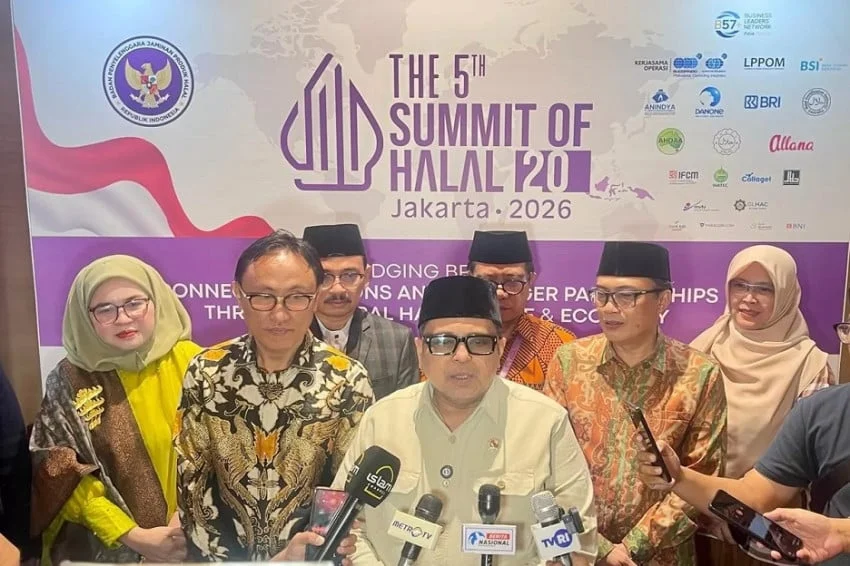
JAKARTA — The international community has increasingly aligned itself with Indonesia’s regulatory framework for consumable and usable goods, marking a pivotal shift in global trade dynamics. More than 80 countries worldwide have officially signaled their readiness to comply with Indonesia’s mandatory halal certification policies. This major milestone was formally announced by the Head of the Halal Product Assurance Organizing Agency (BPJPH), Ahmad Haikal Hasan, following the triumphant conclusion of the fifth annual Summit of Halal 20 (H20) 2026, held in the nation’s capital, Jakarta, on Sunday, September 20, 2026.
The broad international consensus represents the culmination of years of intensive diplomatic outreach, cross-border regulatory harmonization, and aggressive socialization campaigns spearheaded by Indonesian authorities. By engaging international trade partners, certification bodies, and foreign governments, BPJPH has successfully bridged the gap between domestic religious mandates and international commercial practices. As global markets pivot toward inclusive and transparent product standards, Indonesia’s proactive stance has established the country as a primary architect of the modern, interconnected global halal economy.
Global Participation and Strategic Diplomacy at the H20 Summit
The recent conclusion of the 5th Summit of Halal 20 (H20) 2026 served as a cornerstone event for validating this international alignment. Out of the more than 80 nations recognizing and preparing for Indonesia’s regulatory benchmarks, a remarkable 48 countries dispatched official delegations to participate directly in the Jakarta summit. This high-level turnout underscores the immense economic stakes involved, as exporting nations recognize that access to Indonesia’s vast consumer market hinges upon strict adherence to established halal protocols.
Speaking to journalists during a crowded press conference at the close of the summit, Haikal Hasan emphasized that the journey toward global acceptance was deliberate and systematic.
"Yes, 80 countries and more have indeed prepared themselves to receive this policy, 48 of which were present directly at this Halal 20 Indonesia Summit. And we have socialized all of that," Haikal told reporters, addressing inquiries regarding foreign ecosystem support for Indonesia’s mandatory halal implementation.
The H20 platform functioned as an indispensable venue for transnational dialogue, allowing regulatory agencies from diverse cultural and legal backgrounds to synchronize their understanding of Indonesia’s statutory requirements. Through panel discussions, bilateral meetings, and technical workshops, foreign delegates navigated the operational nuances of the certification process. According to the BPJPH leadership, the summit demystified the regulatory framework, transforming potential trade friction into collaborative partnerships.
"This is one of the platforms and vehicles to popularize and broaden knowledge about the upcoming mandatory halal regulations. It means the world has accepted it, the world is ready," Haikal added, projecting an atmosphere of transnational cooperation.
Chronology of Halal Regulation in Indonesia
To fully grasp the magnitude of the 2026 milestone, one must examine the evolutionary timeline of Indonesia’s halal product assurance legislation. The groundwork for the current regulatory landscape was laid decades ago, but the modern era of state-mandated certification formally began with the enactment of Law Number 33 of 2014 concerning Halal Product Assurance (UU JPH). This landmark legislation mandated that products entering, circulating, and trading within Indonesian territory must be certified halal, fundamentally transforming the oversight mechanism from a voluntary framework managed by non-governmental entities into a structured state obligation.
Following the passage of the 2014 law, the transition faced logistical, administrative, and structural challenges, prompting the government to establish BPJPH under the Ministry of Religious Affairs to centralize authority. A crucial turning point arrived with the issuance of Government Regulation Number 39 of 2021, which detailed the implementation of halal product assurance and set phased timelines for mandatory certification across different product categories.
By late 2021 and throughout 2022, BPJPH initiated massive domestic socialization programs while simultaneously opening communication channels with foreign halal certification bodies (FHCBs). Mutual Recognition Agreements (MRAs) became the primary diplomatic tool, allowing foreign certification agencies to be recognized by Indonesia, provided their standards met or exceeded BPJPH requirements.
The year 2024 marked the initial statutory deadline for the first wave of mandatory certification, covering food, beverages, slaughterhouse products, and related processing services. Despite calls from various industry sectors for extensions, the government maintained a firm stance while offering transitional leniencies. By 2025 and into 2026, the focus expanded decisively toward international supply chains, culminating in the diplomatic achievements showcased at the H20 Summit in September 2026. This trajectory demonstrates a consistent, unyielding governmental commitment to fully operationalizing the statutory mandate.
Economic Implications and Global Trade Dynamics
The realization that over 80 countries are now prepared to comply with Indonesia’s halal regulations carries profound economic implications for both the archipelago and its global trading partners. Indonesia represents one of the largest consumer markets in the world, characterized by a predominantly Muslim population with a rapidly expanding middle class. Consequently, foreign manufacturers view halal compliance not merely as a regulatory hurdle, but as a commercial necessity to capture market share in Southeast Asia’s largest economy.
Trade analysts point out that the standardization of halal requirements minimizes ambiguity at ports of entry, thereby streamlining customs procedures and reducing compliance costs over the long term. When international suppliers invest in certified supply chains that satisfy Indonesian standards, those same supply chains often become viable for other Organization of Islamic Cooperation (OIC) markets and Muslim-minority nations with growing halal consumer bases.
Furthermore, the harmonization driven by BPJPH fosters a competitive environment where quality, safety, and ethical consumption intersect. Halal certification is no longer viewed solely through a religious lens; it is increasingly recognized as a comprehensive global standard for food safety, hygiene, and traceability—values that resonate deeply with conscious consumers regardless of their religious affiliation.
Stakeholder Reactions and Industry Perspectives
While government officials express profound optimism, reactions from broader industry stakeholders reflect a mix of proactive adaptation and operational vigilance. Domestic business associations, ranging from micro, small, and medium enterprises (MSMEs) to multinational corporations, have had to overhaul their supply chain audits, ingredient sourcing, and manufacturing facilities to maintain compliance.
Representatives from international chambers of commerce in Jakarta have noted that while the initial adjustment period posed challenges—particularly regarding documentation and the verification of complex chemical additives—the ongoing dialogue facilitated by forums like the H20 Summit has significantly alleviated compliance friction. Foreign embassies representing the 48 attending nations have established dedicated desk officers to assist their domestic producers in navigating BPJPH guidelines, signaling a pragmatic acceptance of the new trade normal.
Islamic financial institutions and Halal supply chain logistics providers have also experienced a surge in demand. Cold-chain storage facilities, dedicated transport fleets, and specialized warehousing designed to prevent cross-contamination with non-halal items have seen increased capital investment, spurred by the certainty that the Indonesian government will not roll back its statutory timeline.
Unwavering Government Resolve
Amid questions regarding potential regulatory delays or exemptions for specific foreign trade partners, Haikal Hasan offered a definitive response during the summit’s closing remarks. He reiterated that Indonesia’s stance remains absolute and unshakeable, bound by the democratic mandate of its national legislation.
The BPJPH head emphasized that the government will continue to execute the policy strictly in accordance with statutory laws, maintaining a collaborative yet firm approach toward all stakeholders. The overarching strategy relies on continuous capacity building, digital transformation of the certification process through integrated information systems, and transparent bilateral cooperation with foreign accreditation bodies.
As the global halal landscape enters this new era of rigorous oversight, Indonesia’s leadership at the H20 Summit solidifies its role as a global standard-bearer. With more than 80 nations actively aligned and institutional mechanisms firmly in place, the mandatory certification policy stands as a testament to the country’s capability to shape international commerce while upholding its domestic legislative commitments.