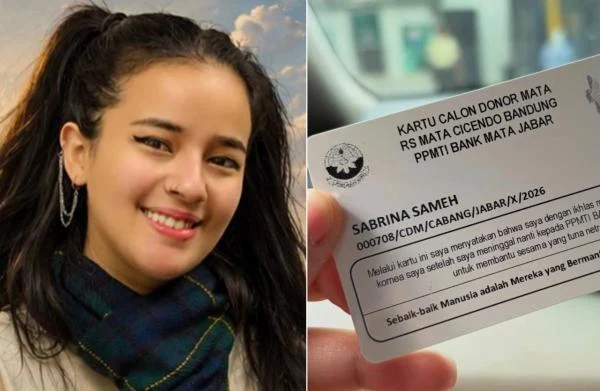
JAKARTA — In a poignant display of altruism that has captured national attention, Indonesian racing driver and multi-talented entertainer Sabrina Sameh has publicly announced her decision to register as a posthumous corneal donor. The prominent public figure, widely recognized for her dual pursuits in the high-octane world of motorsports and the entertainment industry, shared her profound commitment to sight restoration through her official social media channels, sparking a broader cultural conversation surrounding organ donation, medical philanthropy, and public health awareness across the archipelago.
The announcement, which quickly circulated across major digital platforms, centers around a formal official document issued by the Cicendo Eye Hospital in Bandung, West Java. By sharing this milestone with her substantial following, Sabrina Sameh has intentionally elevated the discourse on corneal blindness, a pressing medical concern affecting thousands of individuals throughout Indonesia, while setting a powerful precedent for public figures utilizing their platforms for philanthropic advocacy.
The Announcement and the Official Documentation
The revelation materialized on Sabrina Sameh’s verified Instagram account, @sabrinasameh, where she posted an image of her official donor registration document. The artifact in question—a physical identification card designating her status as a prospective corneal donor—was officially issued by the Cicendo Eye Hospital in Bandung, a premier ophthalmology institution renowned for its specialized medical care and research facilities.
Emblazoned upon the card is an explicit, legally and ethically binding declaration confirming her voluntary intent. The text explicitly outlines the parameters of her decision: "Through this card, I state that I sincerely donate both of my corneas after I pass away to the PPMTI Eye Bank of West Java to help fellow individuals who are visually impaired."
This unambiguous statement underscores a deliberate, calculated choice to engage in anatomical gifting. Unlike spontaneous pledges, formal registration with institutions such as the Cicendo Eye Hospital and the Indonesian Association for the Prevention of Blindness and Restoration of Sight (PPMTI) Eye Bank of West Java requires administrative verification, ensuring that the donor’s final wishes can be legally and efficiently executed in the critical hours immediately following legal death.
Chronology of a Life-Changing Decision: The Influence of Eddi Brokoli
Every major philanthropic decision has a genesis, and for Sabrina Sameh, the journey toward becoming a registered corneal donor began through interpersonal dialogue and advocacy. In the detailed caption accompanying her social media disclosure, the prominent artist and older sister of fellow celebrity Susan Sameh recounted the precise catalyst that shifted her perspective on mortality and medical contribution.
The turning point occurred during a conversation with prominent Indonesian public figure and activist Eddi Brokoli. Known for his distinctive appearance and active involvement in various social and environmental causes, Brokoli engaged Sameh in a discussion concerning the critical shortage of corneal tissue in Indonesia and the life-altering impact of corneal transplantation.
This dialogue served as an educational bridge for Sameh, transforming abstract notions of posthumous donation into a tangible, actionable humanitarian goal. Following her interaction with Brokoli, Sameh initiated independent research, consulted with medical professionals at the Cicendo Eye Hospital, and ultimately completed the administrative procedures required to formalize her status as a prospective donor. This timeline highlights the vital role that peer advocacy and transparent public conversations play in shifting societal attitudes toward organ and tissue donation.
Understanding the Medical Reality: Corneal Blindness in Indonesia
To fully contextualize Sabrina Sameh’s announcement, it is essential to examine the severe public health challenges associated with corneal blindness within the Indonesian healthcare landscape. Corneal opacity—the scarring, thinning, or distortion of the cornea caused by trauma, infections, nutritional deficiencies, or congenital conditions—remains one of the leading causes of preventable blindness globally and within Southeast Asia.
According to data from ophthalmological organizations and health ministries, hundreds of thousands of Indonesians suffer from varying degrees of visual impairment stemming from corneal damage. While many of these individuals could have their sight fully restored through a relatively straightforward surgical procedure known as a corneal transplant (keratoplasty), the demand for viable corneal tissue vastly outstrips the domestic supply.
The Indonesian healthcare system faces persistent structural and cultural hurdles regarding organ and tissue donation. Unlike standard blood donations, which are commonplace and widely understood, tissue donation—particularly post-mortem retrieval of corneas—frequently encounters psychological, cultural, and religious hesitations among the general population. Misconceptions regarding bodily integrity after death, combined with a general lack of administrative awareness regarding how to register as a donor, have historically kept eye bank inventories at critically low levels. Consequently, a significant portion of corneal tissue required for sight-restoring surgeries in Indonesia has historically relied on imports from international eye banks, driving up costs and complicating logistical frameworks.
The Logistics of Post-Mortem Corneal Procurement
The formalization of Sabrina Sameh’s pledge brings attention to the meticulous medical protocols governing corneal donation in Indonesia, specifically managed through specialized networks like the PPMTI Eye Bank of West Java. The retrieval of corneal tissue is a delicate procedure subject to stringent medical, ethical, and legal parameters.
Unlike major visceral organs such as hearts, livers, or kidneys, which must be recovered from patients experiencing brain death while maintained on life support, corneas can be retrieved after somatic death. Specifically, corneal tissue remains viable for extraction typically within a window of 6 to 12 hours following the cessation of heartbeat and respiration, provided the body is kept in appropriate cool storage conditions to cellular degradation.
The process requires immediate notification of the designated eye bank by the deceased individual’s family or medical handlers. Upon notification, a specialized medical team is dispatched to perform the extraction—a sterile, minor surgical procedure that takes approximately 30 to 45 minutes and does not disfigure the donor’s face or preclude traditional or religious funeral rites, as the removed tissue is replaced with specialized prosthetic caps or sutured discreetly.
Institutions such as the Cicendo Eye Hospital serve as crucial regional hubs, housing advanced storage facilities where harvested corneas undergo rigorous serological testing, microbiological screening, and endothelial cell density analysis to ensure safety and transplant viability before being matched with recipients on waiting lists.
Public Reactions and Cultural Implications
The public response to Sabrina Sameh’s announcement has been overwhelmingly positive, generating widespread praise across digital media ecosystems. Fans, fellow celebrities, healthcare professionals, and advocacy groups have lauded her transparency, noting that the endorsement of organ donation by a high-profile figure with a youthful demographic following carries immense cultural weight.
In a society where discussions surrounding death, dying, and post-mortem bodily disposition are frequently avoided due to cultural taboos or religious sensitivities, Sameh’s proactive stance normalizes the conversation. By utilizing her platform to demystify the process—specifically highlighting the physical registration card from the Cicendo Eye Hospital—she has provided her followers with a clear, accessible blueprint on how they can emulate her decision.
Medical advocacy groups and ophthalmological societies have long maintained that public education is the single most effective tool in overcoming donation hesitancy. When public figures cross the threshold from passive supporters to registered donors, it validates the ethical integrity of organizations like the West Java Eye Bank and encourages families to honor the wishes of their deceased loved ones when the time comes for execution.
Broader Impact on Celebrity Philanthropy and Social Responsibility
Sabrina Sameh’s decision places her within a growing cohort of modern Indonesian artists and athletes who leverage their public visibility to champion systemic social causes. While celebrity philanthropy frequently manifests as monetary donations, disaster relief participation, or brand ambassadorships for commercial charities, systemic advocacy regarding public health policy and anatomical donation represents a deeper, more enduring form of social contribution.
The intersection of her identity as a professional racing driver—a domain traditionally associated with high personal risk, physical precision, and life-or-death scenarios—and her commitment to preserving the vision of others adds a compelling narrative layer to her public persona. It demonstrates a holistic approach to personal legacy, transitioning from individual athletic and artistic achievements to collective societal betterment.
Furthermore, her connection with Eddi Brokoli underscores the power of informal mentorship and inter-generational dialogue within the creative and activist communities. As more public figures normalize discussions around tissue and organ donation, the psychological barrier separating the living population from the reality of posthumous medical contribution continues to erode.
Conclusion and Future Outlook
Sabrina Sameh’s public declaration to donate her corneas upon her passing transcends a simple social media post; it represents a significant milestone in public health advocacy within Indonesia. By bridging the gap between personal conviction and institutional action through her registration with the Cicendo Eye Hospital and the PPMTI Eye Bank of West Java, she has provided a masterclass in modern civic responsibility.
As the nation continues to grapple with infrastructural and cultural deficits in organ and tissue procurement, the actions of prominent individuals serve as vital catalysts for institutional growth. Whether this high-profile endorsement will translate into a measurable surge in regional donor registrations remains to be observed through forthcoming data from eye banking institutions. However, the immediate cultural impact is undeniable: thousands of individuals have been prompted to reflect upon the mortality of their physical forms and the profound potential to leave behind the gift of sight for those navigating the darkness of corneal blindness.