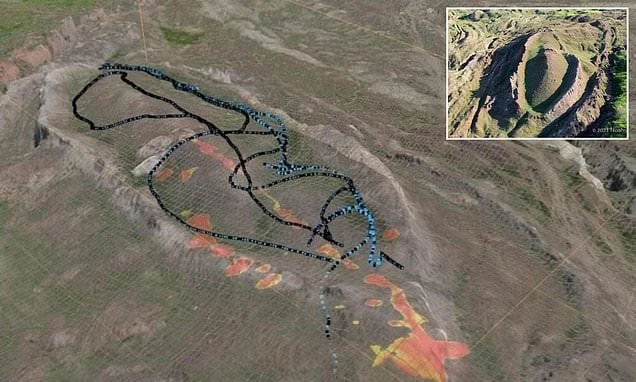
The long-standing quest to locate the historical remains of Noah’s Ark has reached a new juncture following the release of recent geological scan data from the Durupinar site in eastern Turkey. A collaborative team of researchers, led by experts from Sivas Cumhuriyet University and the California-based organization Noah’s Ark Scans, has presented findings suggesting that a prominent, boat-shaped formation located in the Doğubayazıt district of Ağrı Province may indeed be the remnants of the vessel described in ancient religious texts.
For decades, the site near Mount Ararat—frequently associated with the final resting place of the ark—has been a focal point for both amateur explorers and academic archaeologists. The latest investigation, which commenced in September 2026, utilizes advanced ground-penetrating radar and geochemical analysis to look beneath the surface of a 157-meter-long geological formation that has long piqued public curiosity due to its peculiar, ship-like silhouette.
Chronology of the Durupinar Investigation
The Durupinar site was first identified in the late 1940s when a Turkish army captain noticed the unusual formation during aerial reconnaissance. Since then, the site has undergone intermittent scrutiny. In the 1980s and 1990s, the late explorer Ron Wyatt brought significant international attention to the location, claiming it was the landing site of the ark. However, the academic community largely dismissed these claims, attributing the formation to natural geological processes known as mudflows or synclines.
The current project represents a significant departure from previous amateur-led efforts. By securing formal permits from the Turkish government, the research team—headed by archaeologist Cenker Atila—has been able to conduct a rigorous, multi-disciplinary study. The timeline of the current initiative began with preliminary site surveys in early 2026, followed by comprehensive soil sampling and geophysical mapping in September 2026. The team focused on extracting core samples from depths of up to 18 meters, aiming to identify the chemical composition of the subterranean materials to determine whether they consist of natural rock formations or manufactured structural remains.
The Science Behind the Scans
Andrew Jones, a prominent researcher with Noah’s Ark Scans, has been vocal about the implications of the team’s data. Speaking to media outlets, Jones noted that the goal is to provide empirical evidence capable of swaying a skeptical scientific community. The data points to a complex, artificial structure rather than a random geological occurrence.
The methodology employed by the research team involves:
- Ground-Penetrating Radar (GPR): Used to map the density variations beneath the surface, revealing patterns that the researchers describe as "cross-beams" or internal reinforcements consistent with the construction of a large wooden vessel.
- Chemical Analysis: Soil samples are currently undergoing mass spectrometry to detect traces of organic materials, such as fossilized wood or bitumen, which would have been used to waterproof a ship of such magnitude.
- Stratigraphic Mapping: By analyzing the layers of earth surrounding the structure, the team aims to determine if the site was deposited by a singular, high-energy catastrophic event, such as a localized flood, or if it formed over thousands of years through slow sedimentation.
Official Responses and Academic Skepticism
The response from the broader archaeological community remains cautious. While the involvement of Sivas Cumhuriyet University adds a layer of academic credibility, many geologists maintain that the formation is a "natural syncline." According to these critics, the boat-like shape is a result of erosion patterns and tectonic shifts that have occurred in the rugged, volcanic terrain surrounding Mount Ararat.
The Turkish government has been supportive of the research, recognizing the potential for cultural and religious tourism that a confirmed discovery would bring to the Ağrı region. However, official statements from the Ministry of Culture and Tourism remain neutral, emphasizing that the project is an ongoing scientific investigation rather than a confirmed archaeological find. The government has prioritized the preservation of the site, ensuring that any invasive exploration is conducted under strict archaeological protocols to prevent damage to potential artifacts.
Broader Implications of the Discovery
Should the findings be verified through peer-reviewed publication and independent replication, the implications would be profound. For historians, it would necessitate a re-evaluation of the relationship between ancient mythological narratives and physical reality. For theologians, it would provide a tangible link to one of the most widely recognized accounts in the Abrahamic traditions, potentially altering the landscape of religious tourism in the Middle East.
However, the burden of proof remains exceptionally high. In archaeology, the identification of a massive wooden structure from several millennia ago requires not just a visual match, but undeniable material evidence. This includes the identification of non-native timber, specialized construction joints, and clear evidence of maritime engineering that predates the emergence of iron-age seafaring technologies.
Furthermore, the environmental conditions of the region pose a significant challenge. The high altitude, seismic activity, and freeze-thaw cycles of the Ağrı Province are hostile to the preservation of organic materials. If the ark were indeed made of wood, the researchers are looking for traces that have survived thousands of years of environmental degradation.
Socio-Economic Impact on Doğubayazıt
The town of Doğubayazıt stands to gain significantly from the sustained interest in the site. As the gateway to Mount Ararat, the region has long served as a hub for mountaineers and pilgrims. A confirmation of the site’s status as the genuine Bahtera Nuh (Noah’s Ark) would likely trigger a massive influx of visitors. Local authorities are already planning for infrastructure upgrades, including improved roads and visitor centers, to accommodate the potential surge in tourism.
The collaboration between Western researchers and local Turkish universities also underscores a growing trend in "heritage diplomacy," where archaeological research serves as a bridge for international cooperation. By involving local scholars, the project ensures that the research remains culturally sensitive and aligned with the national heritage goals of the Turkish Republic.
The Path Forward
As the research team continues to process the data from the September 2026 scans, the next phase of the project will likely involve deeper excavations. The decision to move from non-invasive scanning to physical excavation is one that requires careful deliberation. Archaeologists are wary of the "salami slicing" effect, where hasty excavations can destroy context before it is properly recorded.
The scientific community awaits the publication of the team’s full report, which is expected to detail the GPR imagery and the chemical analysis of the core samples. Until such a report is released in a reputable journal, the findings remain a fascinating—albeit unproven—addition to the long history of the search for the Ark.
For now, the site at Durupinar remains a mystery. Whether it is a natural wonder or the final resting place of a legendary vessel, it continues to captivate the human imagination, serving as a testament to our enduring desire to connect the stories of the past with the tangible world of the present. As Andrew Jones and his team prepare their next steps, the world watches with anticipation, waiting to see if the "strange structure" will finally reveal its true nature to history.
The narrative of Noah’s Ark has transcended its origins in religious texts to become a universal cultural touchstone. The current investigation, blending modern technology with ancient curiosity, represents the most rigorous attempt yet to bridge that gap. Regardless of the outcome, the project highlights the importance of continued investment in the archaeology of the Near East, a region that continues to hold the keys to understanding the origins of civilization and the collective memory of humanity.
In the coming months, the academic community will likely host symposia and technical reviews to discuss the data. These discussions will be critical in distinguishing between the excitement of a potential discovery and the cold, hard facts of geological and archaeological science. For the residents of Ağrı Province, the wait for a definitive answer is not just a matter of scientific curiosity, but a significant milestone in the history of their region. As the project progresses, the global community remains attentive, mindful that in the pursuit of historical truth, the most surprising answers often lie just beneath the surface of the earth.