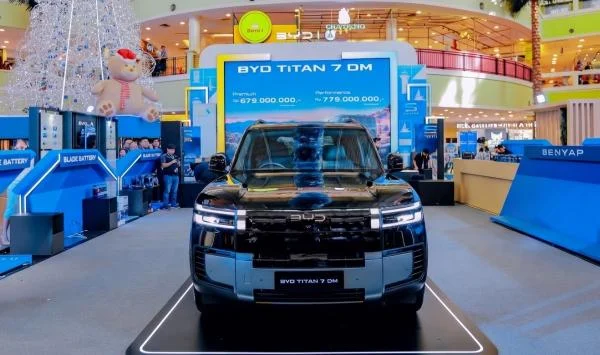
The automotive landscape in East Kalimantan has entered a new phase of technological advancement as global electric vehicle giant BYD officially introduced its latest plug-in hybrid electric vehicle (PHEV), the TiTAN 7 DM, at the BYD Tech Culture Fest (TCF) 2026. Held at the E Walk mall in Balikpapan, the launch marks a significant milestone in the company’s regional expansion strategy, signaling a deeper commitment to providing diverse electrification options to the Indonesian market. By bridging the gap between traditional internal combustion engines and pure battery electric vehicles (BEVs), the TiTAN 7 DM serves as a strategic cornerstone for BYD’s growth in the resource-rich, geographically challenging terrain of the Kalimantan region.
Strategic Market Positioning in East Kalimantan
The selection of Balikpapan as the venue for the TCF 2026 is far from coincidental. As East Kalimantan continues to experience infrastructural growth tied to the development of the new national capital, the demand for high-performance, versatile, and fuel-efficient vehicles has surged. BYD’s decision to bring the TiTAN 7 DM to this specific market reflects an understanding of the region’s unique requirements: a need for long-range reliability that goes beyond the current density of fast-charging infrastructure found in Java.
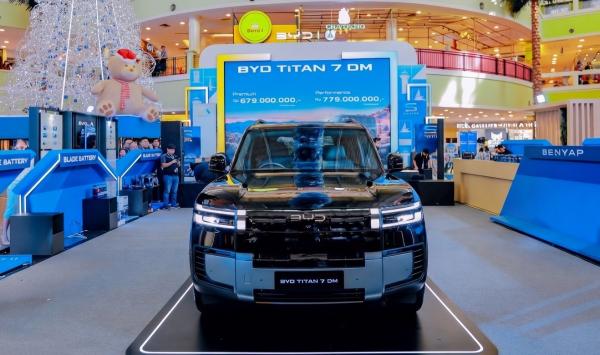
The TiTAN 7 DM is positioned as a premium SUV that offers the best of both worlds. It features BYD’s proprietary Dual Mode Powerful (DM-p) technology, which intelligently cycles between electric power for urban commuting and the efficiency of a combustion engine for long-distance travel across the sprawling landscape of Borneo. Priced at Rp679 million for the Premium variant and Rp779 million for the Performance variant, the vehicle is aimed at affluent professionals and corporate fleets looking to transition toward sustainable mobility without compromising on power or autonomy.
Technical Specifications and Engineering Prowess
At the heart of the TiTAN 7 DM lies a sophisticated powertrain configuration designed to deliver both fuel efficiency and robust off-road capability. The vehicle is equipped with a 1.5T High Efficiency Engine, which acts as the primary power generator and range extender. This internal combustion component is capable of producing 110 kW of power and 220 Nm of torque.
However, the true performance of the vehicle is unlocked by its dual-motor electric system. When the internal combustion engine works in tandem with the electric motors, the system generates a combined output of 300 kW and a massive 630 Nm of torque. This torque delivery is instantaneous, providing the acceleration profile of a high-end sports SUV while maintaining the composure required for daily transport.
A critical feature for the Kalimantan market is the inclusion of an intelligent All-Wheel Drive (AWD) system. Given the diverse road conditions—ranging from smooth urban highways in Balikpapan to more rugged, undulating terrain in the outskirts—the AWD system provides real-time torque distribution. This ensures that the vehicle maintains optimal traction and stability, effectively minimizing wheel slip in adverse weather conditions or on uneven surfaces. By prioritizing these mechanical specifications, BYD is positioning the TiTAN 7 DM as a practical tool for the modern Indonesian driver rather than just a luxury status symbol.
The Role of DM-p Technology in the Energy Transition
The DM-p technology is a significant evolution in BYD’s product lineup. Unlike standard hybrids, the DM-p (Dual Mode Powerful) system emphasizes performance, offering a driving experience that rivals high-displacement combustion engines while significantly reducing carbon emissions. In the context of Indonesia’s roadmap to net-zero emissions, the proliferation of PHEVs is viewed by many industry analysts as a "bridge" technology.

For a vast archipelago like Indonesia, where charging infrastructure is still undergoing rapid development, PHEVs offer a pragmatic solution. Owners can rely on electric power for their daily commute, utilizing home-charging solutions, while retaining the flexibility to undertake long-distance journeys without the "range anxiety" often associated with pure BEVs. This technological choice aligns with the broader government policy of incentivizing low-emission vehicles while ensuring that infrastructure limitations do not hinder the mass adoption of electric mobility.
Industry Context and Competitive Landscape
The introduction of the TiTAN 7 DM occurs within a hyper-competitive environment. Major global players are aggressively expanding their footprint in Indonesia, recognizing the nation’s potential as both a massive consumer market and a strategic manufacturing hub for the ASEAN region. BYD has consistently demonstrated its intention to capture a significant market share by not only importing vehicles but also by investing in the local ecosystem, including service centers and regional distribution hubs.
The TCF 2026 event itself serves as a platform for BYD to showcase its broader technological ecosystem. By integrating the launch of the TiTAN 7 DM with a festival focused on technology and culture, the company is attempting to demystify EV technology for the local populace. This educational approach is essential in a market where consumers have traditionally been hesitant to shift away from proven, fuel-reliant platforms.
Economic and Environmental Implications
From an economic perspective, the availability of the TiTAN 7 DM in East Kalimantan supports the regional transition toward a greener economy. As local industries shift toward sustainable practices, the corporate adoption of hybrid fleets is expected to rise. The competitive pricing of the TiTAN 7 DM, when compared to other luxury imported SUVs, positions it favorably for both high-end private buyers and commercial entities seeking to improve their environmental, social, and governance (ESG) metrics.

Environmentally, the reduction in fuel consumption and the ability to operate in "pure electric" mode for short trips contribute to improved air quality in urban centers. As the government continues to offer tax incentives and benefits for electrified vehicles, the total cost of ownership for a TiTAN 7 DM becomes increasingly attractive, potentially shifting consumer preference away from traditional internal combustion engine vehicles over the next five years.
Future Outlook and Regional Expansion
Looking ahead, the success of the TiTAN 7 DM in Balikpapan will likely serve as a litmus test for BYD’s broader penetration into other provinces in Kalimantan. The company’s ability to provide high-quality after-sales service and technical support in remote areas will be the decisive factor in whether the brand can sustain its growth.
Industry observers note that BYD’s strategy is not merely about selling cars, but about establishing a "culture of electrification." By hosting events like the TCF, the company is fostering a community of early adopters who can advocate for the benefits of the technology. As the infrastructure in Kalimantan catches up to the pace of urban development, the groundwork laid by the TiTAN 7 DM launch will prove to be a foundational element of BYD’s long-term influence in the Indonesian automotive sector.
The trajectory for the remainder of 2026 and into 2027 suggests that BYD will continue to diversify its portfolio, likely introducing more specialized models tailored to the specific geographical needs of Indonesia. For now, the TiTAN 7 DM stands as a testament to the company’s belief in the potential of the Indonesian market and its commitment to delivering high-performance, sustainable mobility solutions to a wider audience. As the automotive industry continues to pivot toward a electrified future, the launch in Balikpapan reinforces that the transition is no longer just a trend in Jakarta, but a nationwide shift that is gaining momentum across the country.