The footballing world remains in a state of profound mourning following the tragic passing of CD Tenerife forward Jesus de Miguel, who succumbed to injuries sustained during a Segunda Division match against FC Andorra on Monday, November 2, 2026. The incident, which occurred during a high-stakes fixture, has sent shockwaves through the Spanish football ecosystem, prompting FC Andorra goalkeeper Jesus Owono to break his silence for the first time since the fatal collision.
The 25-year-old goalkeeper, who was directly involved in the accidental clash, released a poignant statement via the club’s official social media channels on Wednesday, November 4, 2026. His words reflect the psychological toll that such rare but devastating on-pitch accidents take on the players involved, highlighting the thin line between professional competition and human tragedy.
The Chronology of a Fatal Incident
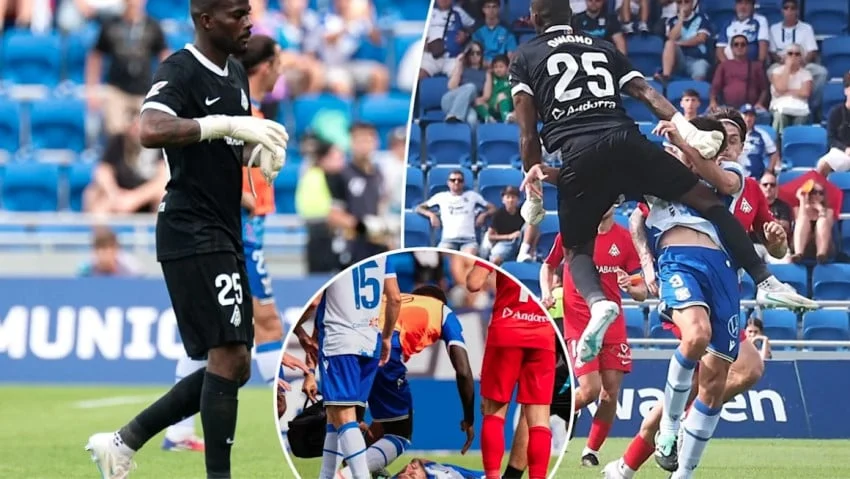
The match between FC Andorra and CD Tenerife was proceeding in a routine, albeit intense, manner during the early stages of the second half. According to match reports and stadium footage, the incident took place in the 58th minute. A long ball played over the top of the defensive line triggered a race for possession between Jesus de Miguel and the advancing Jesus Owono.
As both players converged on the ball at the edge of the penalty area, a violent collision occurred. Owono, attempting to clear the ball, collided with the incoming striker at high speed. The impact was immediate and severe, with De Miguel falling to the turf motionless. Refereeing officials and medical staff from both teams rushed onto the pitch within seconds of the collision, recognizing the gravity of the situation.
Initial medical intervention was provided on the pitch for nearly fifteen minutes. Despite the efforts of paramedics and the emergency team present at the stadium, De Miguel remained unconscious and was subsequently rushed to a local hospital in Andorra. The match was officially abandoned shortly thereafter, as players from both squads were visibly shaken and unable to continue the contest. The hospital later confirmed that De Miguel had suffered irreparable trauma, leading to his untimely passing.
Jesus Owono’s Official Statement
The silence from the FC Andorra camp in the immediate 48 hours following the tragedy was understood as a period of mourning and respect for the deceased. When Jesus Owono finally addressed the public, his tone was one of absolute grief.
"These past few days have been the hardest of my life," Owono stated. "I am struggling to find the words, and it is incredibly difficult to process everything that has unfolded. I feel a profound sense of sorrow for the loss of Jesus."
The goalkeeper, who has been a mainstay for FC Andorra, emphasized that his current priority is not the ongoing investigation or the sporting repercussions of the incident, but rather the emotional well-being of the De Miguel family. He offered his deepest condolences to the family, friends, and the entire CD Tenerife organization.
"I am aware that there will be many questions to be answered in the coming days, and I am prepared to face whatever comes next with the utmost respect for the process," Owono added. "However, right now, in all honesty, I cannot focus on anything other than the memory of Jesus and the immense sadness that we are all experiencing. Rest in peace, Jesus."
The Broader Context of Safety in Football
The death of Jesus de Miguel has reignited a critical debate regarding player safety in professional football. While the sport has implemented significant advancements in medical protocols—such as the mandatory presence of advanced life support equipment and concussion protocols—accidental collisions remain an inherent risk that is difficult to mitigate entirely.
Data from recent years suggests that while cardiac events are the most common cause of on-pitch fatalities, high-impact physical trauma remains a persistent danger. Governing bodies like the RFEF (Royal Spanish Football Federation) and La Liga are expected to launch a comprehensive review of the match day medical protocols, not because of negligence, but to ensure that the response time and the equipment available at the pitch side are at the absolute peak of modern technological capabilities.
Football experts note that collisions involving goalkeepers are statistically among the most dangerous scenarios in the game due to the force generated by a jumping keeper and a sprinting forward. The momentum involved in such incidents is immense, often leading to internal injuries that are not immediately apparent to spectators or even the officiating staff.
Reactions from the Football Community
The football community across Spain and beyond has united in tribute to the late forward. La Liga issued a statement shortly after the news broke, expressing their "deepest condolences to the family, friends, and the entire CD Tenerife family." Players across the Segunda Division have taken to social media to pay their respects, with many clubs holding moments of silence before their respective mid-week training sessions.
CD Tenerife, the club De Miguel represented with distinction, has announced that they will provide full support to the player’s family during this transition. A memorial service is being planned, and it is expected that the league will observe a minute of silence across all stadiums in the upcoming weekend’s fixtures.
The president of the Spanish Footballers’ Association (AFE) commented on the incident, stating: "Today, football has lost more than a player; we have lost a colleague and a friend. Our focus must remain on supporting those who were on the pitch that day, particularly the families of the deceased and those who were directly involved in the incident."
Sporting and Legal Implications
In the aftermath of the match, questions have been raised regarding the sporting status of the game. Under the regulations of the Segunda Division, abandoned matches are typically replayed from the minute they were stopped or rescheduled entirely, depending on the circumstances. However, in this specific instance, the focus of the league authorities has been primarily on the humanitarian aspect.
From a legal perspective, the incident is being treated as a tragic sporting accident. Police authorities in Andorra conducted an initial investigation as part of the standard protocol for sudden deaths, confirming that the incident was indeed a result of an on-pitch collision during the normal course of play. There is no suggestion of foul play or malicious intent, which aligns with the accounts provided by teammates and eyewitnesses.
The mental health of the players involved is now a paramount concern for both FC Andorra and CD Tenerife. Clubs have reportedly deployed trauma counselors to work with the squads, as witnessing a teammate or an opponent suffer a fatal injury can result in long-term psychological distress.
Future Outlook and Legacy
As the Segunda Division attempts to move forward, the legacy of Jesus de Miguel will likely manifest in enhanced safety protocols. Discussions are already surfacing regarding the potential for mandatory protective gear or updated training for medical staff to deal with specific, high-velocity internal trauma.
The tragedy serves as a stark reminder of the physical stakes involved in professional sports. While the game continues to grow in terms of commercial value and viewership, the humanity of the athletes remains the core of the sport. The resilience of the players, particularly those like Jesus Owono who must grapple with the weight of being the other party in such a tragedy, will be tested in the coming weeks.
As of the current writing, FC Andorra has not announced when they will resume training, nor has there been a firm decision on the rescheduling of their upcoming fixtures. The club’s management has prioritized the mental stability of their players over the immediate demands of the competition schedule.
For now, the football world turns its attention to mourning. The story of Jesus de Miguel is not merely a headline in the sports pages; it is a profound human narrative about a life cut short in the pursuit of a passion, leaving behind a legacy that will undoubtedly influence the way the sport approaches safety and the well-being of its participants for years to come. The industry now waits for the formal report from the federation, but the prevailing sentiment remains one of reflection, as the sport takes a collective breath to honor a life lost on the pitch.