President Joko Widodo, accompanied by a high-ranking delegation of government officials and energy sector executives, conducted a strategic inspection of the PT Trans Pacific Petrochemical Indotama (TPPI) refinery located in Tuban, East Java. The visit to the long-dormant facility was designed to evaluate operational readiness, assess national energy security implications, and chart a path toward full capacity utilization. However, prior to the formal inspection of the industrial complex, the entourage partook in an impromptu, culturally grounded interaction with local residents, highlighting a lighter moment that briefly paused the high-stakes agenda of national energy reform.
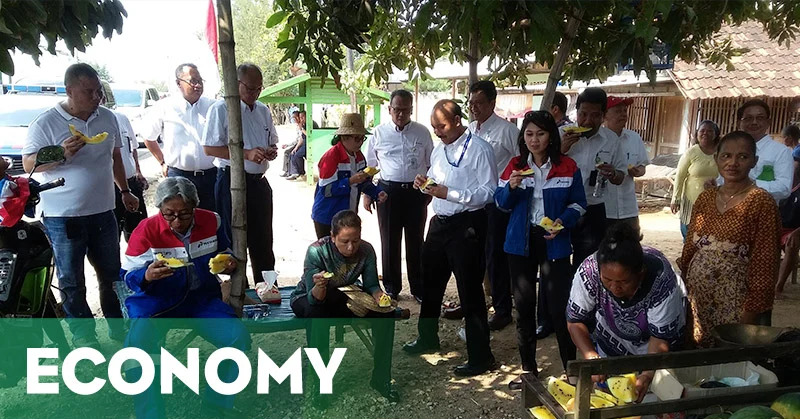
The presidential delegation featured prominent figures including Minister of State-Owned Enterprises (SOEs) Rini Soemarno, Pertamina President Director Dwi Soetijpto, Pertamina Vice President of Communication Wianda Pusponegoro, and Director General of Oil and Gas IGN Wiratmaja Puja. As the convoy approached the perimeters of the TPPI facility in Tuban, the officials opted to traverse a portion of the route on foot, mingling with local villagers who had gathered to witness the presidential visit. This grassroots engagement culminated at a local roadside stall, where the high-level officials paused to sample fresh, locally grown Tuban watermelons harvested from nearby agricultural lands.
The casual interlude provided a human-interest dimension to an otherwise technical and economic mission. Minister Rini Soemarno actively encouraged the entourage and accompanying media to taste the local produce, remarking on its quality. This spontaneous community interaction served as a prelude to the rigorous administrative and industrial assessments awaiting the leadership inside the multi-million-dollar petrochemical complex.
Background Context and Historical Significance of the TPPI Refinery
The PT Trans Pacific Petrochemical Indotama (TPPI) refinery in Tuban occupies a critical position in Indonesia’s domestic energy infrastructure. Conceived decades prior, the facility was designed to function as an integrated aromatics and fuel-producing plant, capable of significantly reducing the nation’s reliance on imported petroleum products. Nevertheless, the history of the TPPI refinery has been plagued by financial distress, legal complexities, and prolonged operational halts that transformed the facility into a symbol of unrealized industrial potential.
For years, the plant operated far below capacity or remained entirely shut down due to complex debt restructurings, shareholder disputes, and challenges in securing consistent crude oil feedstock. These prolonged idling periods inflicted substantial financial losses on the state and exacerbated Indonesia’s vulnerability to global fuel price fluctuations. Because Southeast Asia’s largest economy imports a significant portion of its daily fuel consumption, reviving domestic refining assets like TPPI became an urgent priority for the administration of President Joko Widodo, which took office in 2014 with a mandate to boost domestic energy independence and manufacturing capabilities.
Chronology of the Presidential Inspection
The events of November 11, 2015, unfolded according to a meticulously planned itinerary, though punctuated by spontaneous local engagements. The timeline of the presidential visit to Tuban illustrates the careful balancing act between executive oversight and public relations:
Morning Arrival and Local Engagement: President Joko Widodo and his ministerial entourage arrived in Tuban, East Java. Eschewing a direct motorcade entrance right up to the facility gates, parts of the delegation engaged with local residents who lined the streets.
The Impromptu Fruit Tasting: As the entourage walked through the village adjacent to the refinery complex, they encountered a local resident selling agricultural produce. Stopping at the humble stall, Minister Rini Soemarno, Pertamina Chief Dwi Soetijpto, and other senior officials paused to converse with the vendor and sample the regional watermelons. This brief pause underscored the government’s emphasis on grassroots economic activity.
Formal Entry into the TPPI Complex: Following the brief respite, the delegation transitioned from the local community space into the high-security grounds of the TPPI petrochemical plant.
Technical Briefing and Facility Walkthrough: Inside the complex, President Jokowi received comprehensive briefings from Pertamina executives and operational managers regarding the state of the machinery, storage tanks, and processing units. The discussions focused on safety protocols, maintenance requirements, and the timeline for resuming uninterrupted commercial production.

Post-Inspection Evaluations: The visit concluded with closed-door coordination meetings aimed at finalizing governance structures, feedstock supply agreements, and financial consolidation strategies to ensure the long-term viability of the plant.
Economic Implications and Strategic Integration Under Pertamina
The revitalization of the TPPI refinery was not merely an engineering challenge; it represented a major strategic maneuver for state-owned energy giant Pertamina. In the preceding months, the government had orchestrated steps to bring TPPI under the direct operational umbrella of Pertamina through financial restructuring and debt-to-equity conversions involving state receivables.
By integrating TPPI into Pertamina’s downstream portfolio, the state aimed to optimize the supply chain connecting upstream crude extraction to domestic refining and distribution. Prior to its full reactivation, the refinery’s capacity to produce high-octane motor gasoline (MOGAS), paraxylene, benzene, and liquefied petroleum gas (LPG) was severely underutilized. Bringing the plant back online promised to slash Indonesia’s dependence on the Mean of Platts Singapore (MOPS) benchmark for fuel imports, saving the state billions of rupiah in foreign exchange reserves annually.
Economic analysts noted that the operational revival of the Tuban facility directly impacted the national trade balance. By substituting imported finished fuels with domestically refined products derived from both domestic and imported crude, Indonesia could better insulate its macroeconomic stability against currency depreciation and global commodity price shocks. Furthermore, the revival breathed new life into the local economy of Tuban, generating employment opportunities for local contractors, logistics providers, and service industries tied to the petrochemical sector.
Stakeholder Perspectives and Official Responses
The high-profile visit by President Jokowi and his economic cabinet signaled to investors, workers, and the public that the highest levels of government were personally invested in resolving legacy industrial bottlenecks.
Minister Rini Soemarno, during her interactions at the site, emphasized that the successful turnaround of state-owned enterprises required both rigorous administrative oversight and active empathy toward the communities hosting these mega-projects. Her decision to pause and support a local agricultural vendor in Tuban reflected a deliberate communication strategy: pairing heavy industrial policy with approachable, down-to-earth public engagement.
Meanwhile, Pertamina leadership utilized the presidential inspection to demonstrate operational readiness. Dwi Soetijpto, leading the state oil company at the time, outlined the technical milestones achieved in restarting the refinery units. Pertamina engineers and technical staff worked around the clock to ensure that safety standards met international benchmarks before introducing hydrocarbons back into the processing pipelines. The presence of Vice President of Communication Wianda Pusponegoro ensured that the narrative of national energy sovereignty was effectively communicated to the broader public through mainstream and digital media channels.
Broader Impact on Indonesia’s Energy Independence Agenda
The inspection of the TPPI refinery in Tuban stands as a watershed moment in Indonesia’s modern industrial policy. It encapsulated the complex interplay between macro-level state strategy and micro-level human experiences—from villagers sharing homegrown fruit with cabinet ministers to boardroom executives negotiating multi-billion-dollar asset integrations.
Ultimately, the successful reopening of the TPPI facility validated the administration’s interventionist approach to stalled strategic assets. Rather than allowing valuable infrastructure to deteriorate or remain trapped in endless litigation, the state leveraged its sovereign authority and corporate muscle through Pertamina to reclaim, rehabilitate, and restart critical economic engines.
As the presidential delegation concluded their inspection on that November afternoon and departed the Tuban facility, the foundational steps had been solidified. The brief interlude with the Tuban watermelons faded into a memory, but the heavy lifting of powering Indonesia’s industrial resurgence pressed forward, leaving a lasting imprint on the nation’s energy landscape for the decades to follow.