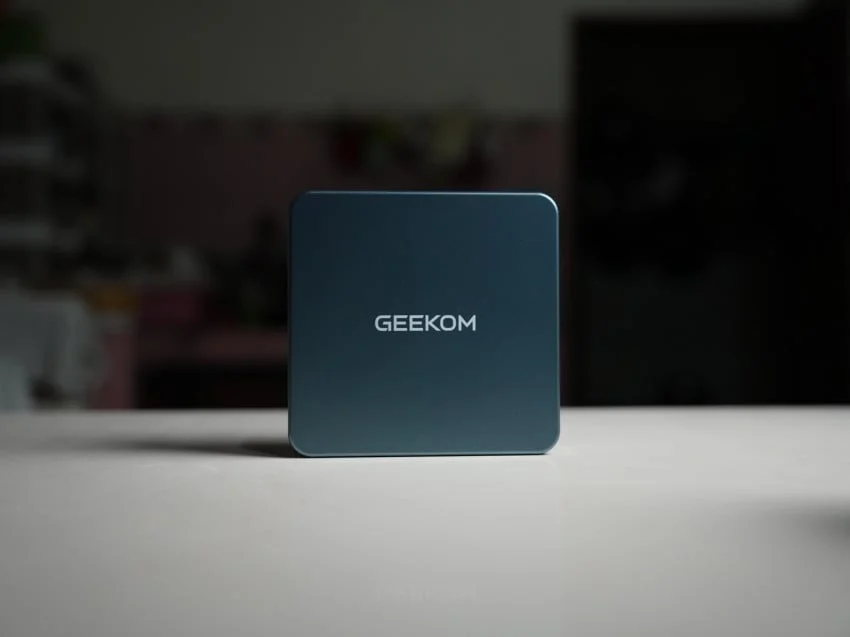
The landscape of personal computing is undergoing a structural transformation as manufacturers pivot away from bulky, traditional desktop towers toward highly integrated, ultra-compact solutions. Geekom, a rising player in the small-form-factor (SFF) market, has recently introduced the IT12 MAX, a device that challenges conventional notions of workstation power by packing enterprise-grade processing capabilities into a chassis measuring just 130 x 135 x 58 millimeters. Priced at approximately Rp12,985,000, the IT12 MAX is positioned as a direct competitor to mid-range laptops and standard desktop configurations, targeting a demographic that prioritizes spatial efficiency without compromising computational throughput.
The evolution of the workstation has been marked by a consistent trend toward miniaturization. Over the past decade, the industry has shifted from mid-tower ATX cases to SFF designs, driven by advancements in thermal management and mobile-grade silicon architecture. The Geekom IT12 MAX serves as a case study in this transition, utilizing the Intel Core Ultra 5-125U processor—a chip rooted in the Meteor Lake-U architecture—to provide a balanced power profile for professional environments.
The Technical Architecture of Modern Mini PCs
At the core of the IT12 MAX lies the Intel Core Ultra 5-125U, a processor designed to optimize the performance-per-watt ratio. This chip features 12 cores and 14 threads, with a maximum turbo frequency reaching 4.3 GHz and a 12MB cache. The processor operates with a base power draw of 15 watts, capable of scaling to a maximum turbo power of 57 watts. This flexibility allows the device to remain cool and quiet during low-intensity tasks while providing sufficient headroom for intensive multitasking or data-heavy applications.
The integration of the Meteor Lake architecture signifies a departure from traditional CPU designs. By utilizing a tiled, chiplet-based approach, Intel has enabled better power delivery and more efficient communication between the processing cores, integrated graphics, and the Neural Processing Unit (NPU). For the end-user, this translates into a responsive system capable of handling complex office suites, light video editing, and multi-monitor setups, which were previously the exclusive domain of larger, more expensive hardware configurations.
The Shift Toward Space-Constrained Productivity
The emergence of the Mini PC category is not merely a design trend but a response to changing workplace demographics. As urban workspaces become more expensive and open-office layouts prioritize desk real estate, the "tower-under-the-desk" model has become increasingly obsolete. The IT12 MAX, with its lunchbox-sized footprint, can be mounted behind a monitor via VESA brackets, effectively rendering the computer invisible while maintaining full functionality.
This form factor offers a distinct advantage for professional environments. By offloading the clutter associated with internal cable management and bulky chassis, businesses can streamline their IT deployment. Furthermore, the portability of a sub-one-liter PC allows for flexible workstation arrangements, where employees can transition between different desks or locations without the need for high-end, stationary hardware.
Comparative Analysis: Mini PC vs. The Modern Laptop
A frequent point of debate among industry analysts involves the trade-off between Mini PCs and modern laptops. While laptops offer integrated batteries and screens, they often suffer from thermals that limit sustained performance. Furthermore, the industry-wide trend of soldering RAM and storage directly to the motherboard has made laptops increasingly difficult to repair or upgrade.
In contrast, the IT12 MAX maintains a level of modularity that appeals to power users and corporate IT departments alike. Users can typically access the internal components for upgrades to memory and storage, extending the lifecycle of the device. From a financial perspective, the IT12 MAX offers a lower cost-of-entry compared to a laptop with identical internal specifications, as the user is not paying for a display, battery, or integrated input devices that may already be present in the workspace.
Market Chronology and Industry Adoption
The trajectory of the Mini PC market has been steady. In the mid-2010s, devices in this category were often relegated to thin-client operations or basic web browsing. However, the COVID-19 pandemic acted as a catalyst for growth, as home office environments necessitated hardware that was both powerful and unobtrusive. According to recent market reports, the SFF segment has seen a compound annual growth rate (CAGR) of approximately 5-7% over the last three years, as businesses seek to balance the performance requirements of remote workers with the budget constraints of decentralized IT management.
Geekom’s entry into the market with the IT12 MAX aligns with a broader industry push from companies like Intel, ASUS, and ASRock, all of which have expanded their NUC (Next Unit of Computing) or similar SFF product lines. The shift is supported by improvements in mobile silicon, which now regularly outperform desktop processors from five years ago.
Broader Implications for the IT Sector
The implications of the IT12 MAX and its counterparts are significant for IT procurement strategies. Organizations that adopt high-performance Mini PCs benefit from:
- Energy Efficiency: With a power draw significantly lower than traditional desktops, Mini PCs reduce the overall energy footprint of large offices, aligning with corporate sustainability initiatives.
- Simplified Maintenance: Many Mini PC manufacturers offer simplified RMA processes and modular components, reducing downtime compared to proprietary laptop motherboards.
- Lifecycle Management: As workstations become easier to mount and swap, the logistical burden of upgrading an entire fleet of computers is reduced.
However, challenges remain. Mini PCs require external peripherals, which can lead to cable management issues if not properly addressed with docking stations or cable management arms. Additionally, the lack of dedicated discrete graphics cards means these devices are not suitable for high-end 3D rendering or professional-grade gaming, limiting their utility in creative industries that rely heavily on GPU acceleration.
Strategic Outlook and Future Trends
Looking ahead, the integration of Artificial Intelligence (AI) at the hardware level is expected to be the next major milestone for Mini PCs. As Intel and AMD continue to incorporate NPUs into their mobile-grade silicon, devices like the Geekom IT12 MAX will likely evolve to handle local AI inference tasks—such as real-time video background removal, voice-to-text processing, and predictive data analysis—without relying on cloud-based computation.
This evolution will further solidify the role of the Mini PC as a legitimate enterprise workstation. For the professional, the shift represents a democratization of performance. It is no longer necessary to sacrifice desk space or aesthetics to achieve high-tier productivity. As the IT12 MAX demonstrates, the future of computing is not necessarily about building larger machines, but about maximizing the density and utility of the components we already have.
While the market for high-performance towers will continue to exist for specialized fields, the mainstream professional standard is clearly trending toward the compact. With its balance of the Core Ultra 5-125U processor, compact dimensions, and functional versatility, the Geekom IT12 MAX acts as a clear indicator of the direction in which the hardware industry is moving. As global supply chains continue to stabilize and semiconductor innovation continues to prioritize efficiency, the "small-but-mighty" philosophy is set to define the next decade of desktop computing.