
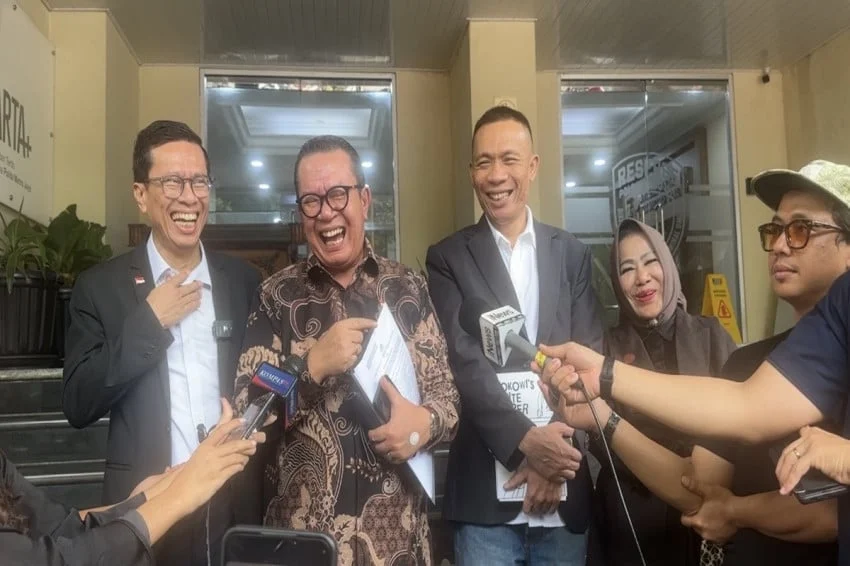
JAKARTA – Following the issuance of a termination of investigation letter (SP3) for Rismon Sianipar in the high-profile case involving allegations of a fake diploma against former President Joko Widodo, the Chairman of Joman Nusantara Bersatu, Andi Azwan, has expressed a fervent hope that the related cases against Roy Suryo and Dr. Tifauzia Tyassuma will promptly reach P21 status, signifying the completion of the investigation file by the police and its transfer to the public prosecutor for immediate trial. This development marks a significant turn in a controversy that has reverberated through Indonesia’s political and legal landscapes for years, highlighting the complexities of digital defamation and the enforcement of the country’s stringent cyber laws.
Andi Azwan conveyed his expectations on Wednesday, April 15, 2026, articulating a clear timeline for the progression of the remaining legal proceedings. "We hope that within this week, there will be a handover of the case files, and by the end of this month, the cases for others [Roy Suryo and Dr. Tifauzia Tyassuma] will achieve P21 status. Roy Suryo and Dr. Tifa should be prepared to meet us in court," Azwan stated, underscoring the organization’s determination to see the cases through to prosecution. His remarks signal an unwavering commitment from Joman Nusantara Bersatu, a prominent pro-Jokowi volunteer group, to ensure accountability for individuals accused of disseminating what they consider to be baseless and defamatory information against the former head of state.
The Genesis of the Fake Diploma Allegations and Rismon Sianipar’s Role
The allegations concerning former President Joko Widodo’s academic credentials first surfaced prominently in the public sphere, often resurfacing during politically charged periods, including presidential election cycles. These claims cast a shadow of doubt over his legitimacy and academic background, despite numerous official confirmations from Gadjah Mada University (UGM), Jokowi’s alma mater, verifying the authenticity of his diploma and academic record. The university, a highly respected institution in Indonesia, has consistently defended the integrity of its records and Jokowi’s graduation.
Rismon Sianipar, an individual who became central to this controversy, was initially named a suspect in connection with these allegations. While the precise nature of his initial involvement has been subject to various interpretations, he was understood to be a key figure in either initiating or significantly propagating the claims. His recent SP3 — Surat Pemberitahuan Penghentian Penyidikan (Letter of Notification of Termination of Investigation) — signifies a pivotal moment. An SP3 is issued by the police when there is insufficient evidence to continue an investigation, when the act is deemed not a criminal offense, or when the suspect dies. In Rismon’s case, the context provided suggests that the termination of his suspect status is linked to the application of restorative justice principles, as alluded to by Joman’s statements. This mechanism allows for resolution outside of formal court proceedings, focusing on reconciliation and rehabilitation, especially for certain types of offenses.
Andi Azwan, commenting on Rismon’s SP3, chose to exercise caution, refraining from extensive commentary to avoid preempting police announcements. However, he expressed profound gratitude to the National Police, particularly the investigators of the Jakarta Metropolitan Police (Polda Metro Jaya) and the Directorate of Criminal Investigation (Dirreskrimum), for their diligent handling of the case. "If anyone suggests there would be no SP3, that is incorrect. Ultimately, whatever actions have been taken, we express our greatest appreciation to the National Police, especially the investigators of Polda Metro Jaya and Dirreskrimum," he affirmed. This sentiment suggests that Joman views the police’s decision as a legitimate and appropriate legal outcome within the framework of Indonesian law.
The Role of Restorative Justice and the New KUHAP
The application of restorative justice (RJ) in Rismon Sianipar’s case is a critical aspect of this development. Restorative justice is an approach to justice that focuses on repairing the harm caused by crime rather than on punishing the offender. It involves the victim, the offender, and the community in a process of resolution. The mention of a "new KUHAP" (Kitab Undang-Undang Hukum Acara Pidana, or Indonesian Criminal Procedure Code) indicates that recent legal reforms or interpretations have broadened the scope for implementing RJ. This modern approach to criminal justice emphasizes reconciliation, victim-offender mediation, and community involvement, aiming to reduce recidivism and foster social harmony. For Rismon, the use of RJ likely means that a resolution was reached outside of a formal trial, possibly involving an apology, compensation, or other forms of reconciliation, leading to the termination of his suspect status. The "sumringah" (cheerful) appearance of Rismon Sianipar at a meeting, as noted by Azwan, further supports the notion of a satisfactory resolution for him through this mechanism. A joint press conference involving Rismon and his legal team is anticipated to provide further details regarding the RJ agreement.
The Ongoing Pursuit of Roy Suryo and Dr. Tifauzia Tyassuma
While Rismon Sianipar has seen his suspect status revoked, the legal spotlight now intensifies on Roy Suryo and Dr. Tifauzia Tyassuma. Both are prominent public figures in Indonesia, known for their outspoken views and, at times, controversial statements on social media and in public discourse. Roy Suryo, a former Minister of Youth and Sports and an expert in information technology, has frequently engaged in public commentary on various issues. Dr. Tifauzia Tyassuma, often referred to as Dr. Tifa, is also known for her strong opinions and widespread social media presence. Their alleged involvement in the Jokowi fake diploma case stems from their public statements, analyses, or dissemination of information that supported or amplified the fake diploma narrative.
Joman Nusantara Bersatu’s insistence on the P21 status for their cases implies that the police investigation against them is believed to be comprehensive and complete, with sufficient evidence to proceed to prosecution. The charges they face are likely related to defamation, spreading false news, or violating Indonesia’s Electronic Information and Transactions (ITE) Law, which carries significant penalties for online libel and the dissemination of hoaxes. The ITE Law has been a subject of extensive debate in Indonesia, with critics arguing it can be used to stifle dissent and freedom of expression, while proponents argue its necessity in combating misinformation and protecting individuals from online harassment. Joman’s firm stance reflects a desire to demonstrate that even prominent figures are not above the law when it comes to spreading what they deem to be damaging falsehoods.
Chronology of a Contentious Case
The journey of the Jokowi fake diploma allegations through the Indonesian legal system has been protracted and complex.
- Initial Allegations (Pre-2019 Elections onwards): Claims regarding Jokowi’s alleged fake diploma emerged sporadically, often intensified during election campaigns to discredit his presidential bids. Gadjah Mada University consistently refuted these claims, providing official documentation.
- Increased Prominence and Public Debate: The allegations gained traction through various online platforms and social media, drawing in public figures who either questioned or defended the authenticity of Jokowi’s diploma.
- Official Complaints and Police Investigations: Formal complaints were lodged with the police, accusing individuals of spreading false information and defamation. These complaints led to the initiation of police investigations into the matter.
- Naming of Suspects: Over time, individuals such as Rismon Sianipar, Roy Suryo, and Dr. Tifauzia Tyassuma were named as suspects by the police, indicating that investigators had found initial grounds to believe they were involved in criminal acts related to the dissemination of the allegations.
- Rismon Sianipar’s SP3 (April 2026): The most recent development saw the issuance of an SP3 for Rismon Sianipar, effectively terminating the investigation against him, likely through the application of restorative justice.
- Current Status of Roy Suryo and Dr. Tifa’s Cases: Investigations against Roy Suryo and Dr. Tifa are ongoing, with Joman Nusantara Bersatu actively pushing for their cases to reach P21 status and proceed to trial. This indicates a bifurcated outcome for the initial set of suspects involved in the same overarching controversy.
Broader Implications and Analysis
The developments in the Jokowi fake diploma case carry significant implications for several facets of Indonesian society:
- Freedom of Expression vs. Defamation: The case reignites the perennial debate in Indonesia regarding the delicate balance between freedom of expression and the legal boundaries of defamation, particularly under the ITE Law. While critical commentary is a cornerstone of democracy, the spread of demonstrably false information can have serious consequences, especially when targeting public officials. The differing outcomes for Rismon Sianipar (SP3 via RJ) and the push for prosecution against Roy Suryo and Dr. Tifa might suggest a nuanced approach by the legal system, potentially distinguishing between initial propagators who might be amenable to restorative justice and those deemed to have persistently or maliciously amplified false claims.
- The Role of Social Media: This case underscores the profound impact of social media in shaping public discourse and the rapid dissemination of both factual and fabricated information. Platforms like Twitter, Facebook, and YouTube played a crucial role in amplifying the diploma allegations, making the enforcement of laws against hoaxes and defamation increasingly complex for authorities.
- Legal System’s Integrity and Consistency: The public will keenly observe how the Indonesian legal system navigates these politically sensitive cases. The application of restorative justice for one suspect while pursuing prosecution for others will invite scrutiny regarding consistency, fairness, and the criteria used to make such distinctions. Transparency in explaining these decisions will be vital for maintaining public trust in the legal process.
- Political Climate: The involvement of a pro-government group like Joman Nusantara Bersatu highlights the political dimensions of such legal battles. These cases often become proxy conflicts reflecting broader political alignments and the desire to safeguard the reputation of political figures. The outcome will inevitably be perceived through a political lens, influencing future discourse around political accountability and criticism.
- Precedent for Future Cases: The handling of this case, particularly the application of restorative justice and the prosecution of prominent figures, will likely set precedents for future cases involving online defamation and the spread of misinformation, especially concerning public officials. It could influence how individuals and organizations approach public criticism and the dissemination of information in the digital age.
As the legal process unfolds, particularly with the anticipated press conference by Rismon Sianipar and his legal team, and the potential progression of cases against Roy Suryo and Dr. Tifauzia Tyassuma to trial, the nation will be watching closely. The outcome will not only determine the fates of the individuals involved but also contribute to shaping the parameters of public discourse, legal enforcement, and political accountability in Indonesia for years to come. The call for P21 by Joman serves as a clear indication that for some, the pursuit of justice in this complex saga is far from over, despite the recent developments.
