
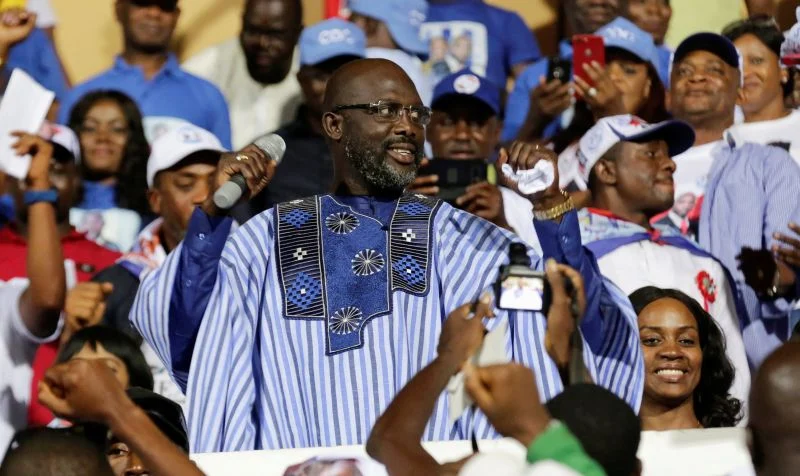
The remarkable journey of George Tawlon Manneh Oppong Ousman Weah, a name synonymous with footballing excellence and now with the highest office in Liberia, marks a unique chapter in both sports and politics. In December 2017, Weah, who had been crowned the world’s best footballer in 1995, officially transitioned from the hallowed turf to the halls of power, being elected President of Liberia. This transition, from the roar of the crowds to the weight of national leadership, underscores a life dedicated to achievement, resilience, and service, first on the global sporting stage and subsequently in the complex arena of national governance.
Born on October 1, 1966, in the bustling capital city of Monrovia, Liberia, Weah’s innate talent for the beautiful game was evident from his formative years. Growing up amidst the dusty, sand-covered pitches of his hometown, he honed his skills with a raw passion that would eventually propel him to international stardom. His early footballing odyssey saw him represent a string of local Liberian clubs, including Invincible Eleven, Mighty Barolle, Bongrange Bonguine, and the Young Survivors of Claretown. Even in these nascent stages, his prowess was undeniable.
The Ascent of a Young Prodigy
Weah’s early career was characterized by a meteoric rise. During his teenage years, he was instrumental in leading Young Survivors, a team reportedly operating without a formal coach, to promotion into the top division of Liberian football. This early success signaled his leadership qualities and his capacity to inspire those around him. His exceptional abilities did not go unnoticed, and in 1987, at the age of 20, he secured a three-year contract with Tonnerre of Yaoundé, a prominent club in Cameroon. It was with this club that he first tasted league championship success in the top division, further solidifying his reputation as a rising star in African football.
The allure of European football soon beckoned. In 1988, AS Monaco, a team competing in France’s top-flight Ligue 1, recognized Weah’s immense potential and offered him a contract. At just 22 years old, he embarked on a new chapter in his career, one that would see him blossom into a global phenomenon. Over five seasons with Monaco, from 1988 to 1992, Weah showcased his electrifying pace, lethal finishing, and an uncanny ability to find the back of the net. He amassed an impressive 57 goals during his tenure, contributing significantly to the team’s success, including a French Cup victory in 1991. His performances were a blend of raw athleticism and technical brilliance, captivating fans and earning him widespread admiration.
Global Acclaim and a Move to Paris
Weah’s reputation continued to grow, and his exceptional work ethic, combined with his uncompromising technical skills, attracted the attention of another French powerhouse, Paris Saint-Germain (PSG). In 1992, he made the move to the capital, where his star continued to ascend. With PSG, Weah cemented his status as one of the world’s most formidable strikers. He played a pivotal role in the club’s triumphs, leading them to win the Coupe de France, the Ligue 1 title, and an impressive semi-final appearance in the 1995 UEFA Champions League. His goal-scoring exploits in Ligue 1 were remarkable, netting 37 goals and providing 3 assists in 123 appearances, further enhancing his legacy as a prolific forward.
The pinnacle of his European club career arrived in 1995 when AC Milan, one of Italy’s most storied clubs, secured his signature from PSG for a substantial fee. Playing in Serie A, a league renowned for its defensive solidity, Weah continued to shine. His impact was immediate, helping AC Milan clinch the Scudetto (league title) in both the 1995-96 and 1998-99 seasons. During his five-year spell at the San Siro, he etched his name in the club’s history, scoring 51 goals and providing 1 assist in 114 appearances.
The Zenith of Individual Achievement
It was during his time at AC Milan that George Weah reached the zenith of his individual career. In 1995, his extraordinary performances on the global stage were recognized with the most prestigious individual accolades in football. He was awarded the FIFA World Player of the Year award, a testament to his unparalleled skill, consistency, and impact. The following year, in 1996, he was honored with the Ballon d’Or, further solidifying his place among the all-time greats of the sport. These awards were not merely personal triumphs; they represented a historic moment for African football, as Weah became the first and, to date, only African player to achieve these coveted honors. His success was a beacon of inspiration for aspiring footballers across the continent and beyond, demonstrating that dreams, no matter how grand, could be realized through talent, dedication, and perseverance.
Following his stellar career in Europe, Weah had brief stints with English clubs Chelsea and Manchester City before eventually returning to Africa and playing for Al-Jazira in the UAE. His football career spanned from the late 1980s to the early 2000s, a period that saw him transform from a local talent into a global icon.
The Transition to Politics and the Presidential Bid
Upon hanging up his boots, George Weah did not fade from the public eye. Instead, he embarked on a new and ambitious path: politics. Driven by a desire to serve his country, which had endured years of civil war and political instability, Weah entered the political arena. His commitment to improving the lives of ordinary Liberians was a significant factor in his growing popularity.
His political journey began with a bid for the Liberian presidency in 2005. Running on the ticket of the Congress for Democratic Change (CDC), he narrowly lost to Ellen Johnson Sirleaf, the country’s first female head of state. Despite the defeat, Weah continued his political engagement, serving as a senator for Montserrado County, one of Liberia’s most populous counties, from 2015 to 2017. This period in the Senate provided him with valuable experience in governance and policy-making, further preparing him for national leadership.
The 2017 presidential election saw George Weah make a determined return to the presidential race. Campaigning on a platform of "change" and promising to tackle corruption, poverty, and unemployment, he resonated with a populace eager for a new direction. His campaign was marked by rallies, public appearances, and extensive use of social media to connect with voters. His footballing fame, combined with his promises of reform, created a powerful narrative that captivated the nation.
Election Victory and the Dawn of a New Era
The results of the 2017 presidential election were announced on December 29, 2017. George Weah secured a decisive victory, winning 61.5% of the vote in the run-off election against incumbent Vice President Joseph Boakai. This triumph marked a historic moment for Liberia, ushering in a new political era and fulfilling Weah’s long-held ambition to lead his nation. His election was met with widespread jubilation across Liberia and garnered significant international attention, hailed as a symbol of hope and a testament to the power of democratic transitions.
The transition from a global football superstar to a head of state is an exceptionally rare occurrence. While many athletes have entered politics, few have reached the highest executive office in their country. Weah’s ascent offers a unique case study in the intersection of celebrity, public service, and political aspiration.
Governing Liberia: Challenges and Opportunities
As President, George Weah inherited a nation grappling with numerous challenges. Liberia, despite its rich natural resources, has historically struggled with widespread poverty, inadequate infrastructure, and a need for robust institutional reform. The nation’s economy remains heavily reliant on commodity exports, making it vulnerable to global price fluctuations. Weah’s administration has faced the critical task of fostering economic diversification, creating jobs, and improving the delivery of essential services such as healthcare and education.
One of the key policy priorities for the Weah administration has been to combat corruption, a persistent issue that has plagued Liberia for decades. His government has emphasized transparency and accountability, seeking to rebuild public trust and attract foreign investment. Efforts have also been made to strengthen Liberia’s democratic institutions and uphold the rule of law.
The COVID-19 pandemic presented a significant global challenge that also impacted Liberia, straining its healthcare system and economy. Weah’s government, like others around the world, had to navigate the complexities of public health responses while mitigating economic fallout.
A Legacy in the Making
George Weah’s story is one of extraordinary achievement and remarkable transition. From the dusty fields of Monrovia to the grandest stadiums of Europe, and ultimately to the presidential palace, his life has been a testament to his drive and determination. His legacy as a footballer is already firmly cemented, recognized by his FIFA World Player of the Year and Ballon d’Or titles. Now, as President, he is forging a new legacy, one that will be judged by his ability to lead Liberia towards a brighter and more prosperous future. His journey serves as a powerful inspiration, demonstrating that individuals from humble beginnings can achieve the highest levels of success and, with that success, can aspire to serve and uplift their nations. The world watches with keen interest as George Weah continues to write the next chapter of his extraordinary life, now as the leader of Liberia.
