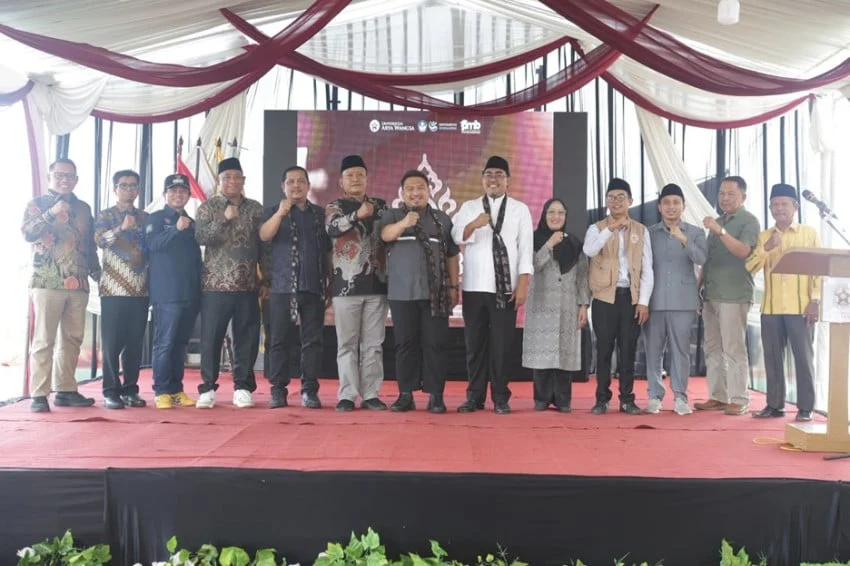
The ongoing battle against narcotics in Indonesia reached a significant milestone on Saturday, October 31, 2026, as high-ranking government officials and law enforcement representatives gathered at Universitas Arya Wangsa (UAW) in Subang, West Java. Marking a concerted effort to safeguard the nation’s academic communities, members of Commission III of the House of Representatives (DPR RI) alongside the National Narcotics Agency (BNN) spearheaded a comprehensive seminar titled the Symposium on Strengthening the Prevention and Eradication of Drug Abuse. The event served as a critical platform to address the growing sophistication of drug distribution networks while emphasizing that proactive prevention remains the single most effective defense mechanism for the younger generation.
The high-profile gathering brought together prominent figures, including Jazilul Fawaid, a senior member of Commission III of the DPR RI, and Fathur Rohman, Head of the Karawang Regency BNN. Both leaders addressed a packed auditorium of incoming freshmen, highlighting the extreme vulnerabilities that young adults face as they transition into higher education. By engaging students directly at the start of their academic journey, the initiative aims to build psychological and social resilience against the pervasive threat of narcotics.
Strategic Focus on Prevention Over Rehabilitation
At the heart of the symposium was a resolute message underscoring the severe limitations and human costs associated with drug rehabilitation. Addressing the auditorium, Jazilul Fawaid—who also serves as the founder of Universitas Arya Wangsa—articulated a clear philosophy regarding modern drug policy. He stressed that while law enforcement and rehabilitation facilities are indispensable components of the national strategy, they represent reactive measures deployed only after irreversible damage has often been done.
"I am genuinely pleased that the BNN has taken the direct initiative to conduct anti-drug socialization campaigns among young people, particularly the new students of Universitas Arya Wangsa," stated Jazilul, who is widely known as Gus Jazil. "This preventive approach is infinitely more important because it is fundamentally easier to prevent substance use than to reverse it once an individual has fallen into dependency. The rehabilitation process for victims of drug abuse is extraordinarily difficult, demanding immense psychological, physical, and financial resources."
Gus Jazil noted that college campuses have historically been primary targets for narcotics syndicates seeking to expand their consumer bases. By targeting university students, traffickers exploit the transitional phase of early adulthood, characterized by a desire for social exploration, independence, and peer acceptance. Consequently, equipping incoming students with factual knowledge, critical thinking skills, and institutional support systems creates a robust firewall against predatory drug networks.
Collaborative Commitment and Legislative Backing
The event also underscored the necessity of a unified, multi-sectoral approach to national security and public health. Gus Jazil praised the continuous efforts of the BNN and the Indonesian National Police (Polri) in executing targeted raids, dismantling clandestine laboratories, and arresting high-level traffickers. However, he maintained that law enforcement alone cannot eradicate the narcotics trade without active cooperation from educational institutions, religious organizations, civil society, and families.
As a senior legislator representing Commission III—which oversees legal affairs, human rights, and security—Gus Jazil reiterated the parliament’s unwavering commitment to providing the necessary legislative and budgetary support to anti-narcotics agencies.
"We in Commission III of the DPR RI will provide our full and unconditional support to the BNN and the National Police in their relentless efforts to eradicate the distribution and abuse of narcotics across the entire archipelago," Gus Jazil affirmed. He called upon university administrators nationwide to maintain open channels of communication with law enforcement agencies and to implement rigorous, campus-wide policies that discourage substance experimentation.
Echoing these sentiments, Fathur Rohman, representing the BNN apparatus at the regional level, detailed the operational realities of combating drug trafficking in West Java. Rohman presented localized data highlighting how Subang and its surrounding industrial corridors have increasingly become transit zones for illicit substances moving between major metropolitan centers. He urged students to act as ambassadors of change within their respective communities, noting that peer-to-peer education often penetrates social circles far more effectively than traditional top-down government campaigns.
Broader Context of Indonesia’s Narcotics Emergency
The symposium at Universitas Arya Wangsa takes place against a backdrop of ongoing national concern regarding drug abuse in Indonesia. For decades, Indonesian authorities have maintained a zero-tolerance stance on narcotics, categorizing the drug trade as an extraordinary crime that threatens the sovereignty and demographic dividend of the nation.
Data compiled by the BNN and academic research institutions indicate that drug trafficking patterns have evolved rapidly in recent years. Syndicate networks have shifted away from traditional plant-based narcotics toward synthetic designer drugs, commonly referred to as New Psychoactive Substances (NPS). These chemical compounds are often masked in consumer-friendly formats—such as liquids, vape cartridges, and edible items—making them particularly alluring and deceptive to teenagers and young adults on university campuses.
Furthermore, the economic implications of widespread drug abuse are staggering. According to national health estimates, substance abuse drains billions of rupiah annually from the state economy through lost productivity, healthcare expenditures, and the operational costs of the criminal justice system. More importantly, the human toll—measured in broken families, truncated educational careers, and lost potential—remains incalculable.
By focusing educational interventions on university freshmen, agencies like the BNN aim to intervene precisely at the demographic tipping point. Research consistently demonstrates that the majority of individuals who initiate drug use do so during their late teens and early twenties. Intercepting this vulnerability window through structured dialogue, peer counseling, and legal awareness campaigns is viewed by criminologists as a vital paradigm shift toward sustainable public safety.
Long-Term Implications for Higher Education in Indonesia
The collaboration between the legislature, law enforcement, and private higher education institutions like Universitas Arya Wangsa signals a shifting paradigm in how Indonesian campuses approach security and student welfare. Historically, universities maintained a degree of autonomy that occasionally hindered direct law enforcement intervention, sometimes creating blind spots where illicit activities could operate unmonitored.
Modern administrative frameworks, however, increasingly recognize that institutional safety requires transparent partnerships with agencies like the BNN. By institutionalizing anti-drug symposiums as a standard component of orientation weeks for new students, universities are institutionalizing a culture of accountability and collective responsibility.
As the symposium concluded on Saturday afternoon, student representatives from Universitas Arya Wangsa formally pledged their commitment to maintaining a drug-free campus environment. The administration announced plans to follow up the event with student-led advocacy groups, regular health screenings, and psychological support clinics designed to assist students navigating the stresses of academic life without resorting to harmful coping mechanisms.
Ultimately, the event at Universitas Arya Wangsa serves as a microcosm of Indonesia’s broader struggle against narcotics. It highlights that while the war on drugs requires the heavy machinery of law enforcement and legal penalties, the ultimate victory will be secured in classrooms, community centers, and lecture halls where the next generation is empowered to choose a healthier, safer, and more productive future.