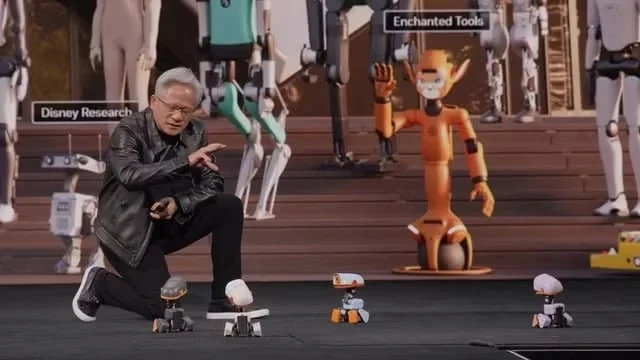
The recent unveiling of the Microduck robot at the NVIDIA GTC conference in Berlin has marked a significant shift in the trajectory of consumer and research-grade robotics. Standing at a modest height of 25 centimeters and weighing less than a kilogram, these diminutive, duck-shaped machines have captured the attention of the global technology community, not merely for their aesthetic charm but for the sophisticated artificial intelligence architecture underpinning their functionality. Priced at an accessible USD 399, the Microduck represents a strategic collaboration between NVIDIA, Hugging Face, and Pollen Robotics, signaling a concerted effort to democratize robotics research and machine learning development.
The GTC Berlin Unveiling and Initial Reception
During the GTC Berlin keynote address, NVIDIA CEO Jensen Huang showcased the operational capabilities of the Microduck units. Before a live audience, the robots executed a series of physical maneuvers—ranging from standing and sitting to complex postural adjustments—in direct response to voice commands. The demonstration was punctuated by moments of levity, particularly when one unit displayed a slight delay in processing a command, a candid reflection of the nascent nature of edge-computing integration.
The market response was immediate and overwhelming. Reports from TechCrunch indicate that the platform secured over 20,000 pre-orders within the first few days of its announcement. This rapid adoption suggests a substantial latent demand for affordable, programmable robotic hardware that bridges the gap between industrial-grade automation and consumer-level hobbyist devices.
Chronology and Collaborative Development
The development of the Microduck is the result of a multi-year effort to lower the barriers to entry for robotics research. The project originated as a collaborative venture between Pollen Robotics, known for their modular robotic platforms, and Hugging Face, the prominent open-source AI platform. The integration of NVIDIA’s hardware and software ecosystem—specifically the Isaac Sim platform—provided the final catalyst for the robot’s functionality.
Historically, the development of robotic hardware was hampered by the high cost of physical prototypes and the iterative nature of manual programming. Early robotics research in the 1990s and early 2000s required researchers to hard-code specific joint movements, a process that was both time-consuming and prone to failure. The Microduck development cycle represents a departure from this paradigm. Instead of manual programming, the developers utilized the "sim-to-real" workflow, which has become a cornerstone of modern robotics. By training the AI agents within the Isaac Sim environment, developers could simulate thousands of hours of movement and motor control in a virtual space, effectively "teaching" the robot how to interact with its physical environment before it was ever manufactured.
The Technical Architecture: Isaac Sim and AI Training
The intelligence of the Microduck is not stored in a static database of movements but is rather derived from neural networks trained in simulated environments. Isaac Sim, a virtual robotics laboratory powered by NVIDIA’s Omniverse, allows for the creation of high-fidelity, physically accurate scenarios. Within this environment, the robots learn to maintain balance, navigate obstacles, and interpret voice commands through reinforcement learning.
This methodology offers two primary advantages: scalability and safety. By utilizing cloud-based computational resources, the training process is significantly accelerated. A physical robot would require weeks to "learn" how to recover from a fall; in the virtual simulation, the AI can perform the same action thousands of times in a matter of hours, refining its motor skills through trial and error without the risk of damaging the hardware. This digital-first approach to physical robotics is likely to influence future hardware development, as it minimizes the need for costly iterative prototyping.
Market Implications and Industry Statements
Industry analysts have characterized the Microduck as a pivotal tool for educational institutions and independent developers. By providing a platform that is both affordable and capable of high-level machine learning research, the collaboration is effectively lowering the barrier to entry for robotics engineering.
"The goal is to provide a platform that is accessible enough for a student to experiment with, yet robust enough for an engineer to conduct meaningful research," noted a spokesperson associated with the project. While official statements from NVIDIA emphasize the educational potential of the robot, the underlying technology has broader applications. The ability to simulate motor control and AI interaction is directly applicable to the development of autonomous delivery drones, service robots for the elderly, and industrial collaborative robots (cobots).
The pricing model of USD 399 positions the Microduck in a competitive bracket, bridging the divide between high-end STEM educational toys and professional research hardware. This pricing strategy reflects a broader industry trend where the "intelligence" of the robot is decoupled from the cost of the hardware, allowing for more widespread experimentation and rapid software iteration.
The Role of Open Source in Robotics
A significant portion of the Microduck’s appeal lies in its integration with Hugging Face’s repository. By enabling researchers to share their training models and movement algorithms, the project fosters a community-driven ecosystem. This open-source approach to hardware and software development is expected to lead to rapid improvements in the robot’s capabilities.
As users experiment with the platform, they are essentially contributing to a collective library of behaviors. For example, if a developer creates an efficient algorithm for navigating a staircase, that model can be shared, tested, and further refined by the global community. This network effect is expected to accelerate the development of complex motor skills that would otherwise take individual laboratories years to achieve.
Fact-Based Analysis: Challenges and Future Outlook
Despite the enthusiasm surrounding the Microduck, the project faces several technical and logistical hurdles. The transition from simulation to reality—known as the "sim-to-real gap"—remains one of the most significant challenges in robotics. Even with high-fidelity simulations, the physical world is rife with variables that are difficult to replicate, such as variations in surface friction, battery degradation, and sensor noise.
Furthermore, the surge in demand presents a supply chain challenge for the manufacturers. Scaling the production of 20,000 units while maintaining the quality standards required for delicate sensors and actuators is a non-trivial endeavor. If the project is to succeed in the long term, the developers must ensure that the user experience remains seamless for non-experts, who may not have the technical background to troubleshoot hardware-software synchronization issues.
However, the implications of this project are profound. The Microduck is not merely a toy; it is a manifestation of the "AI-in-a-box" concept, where sophisticated machine learning capabilities are integrated into small, manageable hardware platforms. If this model proves successful, it could herald a new era where domestic robots become common household tools, capable of learning, adapting, and performing tasks that were previously reserved for expensive, industrial-grade systems.
Conclusion: A Catalyst for Innovation
The Microduck project, while currently in its early stages of distribution, has already succeeded in its primary objective: to bring high-level robotics research into the hands of the public. By leveraging NVIDIA’s advanced simulation tools and the open-source spirit of the developer community, the project provides a blueprint for how future robotic systems will be designed.
The industry is watching closely to see how the platform evolves. If the community successfully leverages the provided toolsets to create a diverse range of behaviors and applications, the Microduck could become the "Arduino of robotics"—a foundational platform upon which the next generation of robotic engineers builds their careers. As the technology matures, the lessons learned from these small, duck-shaped robots will likely find their way into larger, more complex machines, permanently altering the landscape of human-robot interaction.