The revitalization of strategic national energy infrastructure often commands intense media scrutiny, marked by high-level inspections, rigorous economic projections, and complex political discourse. However, beneath the gravity of multi-billion-dollar state enterprise projects, official visits occasionally reveal moments of grassroots connection and local cultural engagement. This was precisely the case when President Joko Widodo, alongside then-Minister of State-Owned Enterprises (BUMN) Rini Soemarno, top executives of state energy giant PT Pertamina (Persero), and other senior government officials, undertook a high-profile working visit to the PT Trans Pacific Petrochemical Indotama (TPPI) refinery located in Tuban, East Java.
The visit, conducted on Wednesday, November 11, 2015, carried immense economic significance. The TPPI facility had endured a prolonged period of operational dormancy, financial turbulence, and legal complexities that had severely hampered national petrochemical production and fuel self-sufficiency. Yet, before the entourage plunged into the technical assessments, complex financial audits, and strategic briefings awaiting them inside the industrial complex, a distinctly human moment unfolded. Walking through the surrounding neighborhood to greet constituents, the state officials paused at a local fruit stall, transforming a routine ministerial inspection into a memorable interaction with the agrarian community of Tuban.
Background Context of the TPPI Refinery
To fully understand the weight of the November 2015 presidential inspection, one must examine the critical role the TPPI facility plays in Indonesia’s broader macroeconomic framework. Situated in Tuban, East Java, the TPPI complex was conceptualized as a cornerstone for domestic petrochemical production and fuel refining. The facility was designed to produce essential petroleum products, including premium gasoline, diesel, and aromatic petrochemicals such as paraxylene, benzene, orthoxylene, and toluene. These components are vital not only for Indonesia’s domestic fuel supply chain but also for the downstream manufacturing industries that rely heavily on domestic petrochemical feedstocks.
Despite its strategic importance, the refinery’s history prior to late 2015 was fraught with financial distress, ownership disputes, and operational halts. For years, the facility operated well below capacity or remained completely idle due to corporate debt restructurings, feedstock supply bottlenecks, and challenges in governance. The prolonged closure forced Indonesia to rely more heavily on imported refined petroleum products, placing a heavy burden on the state budget and the nation’s foreign exchange reserves.
Recognizing the urgent need to secure national energy independence and reduce reliance on foreign fuel imports, the administration of President Joko Widodo prioritized the revival of idle state assets. Bringing the TPPI refinery back online became a litmus test for the government’s commitment to reforming the energy sector, empowering state-owned enterprises, and maximizing domestic production capabilities. Consequently, the visit by the President and his chief economic ministers was not merely symbolic; it was a decisive step toward reactivating a multi-billion-dollar national asset that held the key to regional economic revitalization.
Chronology of the Presidential Visit
The sequence of events on November 11, 2015, was meticulously planned to balance rigorous oversight with direct engagement with the local populace. The delegation, led by President Joko Widodo, arrived in Tuban via official transport, accompanied by a high-ranking entourage of state officials and corporate leaders.
Alongside President Widodo were Minister of State-Owned Enterprises Rini Soemarno, Pertamina President Director Dwi Soetijpto, Pertamina Vice President of Communication Wianda Pusponegoro, and Director General of Oil and Gas at the Ministry of Energy and Mineral Resources IGN Wiratmaja Puja.
Upon arrival in the vicinity of the industrial zone, the itinerary temporarily deviated from rigid protocol. Rather than driving directly through the security gates of the refinery complex in armored motorcades, the President and select members of his delegation chose to walk through the local neighborhood flanking the industrial perimeter. This decision allowed the leaders to observe firsthand the socioeconomic conditions of the surrounding communities, which had experienced the economic highs and lows tied to the refinery’s operational status.
As the entourage walked along the dusty pathways, dozens of local residents gathered to catch a glimpse of the national leaders. In an informal display of accessibility, residents approached the delegation to exchange greetings and capture photographs with the ministers and corporate executives. The palpable excitement among the townspeople underscored the community’s deep connection to the national projects operating in their backyard.
The Impromptu Cultural Pause: Tuban Watermelon
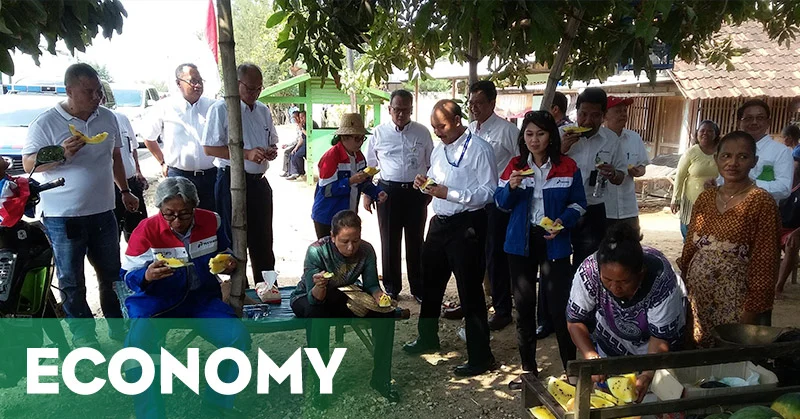
Amidst the warm reception from local residents, the walking tour led the presidential entourage past a humble roadside stall operated by a local farmer and fruit vendor. The stall proudly displayed piles of freshly harvested local produce, most notably vibrant, large Tuban watermelons cultivated in the agricultural lands adjacent to the coastal industrial corridor.
Tuban, traditionally known for its robust agricultural output alongside its growing industrial footprint, produces high-quality agricultural goods owing to its favorable soil composition and tropical climate. Recognizing an opportunity to support local commerce and share a lighthearted moment with the residents, the high-ranking officials stopped at the stall.

Breaking away from the formal security perimeter, Minister Rini Soemarno engaged the vendor in friendly conversation, examining the harvested fruit. With characteristic enthusiasm, she invited the rest of the delegation and the surrounding press corps to partake in tasting the local harvest.
"Ayo-ayo coba dulu semangkanya. Enak ini semangkanya," remarked Minister Rini Soemarno, encouraging her colleagues and onlookers to sample the locally grown fruit right there at the roadside stall.
Pertamina President Director Dwi Soetijpto, along with other members of the official party, gladly joined in. The impromptu tasting session provided a brief, relaxed interlude before the heavy administrative burdens of the day. Slicing into the crisp, sweet fruit harvested from nearby farms, the officials experienced a genuine taste of Tuban’s agricultural bounty. After thoroughly enjoying the refreshment and exchanging pleasantries with the bewildered yet delighted vendor—who likely never expected the nation’s top economic ministers to stop at her modest stall—the delegation settled the payment and resumed their march toward the gates of the TPPI facility.
Official Inspection and Technical Briefings
Following the lighthearted interlude at the fruit stall, the delegation transitioned swiftly from grassroots diplomacy to high-stakes industrial governance. Entering the secure perimeter of the PT Trans Pacific Petrochemical Indotama complex, President Widodo and his ministers were greeted by plant operators, technical engineers, and managerial staff tasked with overseeing the complex rehabilitation of the refinery.
The primary objective of the inspection was to evaluate the readiness of the refinery to resume full-scale commercial operations. Technical teams presented detailed briefings outlining the mechanical integrity of the processing units, the status of crude oil and condensate feedstock supply agreements, and the projected output capacities once the facility was fully re-energized.
During the briefings, discussions centered heavily on the integration of TPPI into Pertamina’s overarching downstream supply chain. As the majority stakeholder following strategic corporate restructuring steps orchestrated by the government, Pertamina assumed operational control to steer the refinery out of its prolonged dormancy. The leadership team, spearheaded by Dwi Soetijpto, detailed the logistical frameworks established to ensure a steady influx of raw materials and the seamless distribution of refined fuels to domestic markets across Java and beyond.
The visit also served as an opportunity for the President to inspect the physical infrastructure, including the storage tanks, catalytic cracking units, and marine loading facilities. By walking the grounds, President Widodo sought to verify that the capital expenditures and administrative directives issued by the central government were translating into tangible progress on the ground.
Broader Economic Impact and Strategic Implications
The reactivation of the TPPI refinery, highlighted by the November 2015 presidential inspection, carried profound macroeconomic implications for Indonesia. For decades, the nation’s energy sector had grappled with a persistent deficit in domestic refining capacity, forcing state energy enterprises to import massive quantities of finished fuels to meet surging domestic demand. This structural vulnerability exposed the national economy to fluctuations in global oil prices and exerted continuous pressure on the country’s trade balance and foreign exchange reserves.
Bringing the Tuban facility back to life represented a pivotal turning point. Once fully operational, the refinery was projected to supply a significant percentage of Indonesia’s national fuel requirements, particularly gasoline and diesel, while simultaneously producing high-value petrochemicals that would feed domestic manufacturing industries. This reduction in dependency on foreign fuel imports translated to substantial fiscal savings for the state budget and bolstered national energy security.
Furthermore, the operational revival of the plant held immense regional economic significance for Tuban and the wider East Java province. The influx of industrial activity generated thousands of direct and indirect employment opportunities, stimulating local micro, small, and medium enterprises (MSMEs)—ranging from local catering services and housing rentals to agricultural suppliers like the very watermelon vendor who hosted the state ministers. The symbiotic relationship between large-scale state infrastructure and local community commerce was vividly demonstrated during the officials’ morning walk, reinforcing the government’s narrative that national economic development must tangibly benefit the grassroots populace.
Conclusion
The working visit of President Joko Widodo, Minister Rini Soemarno, and Pertamina’s leadership to the TPPI refinery in Tuban on November 11, 2015, bridges the gap between high-level macroeconomic strategy and human-centric governance. While the primary mission was rooted in assessing the technical and financial rehabilitation of a critical national energy asset, the day will also be remembered for its unplanned moments of cultural warmth. From walking the neighborhood streets and engaging directly with local citizens to pausing at a roadside stall to taste the sweet harvest of Tuban’s agricultural lands, the leadership demonstrated an approachable demeanor that resonated deeply with the local community. Ultimately, this balanced blend of rigorous industrial oversight and grassroots engagement encapsulated a pivotal chapter in Indonesia’s ongoing quest for energy independence and sustainable national development.