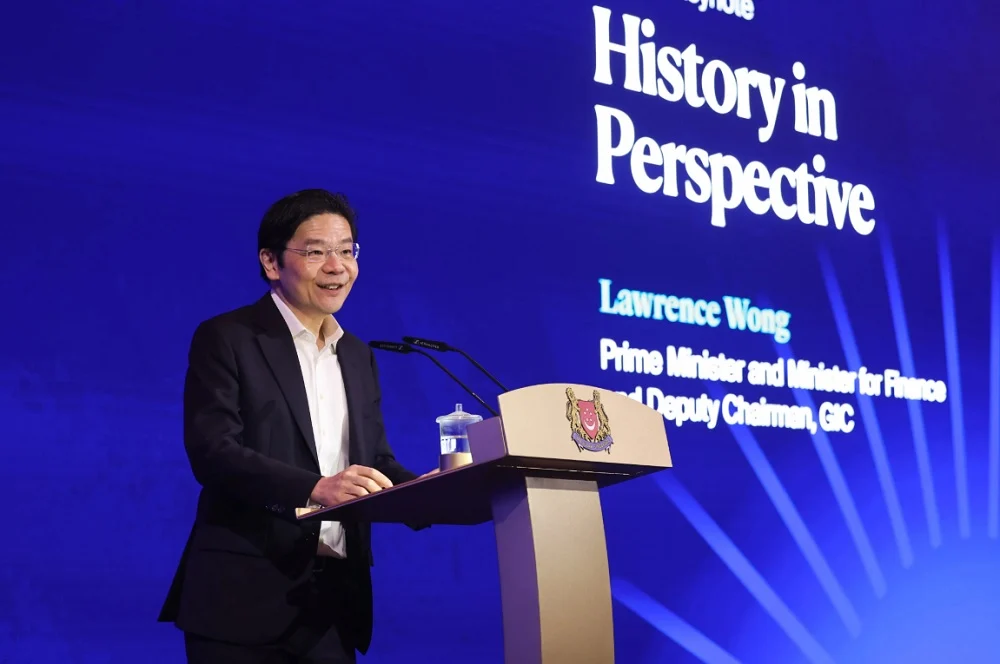
The government of Singapore has announced a significant upward adjustment to the annual compensation packages for its political leadership, a decision that further cements the city-state’s position as the nation providing the highest-paid political executives in the world. Prime Minister Lawrence Wong, already the highest-earning head of government globally, is set to see his annual remuneration increase by SGD 1.4 million (approximately IDR 19.39 billion). This adjustment brings his total annual package to SGD 3.6 million, equivalent to roughly IDR 49.87 billion, marking a substantial increase of more than 60 percent from his previous salary of SGD 2.2 million.
Contextualizing the Salary Adjustment
The rationale behind this policy, as articulated by Prime Minister Wong and the Singaporean administration, is rooted in the long-standing national philosophy of competitive remuneration. For decades, the People’s Action Party (PAP) government has maintained that the public sector must offer compensation packages that are comparable to, or at least competitive with, the private sector to attract top-tier talent. The logic is twofold: to ensure that the most capable individuals are incentivized to serve in public office, and to maintain a high-integrity governance model that discourages systemic corruption by eliminating the need for officials to seek secondary income streams.
However, the announcement has ignited a fierce debate within Singaporean society. While the government views these salaries as a necessity for maintaining a “clean and efficient” bureaucracy, many citizens have expressed concerns regarding the widening wealth gap. With the median monthly household income in Singapore standing at approximately SGD 5,775, the disparity between the nation’s political elite and the average working citizen is starkly visible. This decision comes at a time when residents are navigating a period of global economic uncertainty, characterized by persistent inflationary pressures and concerns over job security.
A Comparative Analysis of Global Political Salaries
Singapore’s approach to political compensation remains a global outlier. To understand the scale of the remuneration, one must compare it with the compensation packages of other world leaders. Currently, the Prime Minister of Singapore earns significantly more than his counterparts in the world’s largest economies.
For instance, the Chief Executive of Hong Kong, John Lee, earns approximately USD 719,000 annually. The President of Switzerland, Guy Parmelin, receives roughly USD 606,000 per year. Even the heads of state of major global powers operate on a drastically different pay scale. The President of the United States, Donald Trump, is paid an annual salary of USD 400,000, while the British Prime Minister, Andy Burnham, receives approximately USD 230,000.
When measured against these international benchmarks, the Singaporean cabinet’s salary structure is not merely high; it is positioned in an entirely different economic bracket. The government argues that this is a reflection of the "market rate" for high-level executive talent in a highly competitive, globalized city-state, though international observers often view it as a unique social contract that prioritizes administrative efficiency above egalitarian principles.
Prime Minister Wong’s Response and Philanthropic Gesture
Recognizing the optics of the situation, Prime Minister Lawrence Wong has moved to mitigate the public backlash. During a briefing on September 8, 2026, Wong acknowledged that the salary increase has drawn intense scrutiny, particularly because the absolute figures are far removed from the daily economic reality of the average Singaporean.
In a gesture intended to signal alignment with the public interest, Wong announced that he would donate the entirety of the SGD 1.4 million salary increase to charitable organizations over the next five years. This decision reflects an attempt to balance the government’s stated policy of maintaining high market-linked salaries with the political necessity of addressing public dissatisfaction regarding income inequality.
"I recognize that for many Singaporeans, these numbers are difficult to reconcile with their own economic experiences," Wong noted during the briefing. "However, the difficulty remains in convincing top-tier business leaders and civil servants to move from the private sector to the public sector, where the pressure and public scrutiny are significantly higher."
Historical Development of Singapore’s Salary Benchmarking
The policy of pegging ministerial salaries to private sector incomes was formalized in the 1990s. The government utilizes a benchmark based on the median income of the top earners across several professions, including banking, law, and engineering. The goal was to ensure that the government could compete with the private sector for the best minds in the country.
Throughout the 2000s and 2010s, this policy was periodically reviewed. While the government has occasionally adjusted the formula to account for economic downturns—such as during the 2008 global financial crisis—the underlying principle of competitive pay has remained a cornerstone of the Singaporean governance model. The recent increase represents a recalibration of this benchmark to reflect the current market conditions in Singapore’s highly lucrative financial and corporate sectors.
Economic and Political Implications
The implications of this salary hike are multi-faceted. From an economic perspective, the government maintains that the cost of these salaries is a small price to pay for a corruption-free, highly efficient government that has consistently delivered world-class public services, infrastructure, and a stable investment climate. The "high-pay for high-integrity" model is often cited by the PAP as the reason Singapore has avoided the institutionalized graft seen in many other nations in the region.
However, the political implications are more complex. As Singapore’s political landscape becomes more competitive, the perception of a "disconnected elite" can become a liability. The current discourse suggests that while Singaporeans value competence, there is an increasing demand for the government to show empathy toward those struggling with the rising cost of living.
Critics from opposition circles argue that the "market-linked" argument is fundamentally flawed because public service is a vocation, not a corporate career. They contend that the high salaries create a barrier between the governors and the governed, potentially alienating the leadership from the challenges faced by the lower and middle-income segments of the population.
Public Sentiment and Future Challenges
The public reaction to the announcement has been characterized by a mix of resignation and vocal criticism. On social media platforms and in public forums, many Singaporeans have questioned the timing of the raise, pointing to rising utility costs, housing affordability issues, and the volatility of the global economy.
The government’s challenge now lies in ensuring that this salary adjustment does not erode public trust. By having the Prime Minister donate his increase, the administration is attempting to de-escalate the situation. However, whether this will satisfy the broader electorate remains to be seen.
Furthermore, the government must continue to address the structural issues that have made the "market-linked" salary model so controversial. If the salary gap continues to widen while the median wage stagnates, the political cost of the current compensation structure may eventually outweigh the benefits of attracting private sector talent.
Conclusion: A Balancing Act
The decision to increase the Prime Minister’s salary by SGD 1.4 million is a bold assertion of Singapore’s commitment to its long-standing governance model. By choosing to prioritize competitive pay for its leaders, Singapore is doubling down on its bet that high-quality, professional governance is the primary driver of its national success.
Yet, the move serves as a reminder of the delicate balance that small, highly developed nations must strike. In an era of increasing income inequality and heightened social awareness, the "market rate" for a political leader is not just an economic figure; it is a political statement. As Prime Minister Lawrence Wong navigates his term, the effectiveness of his administration will be measured not only by the success of his economic policies but also by his ability to maintain the trust of a citizenry that is increasingly sensitive to the gap between their leaders and themselves.
The next five years will be a critical test for the Singaporean administration. With the Prime Minister’s pledge to donate his salary increase, he has signaled a willingness to engage in a compromise. Whether this will be sufficient to quell the domestic debate remains a focal point for political analysts and the public alike, as the nation continues to reconcile its elite global standing with the domestic realities of its people.